


Genesis of two most prevalent PROP1 gene variants causing combined pituitary hormone deficiency in 21 populations
- PMID: 26059845
- PMCID: PMC4755373
- DOI: 10.1038/ejhg.2015.126
Genesis of two most prevalent PROP1 gene variants causing combined pituitary hormone deficiency in 21 populations
Abstract
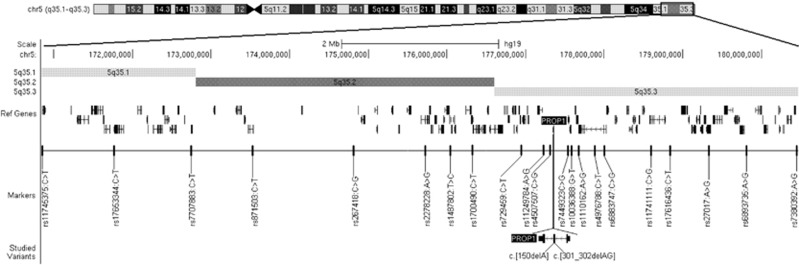
Two variants (c.[301_302delAG];[301_302delAG] and c.[150delA];[150delA]) in the PROP1 gene are the most common genetic causes of recessively inherited combined pituitary hormones deficiency (CPHD). Our objective was to analyze in detail the origin of the two most prevalent variants. In the multicentric study were included 237 patients with CPHD and their 15 relatives carrying c.[301_302delAG];[301_302delAG] or c.[150delA];[150delA] or c.[301_302delAG];[ 150delA]. They originated from 21 different countries worldwide. We genotyped 21 single-nucleotide variant markers flanking the 9.6-Mb region around the PROP1 gene that are not in mutual linkage disequilibrium in the general populations--a finding of a common haplotype would be indicative of ancestral origin of the variant. Haplotypes were reconstructed by Phase and Haploview software, and the variant age was estimated using an allelic association method. We demonstrated the ancestral origin of both variants--c.[301_302delAG] was carried on 0.2 Mb-long haplotype in a majority of European patients arising ~101 generations ago (confidence interval 90.1-116.4). Patients from the Iberian Peninsula displayed a different haplotype, which was estimated to have emerged 23.3 (20.1-29.1) generations ago. Subsequently, the data indicated that both the haplotypes were transmitted to Latin American patients ~13.8 (12.2-17.0) and 16.4 (14.4-20.1) generations ago, respectively. The c.[150delA] variant that was carried on a haplotype spanning about 0.3 Mb was estimated to appear 43.7 (38.4-52.7) generations ago. We present strong evidence that the most frequent variants in the PROP1 gene are not a consequence of variant hot spots as previously assumed, but are founder variants.
Conflict of interest statement
P.D., M.R.B., R.W.P., J.S.P. and J.L. have previously consulted for and received grant support from Eli Lilly and Company. W.F.B. was previously employed by and has equity interests in Eli Lilly and Company. Other authors declare no potential conflict of interest.
Figures
References
-
- 1Sornson MW, Wu W, Dasen JS et al: Pituitary lineage determination by the Prophet of Pit-1 homeodomain factor defective in Ames dwarfism. Nature 1996; 384: 327–333. - PubMed
-
- 2Wu W, Cogan JD, Pfaffle RW et al: Mutations in PROP1 cause familial combined pituitary hormone deficiency. Nat Genet 1998; 18: 147–149. - PubMed
-
- 4Krzisnik C, Kolacio Z, Battelino T, Brown M, Parks JS, Laron Z: The 'little people' of the island of Krk - revisited. Etiology of hypopituitarism revealed. J Endocr Genet 1999; 1: 9–19.
-
- 5Strachan T, Read A: Human Molecular Genetics. 4th edn. Garland Science: New York, NY, USA, 2010.
Publication types
MeSH terms
Substances
Supplementary concepts
LinkOut - more resources
Full Text Sources
Other Literature Sources
Medical
Miscellaneous
