


Sustained Domestic Vector Exposure Is Associated With Increased Chagas Cardiomyopathy Risk but Decreased Parasitemia and Congenital Transmission Risk Among Young Women in Bolivia
- PMID: 26063720
- PMCID: PMC4551010
- DOI: 10.1093/cid/civ446
Sustained Domestic Vector Exposure Is Associated With Increased Chagas Cardiomyopathy Risk but Decreased Parasitemia and Congenital Transmission Risk Among Young Women in Bolivia
Abstract
Background: We studied women and their infants to evaluate risk factors for congenital transmission and cardiomyopathy in Trypanosoma cruzi-infected women.
Methods: Women provided data and blood for serology and quantitative polymerase chain reaction (PCR). Infants of infected women had blood tested at 0 and 1 month by microscopy, PCR and immunoblot, and serology at 6 and 9 months. Women underwent electrocardiography (ECG).
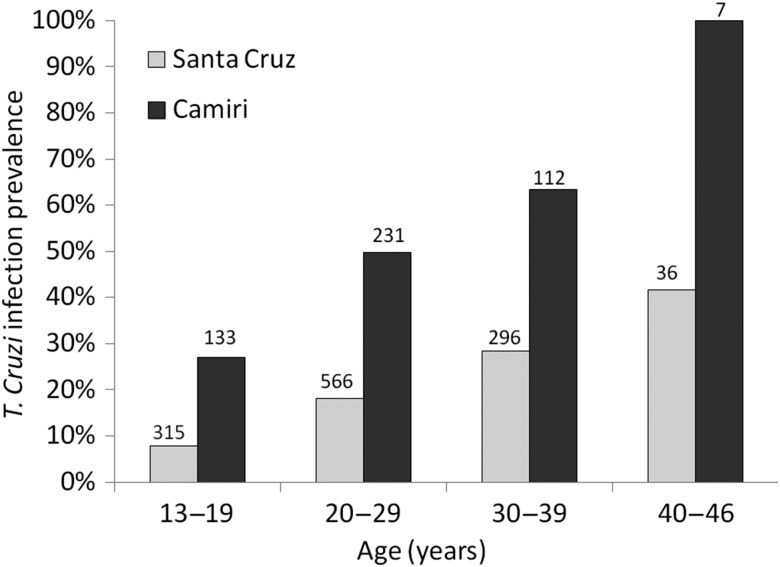
Results: Of 1696 women, 456 (26.9%) were infected; 31 (6.8%) transmitted T. cruzi to their infants. Women who transmitted had higher parasite loads than those who did not (median, 62.0 [interquartile range {IQR}, 25.8-204.8] vs 0.05 [IQR, 0-29.6]; P < .0001). Transmission was higher in twin than in singleton births (27.3% vs 6.4%; P = .04). Women who had not lived in infested houses transmitted more frequently (9.7% vs 4.6%; P = .04), were more likely to have positive results by PCR (65.5% vs 33.9%; P < .001), and had higher parasite loads than those who had lived in infested houses (median, 25.8 [IQR, 0-64.1] vs 0 [IQR, 0-12.3]; P < .001). Of 302 infected women, 28 (9.3%) had ECG abnormalities consistent with Chagas cardiomyopathy; risk was higher for older women (odds ratio [OR], 1.06 [95% confidence interval {CI}, 1.01-1.12] per year) and those with vector exposure (OR, 3.7 [95% CI, 1.4-10.2]). We observed a strong dose-response relationship between ECG abnormalities and reported years of living in an infested house.
Conclusions: We hypothesize that repeated vector-borne infection sustains antigen exposure and the consequent inflammatory response at a higher chronic level, increasing cardiac morbidity, but possibly enabling exposed women to control parasitemia in the face of pregnancy-induced Th2 polarization.
Keywords: Chagas disease; Trypanosoma cruzi; cardiomyopathy; infectious disease transmission; vertical.
© The Author 2015. Published by Oxford University Press on behalf of the Infectious Diseases Society of America. All rights reserved. For Permissions, please e-mail: journals.permissions@oup.com.
Figures
Comment in
-
Acute Chagas Disease and Risk of Congenital Infection.Clin Infect Dis. 2016 Feb 1;62(3):407-8. doi: 10.1093/cid/civ863. Epub 2015 Sep 28. Clin Infect Dis. 2016. PMID: 26420798 No abstract available.
-
Reply to Henao-Martínez, et al.Clin Infect Dis. 2016 Feb 1;62(3):408. doi: 10.1093/cid/civ864. Epub 2015 Sep 28. Clin Infect Dis. 2016. PMID: 26420799 No abstract available.
References
-
- World Health Organization. Global burden of disease estimates for 2000–2012. Available at: http://www.who.int/healthinfo/global_burden_disease/estimates/en/index2.... Accessed 18 June 2015.
-
- World Health Organization. Chagas disease in Latin America: an epidemiological update based on 2010 estimates. Wkly Epidemiol Rec 2015; 90:33–44. - PubMed
-
- Marin-Neto JA, Cunha-Neto E, Maciel BC, Simoes MV. Pathogenesis of chronic Chagas heart disease. Circulation 2007; 115:1109–23. - PubMed
-
- Maguire JH, Hoff R, Sherlock I et al. Cardiac morbidity and mortality due to Chagas’ disease: prospective electrocardiographic study of a Brazilian community. Circulation 1987; 75:1140–5. - PubMed
Publication types
MeSH terms
Substances
Grants and funding
LinkOut - more resources
Full Text Sources
Other Literature Sources
Medical
