Review
. 2015:2015:823620.
doi: 10.1155/2015/823620. Epub 2015 May 6.

MicroRNAs as Regulator of Signaling Networks in Metastatic Colon Cancer

Affiliations
Review

MicroRNAs as Regulator of Signaling Networks in Metastatic Colon Cancer

Jian Wang et al. Biomed Res Int. 2015.

Abstract

MicroRNAs (miRNAs) are a class of small, noncoding RNA molecules capable of regulating gene expression translationally and/or transcriptionally. A large number of evidence have demonstrated that miRNAs have a functional role in both physiological and pathological processes by regulating the expression of their target genes. Recently, the functionalities of miRNAs in the initiation, progression, angiogenesis, metastasis, and chemoresistance of tumors have gained increasing attentions. Particularly, the alteration of miRNA profiles has been correlated with the transformation and metastasis of various cancers, including colon cancer. This paper reports the latest findings on miRNAs involved in different signaling networks leading to colon cancer metastasis, mainly focusing on miRNA profiling and their roles in PTEN/PI3K, EGFR, TGFβ, and p53 signaling pathways of metastatic colon cancer. The potential of miRNAs used as biomarkers in the diagnosis, prognosis, and therapeutic targets in colon cancer is also discussed.


Figures
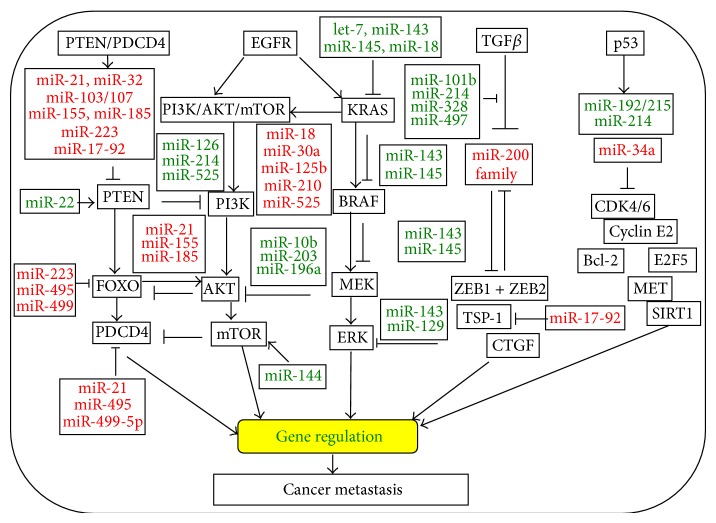
Figure 1
Figure 1
An illustration represents the overview of microRNAs (miRNAs) and their targets involving the key signaling pathways in metastatic colon cancer. The depicted miRNAs affect important factors of colon cancer development and malignancy, such as PTEN/PDCD4, EGFR/KRAS, EGFR/mTOR, TGFβ, p53, and EMT transcription factors. miRNAs are able to regulate gene expressions and target the signaling pathways for controlling the proliferation, metastasis, chemoresistance, and survival of colon cancer cells. miRNAs that are labeled in red fonts are oncomirs upregulated in colon cancer; whereas miRNAs that labeled in green fonts are tumor suppressor miRNAs downregulated in colon cancer.

References

    1. Ferlay J., Shin H.-R., Bray F., Forman D., Mathers C., Parkin D. M. Estimates of worldwide burden of cancer in 2008: GLOBOCAN 2008. International Journal of Cancer. 2010;127(12):2893–2917. doi: 10.1002/ijc.25516. - DOI - PubMed
    1. Fritzmann J., Morkel M., Besser D., et al. A colorectal cancer expression profile that includes transforming growth factor β inhibitor BAMBI predicts metastatic potential. Gastroenterology. 2009;137(1):165–175. doi: 10.1053/j.gastro.2009.03.041. - DOI - PubMed
    1. Han J., Lee Y., Yeom K.-H., Kim Y.-K., Jin H., Kim V. N. The Drosha-DGCR8 complex in primary microRNA processing. Genes and Development. 2004;18(24):3016–3027. doi: 10.1101/gad.1262504. - DOI - PMC - PubMed
    1. Manikandan J., Aarthi J. J., Kumar S. D., Pushparaj P. N. Oncomirs: the potential role of non-coding microRNAs in understanding cancer. Bioinformation. 2008;2(8):330–334. doi: 10.6026/97320630002330. - DOI - PMC - PubMed
    1. Schee K., Fodstad Ø., Flatmark K. MicroRNAs as biomarkers in colorectal cancer. The American Journal of Pathology. 2010;177(4):1592–1599. doi: 10.2353/ajpath.2010.100024. - DOI - PMC - PubMed

Publication types

MeSH terms

LinkOut - more resources
