


Comprehensive Echocardiographic Detection of Treatment-Related Cardiac Dysfunction in Adult Survivors of Childhood Cancer: Results From the St. Jude Lifetime Cohort Study
- PMID: 26065990
- PMCID: PMC4539123
- DOI: 10.1016/j.jacc.2015.04.013
Comprehensive Echocardiographic Detection of Treatment-Related Cardiac Dysfunction in Adult Survivors of Childhood Cancer: Results From the St. Jude Lifetime Cohort Study
Abstract
Background: Treatment-related cardiac death is the primary, noncancer cause of mortality in adult survivors of childhood malignancies. Early detection of cardiac dysfunction may identify a high-risk subset of survivors for early intervention.
Objectives: This study sought to determine the prevalence of cardiac dysfunction in adult survivors of childhood malignancies.
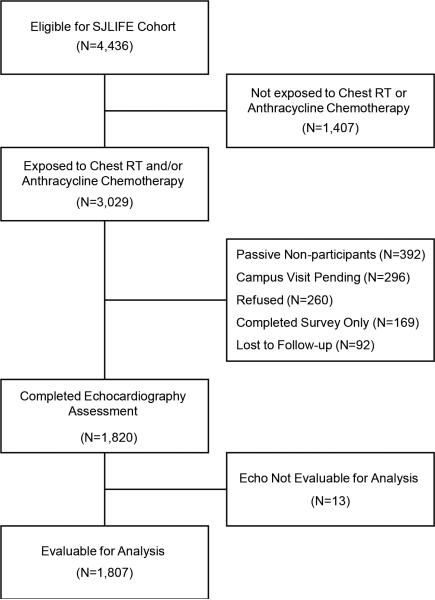
Methods: Echocardiographic assessment included 3-dimensional (3D) left ventricular ejection fraction (LVEF), global longitudinal and circumferential myocardial strain, and diastolic function, graded per American Society of Echocardiography guidelines in 1,820 adult (median age 31 years; range: 18 to 65 years) survivors of childhood cancer (median time from diagnosis 23 years; range: 10 to 48 years) exposed to anthracycline chemotherapy (n = 1,050), chest-directed radiotherapy (n = 306), or both (n = 464).
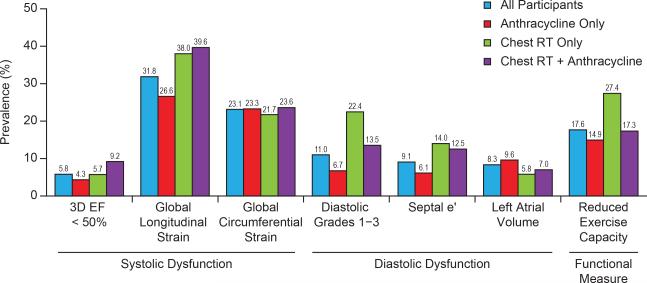
Results: Only 5.8% of survivors had abnormal 3D LVEFs (<50%). However, 32.1% of survivors with normal 3D LVEFs had evidence of cardiac dysfunction by global longitudinal strain (28%), American Society of Echocardiography-graded diastolic assessment (8.7%), or both. Abnormal global longitudinal strain was associated with chest-directed radiotherapy at 1 to 19.9 Gy (rate ratio [RR]: 1.38; 95% confidence interval [CI]: 1.14 to 1.66), 20 to 29.9 Gy (RR: 1.65; 95% CI: 1.31 to 2.08), and >30 Gy (RR: 2.39; 95% CI: 1.79 to 3.18) and anthracycline dose > 300 mg/m(2) (RR: 1.72; 95% CI: 1.31 to 2.26). Survivors with metabolic syndrome were twice as likely to have abnormal global longitudinal strain (RR: 1.94; 95% CI: 1.66 to 2.28) and abnormal diastolic function (RR: 1.68; 95% CI: 1.39 to 2.03) but not abnormal 3D LVEFs (RR: 1.07; 95% CI: 0.74 to 1.53).
Conclusions: Abnormal global longitudinal strain and diastolic function are more prevalent than reduced 3D LVEF and are associated with treatment exposure. They may identify a subset of survivors at higher risk for poor clinical cardiac outcomes who may benefit from early medical intervention.
Keywords: cardiomyopathy; cardiotoxicity; heart failure; late effects; screening; strain.
Copyright © 2015 American College of Cardiology Foundation. Published by Elsevier Inc. All rights reserved.
Figures
Comment in
-
Subclinical Cardiotoxicity Associated With Cancer Therapy: Early Detection and Future Directions.J Am Coll Cardiol. 2015 Jun 16;65(23):2523-5. doi: 10.1016/j.jacc.2015.04.012. J Am Coll Cardiol. 2015. PMID: 26065991 No abstract available.
References
-
- Howlader NNA, Krapcho M, Neyman N, Aminou R, Altekruse SF, Kosary CL, Ruhl J, Tatalovich Z, Cho H, Mariotto A, Eisner MP, Lewis DR, Chen HS, Feuer EJ, Cronin KA, editors. SEER Cancer Statistics Review (CSR) National Cancer Institute; Bethesda, MD: 2012. SEER Cancer Statistics Review 1975-2009 (Vintage 2009 Populations).
-
- Oeffinger KC, Mertens AC, Sklar CA, et al. Chronic health conditions in adult survivors of childhood cancer. N Engl J Med. 2006;355:1572–82. - PubMed
Publication types
MeSH terms
Substances
Grants and funding
LinkOut - more resources
Full Text Sources
Other Literature Sources
