


Air ambulance and hospital services for critically ill and injured in Greenland, Iceland and the Faroe Islands: how can we improve?
- PMID: 26066019
- PMCID: PMC4463496
- DOI: 10.3402/ijch.v74.25697
Air ambulance and hospital services for critically ill and injured in Greenland, Iceland and the Faroe Islands: how can we improve?
Abstract
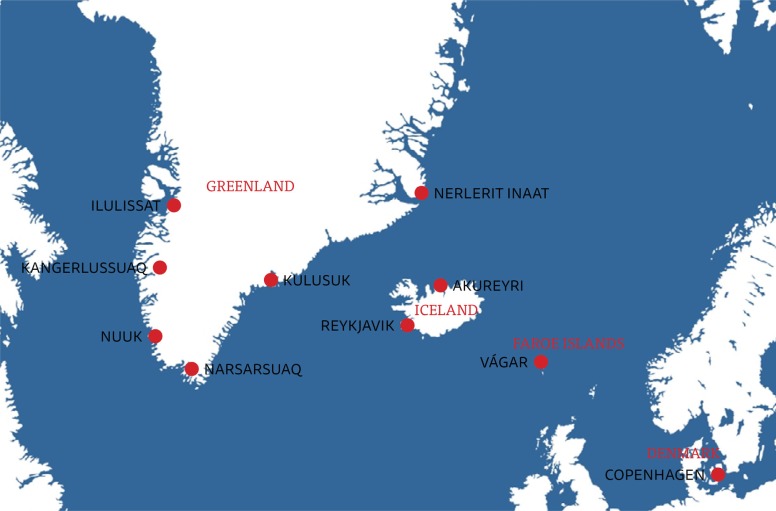
The Nordic Atlantic Cooperation (NORA) is an intergovernmental organization under the auspices of the Nordic Council of Ministers. The NORA region comprises Greenland, Iceland, Faroe Islands and western coastal areas of Norway. Historical, cultural and institutional links bind these nations together in multiple ways, and regional co-operation has in recent years become a focus of interest. This commentary addresses air medical services (AMSs) and available advanced hospital services in the 3 smallest NORA countries challenged sparse populations, hereafter referred to as the region. It seems likely that strengthened regional co-operation can help these countries to address common challenges within health care by exchanging know-how and best practices, pooling resources and improving the efficiency of care delivery. The 4 largest hospitals in the region, Dronning Ingrids Hospital in Nuuk (Greenland), Landspítali in Reykjavík and Sjúkrahúsið á Akureyri, (both in Iceland) and Landssjúkrahúsið Tórshavn on the Faroe Islands, have therefore undertaken the project Network for patient transport in the North-West Atlantic (in Danish: Netværk for patienttransport i Vest-Norden). The goal of the project, and of this article, is to exchange information and provide an overview of current AMSs and access to acute hospital care for severely ill or injured patients in the 3 participating countries. Of equal importance is the intention to highlight the need for increased regional co-operation to optimize use of limited resources in the provision of health care services.
Keywords: Faroe Islands; Greenland; Iceland; Nordic Atlantic Cooperation; air medical services; emergency medical services; health care delivery.
Figures
References
-
- Lockey D. International EMS systems: geographical lottery and diversity but many common challenges. Resuscitation. 2009;80:722. - PubMed
-
- Air Medicine: accessing the Future of Health Care. 2006. [cited 2013 Apr 7]. Available from: http://www.vdh.virginia.gov/OEMS/Files_page/Medevac/FAREWhitePaper.pdf.
-
- Kruger AJ, Lossius HM, Mikkelsen S, Kurola J, Castren M, Skogvoll E. Pre-hospital critical care by anaesthesiologist-staffed pre-hospital services in Scandinavia: a prospective population-based study. Acta Anaesthesiol Scand. 2013;57:1175–85. - PubMed
-
- Lossius HM, Soreide E, Hotvedt R, Hapnes SA, Eielsen OV, Forde OH, et al. Prehospital advanced life support provided by specially trained physicians: is there a benefit in terms of life years gained? Acta Anaesthesiol Scand. 2002;46:771–8. - PubMed
-
- Antman EM, Hand M, Armstrong PW, Bates ER, Green LA, Halasyamani LK, et al. 2007 focused update of the ACC/AHA 2004 Guidelines for the Management of Patients with ST-Elevation Myocardial Infarction: a report of the American College of Cardiology/American Heart Association Task Force on Practice Guidelines: developed in collaboration with the Canadian Cardiovascular Society endorsed by the American Academy of Family Physicians: 2007 Writing Group to Review New Evidence and Update the ACC/AHA 2004 Guidelines for the Management of Patients With ST-Elevation Myocardial Infarction, Writing on Behalf of the 2004 Writing Committee. Circulation. 2008;117:296–329. - PubMed
Publication types
MeSH terms
LinkOut - more resources
Full Text Sources
Other Literature Sources
Medical
