Predictive Modeling and Concentration of the Risk of Suicide: Implications for Preventive Interventions in the US Department of Veterans Affairs
- PMID: 26066914
- PMCID: PMC4539821
- DOI: 10.2105/AJPH.2015.302737
Predictive Modeling and Concentration of the Risk of Suicide: Implications for Preventive Interventions in the US Department of Veterans Affairs
Abstract
Objectives: The Veterans Health Administration (VHA) evaluated the use of predictive modeling to identify patients at risk for suicide and to supplement ongoing care with risk-stratified interventions.
Methods: Suicide data came from the National Death Index. Predictors were measures from VHA clinical records incorporating patient-months from October 1, 2008, to September 30, 2011, for all suicide decedents and 1% of living patients, divided randomly into development and validation samples. We used data on all patients alive on September 30, 2010, to evaluate predictions of suicide risk over 1 year.
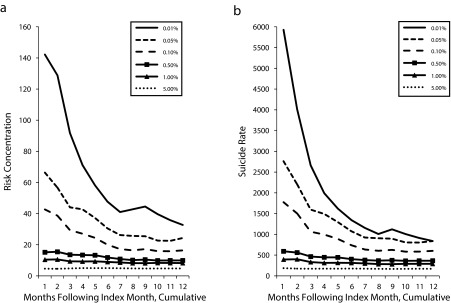
Results: Modeling demonstrated that suicide rates were 82 and 60 times greater than the rate in the overall sample in the highest 0.01% stratum for calculated risk for the development and validation samples, respectively; 39 and 30 times greater in the highest 0.10%; 14 and 12 times greater in the highest 1.00%; and 6.3 and 5.7 times greater in the highest 5.00%.
Conclusions: Predictive modeling can identify high-risk patients who were not identified on clinical grounds. VHA is developing modeling to enhance clinical care and to guide the delivery of preventive interventions.
Figures
References
-
- Office of the Surgeon General and National Action Alliance for Suicide Prevention. 2012 National Strategy for Suicide Prevention: Goals and Objectives for Action. Washington, DC: US Dept of Health and Human Services; 2012. - PubMed
-
- Kemp J. Suicide rates in VHA patients with comparisons with other Americans and other veterans through 2010. Available at: http://www.mentalhealth.va.gov/docs/suicide_data_report_update_january_2.... Accessed November 3, 2014.
-
- Xu JQ, Kochanek KD, Murphy SL, Arias E. Mortality in the United States, 2012. Hyattsville, MD: National Center for Health Statistics; 2014. NCHS data brief 168.
MeSH terms
LinkOut - more resources
Full Text Sources
Medical