Review
. 2015 Oct:36:1-6.
doi: 10.1016/j.ceb.2015.05.003. Epub 2015 Jun 8.

Chemokine-guided cell positioning in the lymph node orchestrates the generation of adaptive immune responses

Affiliations
Review

Chemokine-guided cell positioning in the lymph node orchestrates the generation of adaptive immune responses

Jeffrey Lian et al. Curr Opin Cell Biol. 2015 Oct.

Abstract

The generation of adaptive immune responses occurs in the lymph node (LN) and requires that lymphocytes locate and interact with cognate antigen-bearing dendritic cells. This process requires the coordinated movement of both innate and adaptive immune cells, and is orchestrated by the chemokine family of chemotactic cytokines. Upon initiation of inflammation, the LN undergoes dramatic changes that include the marked induction of specific chemokines in distinct regions of the reactive LN. These chemokine rich domains establish LN niches that facilitate the differentiation of CD4+ T cells into effector cell subsets and the rapid activation of memory CD8+ T cells. This review will focus on recent advances highlighting the importance of LN chemokines for shaping adaptive immune responses by controlling immune cell migration, positioning, and interactions in the reactive LN.


Figures

Figure 1
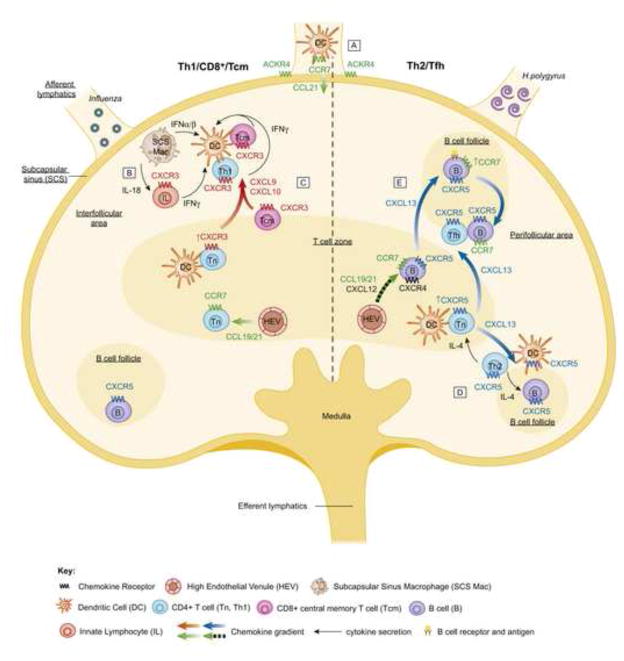
Figure 1. Chemokine-mediated cellular positioning in the reactive lymph node creates specialized niches to facilitate T cell differentiation and activation
A) Antigen from the site of infection arrives via the afferent lymphatics in soluble form or carried by dendritic cells (DC). Atypical chemokine receptor 4 (ACKR4) expressed on ceiling lymphatic endothelial cells scavenges CCL21 and creates a localized gradient for DC entry into the draining lymph node (LN) via the floor of the subcapsular sinus (SCS). B) Specialized macrophages are positioned within the subcapsular sinus (SCS Mac) and take up antigen, secreting inflammatory cytokines, such as IL-18 and type I interferons upon activation. Innate lymphocytes expressing CXCR3 are positioned near the SCS, responding to IL-18 and producing IFNγ upon activation. Type 1 and II IFNs induce the production of CXCL9 and CXCL10 by local stromal cells and DCs, attracting and priming CXCR3-expressing CD4+ T helper-type 1 (Th1) cells. CD8+ central memory T cells (Tcm) are prepositioned in the outermost region of the T cell zone or are preferentially recruited to these regions by their constitutive expression of CXCR3. C) Naïve T cells (Tn) enter the LN via high endothelial cells (HEV) in the deep T cell zone. In response to a Th1-type inducing stimulus, such as influenza virus, Tn are initially primed by antigen-bearing DCs, become activated, and upregulate CXCR3 expression. CXCL9 and CXCL10 gradients direct priming CD4 + T cells and Tcm out of the T cell zone and towards peripheral regions of the LN. T cells localize to the interfollicular and medullary regions and interact with infected and activated antigen presenting cells (APCs), resulting in optimal Th1 differentiation and IFNγ production. D) Newly activated naïve T cells respond to a Th2-type inducing stimulus, such as a parasite, by upregulating CXCR5 and migrating out of the T cell zone via a CXCL13 gradient into the perifollicular areas near B cell follicles. There they interact with DCs, which have also upregulated CXCR5 in response to a Th2-indcuing stimulus to generate a Th2 response. E) Naïve B cells also enter the LN via HEV in chemokine-mediated process that is dependent on CXCR4 and CCR7 in a partially redundant manner. B cells are then recruited into the B cell follicle in response to CXCL13. Following B cell activation, B cells upregulate CCR7, which guide their movement the to the border of the follicle where they are in position to interact with T follicular helper cells (Tfh). Tfh cells express high levels of CXCR5 and are specialized to provide B cell help for class switching. Figure was modified from [43].

References

    1. Förster R, Braun A, Worbs T. Lymph node homing of T cells and dendritic cells via afferent lymphatics. Trends Immunol. 2012;33:271–80. - PubMed
    1. Munoz MA, Biro M, Weninger W. T cell migration in intact lymph nodes in vivo. Curr Opin Cell Biol. 2014;30:17–24. - PubMed
    1. Schumann K, Lämmermann T, Bruckner M, Legler DF, Polleux J, Spatz JP, Schuler G, Förster R, Lutz MB, Sorokin L, et al. Immobilized chemokine fields and soluble chemokine gradients cooperatively shape migration patterns of dendritic cells. Immunity. 2010;32:703–13. - PubMed
    1. Britschgi MR, Favre S, Luther SA. CCL21 is sufficient to mediate DC migration, maturation and function in the absence of CCL19. Eur J Immunol. 2010;40:1266–71. - PubMed
    1. Weber M, Hauschild R, Schwarz J, Moussion C, Vries I, de Legler DF, Luther SA, Bollenbach T, Sixt M. Interstitial dendritic cell guidance by haptotactic chemokine gradients. Science. 2013;339:328–32. - PubMed

Publication types