. 2015 Jun 12:6:7368.
doi: 10.1038/ncomms8368.

Morphological plasticity of the coral skeleton under CO2-driven seawater acidification

Affiliations

Morphological plasticity of the coral skeleton under CO2-driven seawater acidification

E Tambutté et al. Nat Commun. .

Abstract

Ocean acidification causes corals to calcify at reduced rates, but current understanding of the underlying processes is limited. Here, we conduct a mechanistic study into how seawater acidification alters skeletal growth of the coral Stylophora pistillata. Reductions in colony calcification rates are manifested as increases in skeletal porosity at lower pH, while linear extension of skeletons remains unchanged. Inspection of the microstructure of skeletons and measurements of pH at the site of calcification indicate that dissolution is not responsible for changes in skeletal porosity. Instead, changes occur by enlargement of corallite-calyxes and thinning of associated skeletal elements, constituting a modification in skeleton architecture. We also detect increases in the organic matrix protein content of skeletons formed under lower pH. Overall, our study reveals that seawater acidification not only causes decreases in calcification, but can also cause morphological change of the coral skeleton to a more porous and potentially fragile phenotype.


Figures
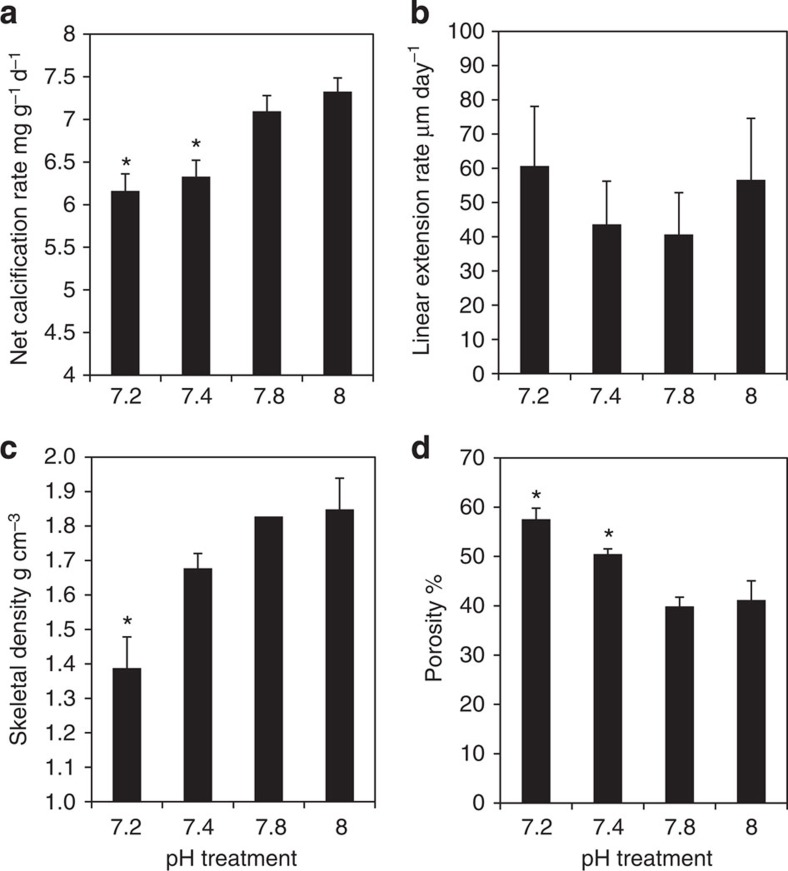
Figure 1
Figure 1. Skeletal growth parameters in the four pH treatments.
(a) Net calcification rate (one way ANOVA, n=12, F3,44=4.11, P<0.05). (b) Linear extension (one way ANOVA, n=15, F3,56=0.62, P>0.05). (c) Bulk skeletal density (one way ANOVA, n=7, F3,24=16.44, P<0.001). (d) Skeletal porosity (one way ANOVA, n=3, F 3,8=11.05, P<0.05). Data are means±s.e.m. Asterisk (*) indicates values that are significantly different for treatment with pH 8 (P<0.05).
Figure 2
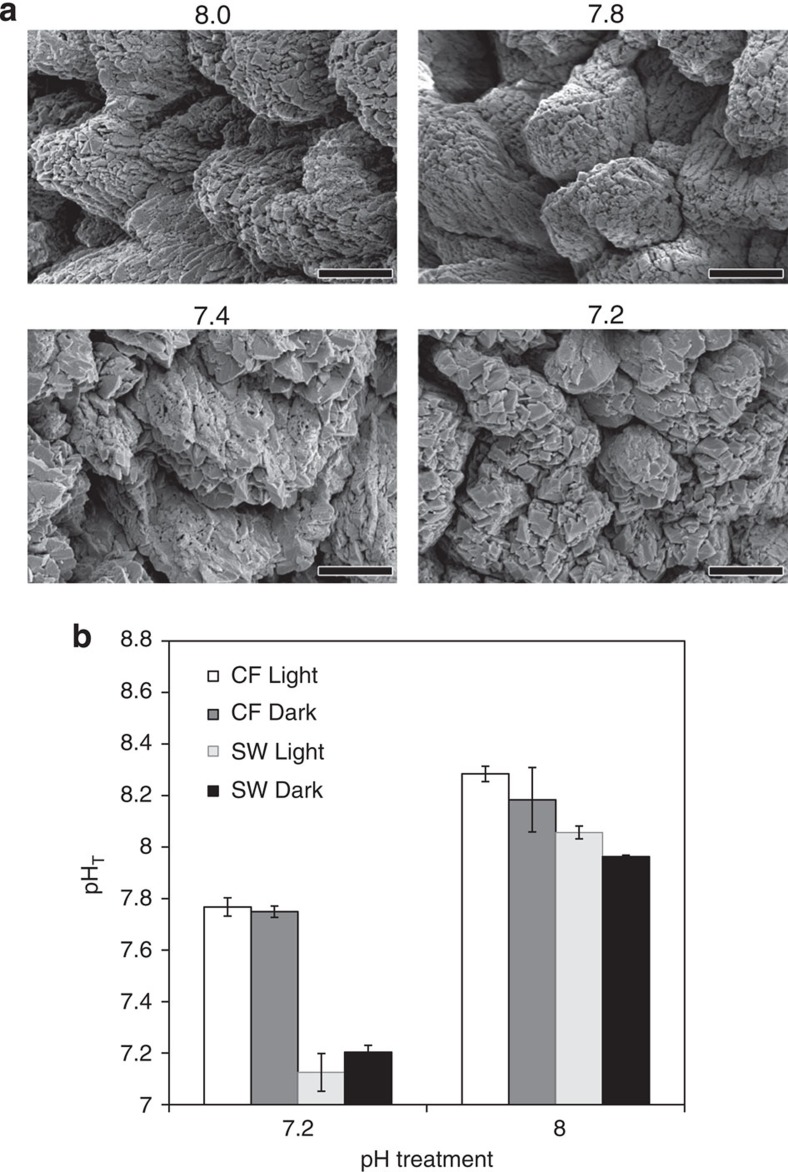
Figure 2. Indicators of physio-chemical conditions at the site of calcification in corals in the four pH treatments.
(a) Aragonite crystal morphology imaged by scanning electron microscopy. Scale bar, 5 μm. pH treatment indicated above each image. (b) Calcifying fluid pH in corals under light and dark conditions at seawater pH 7.2 and pH 8.0. Data are means±s.e.m. CF=calcifying fluid; SW=seawater surrounding the colonies.
Figure 3
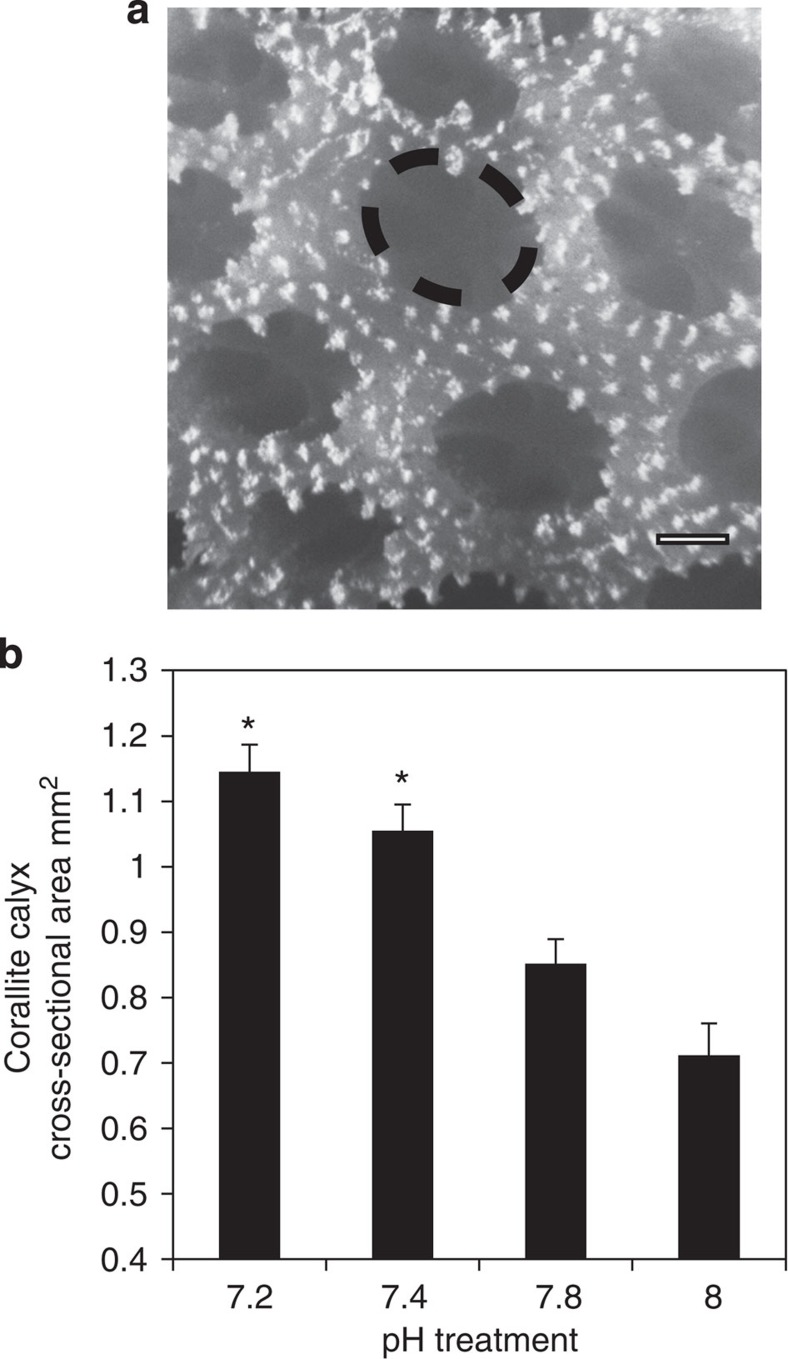
Figure 3. Corallite calyx size in the four pH treatments.
(a) Image of corallite calyxes in the skeleton of S. pistillata. Dotted line shows the extent of cross-sectional area of a representative corallite calyx. Scale bar, 0.5 mm. (b) Corallite calyx size (cross-sectional area) (one way ANOVA, n=9, F3,32=21.60, P<0.001). Data are means±s.e.m. Asterisk (*) indicates values that are significantly different for treatment with pH 8 (P<0.05).
Figure 4
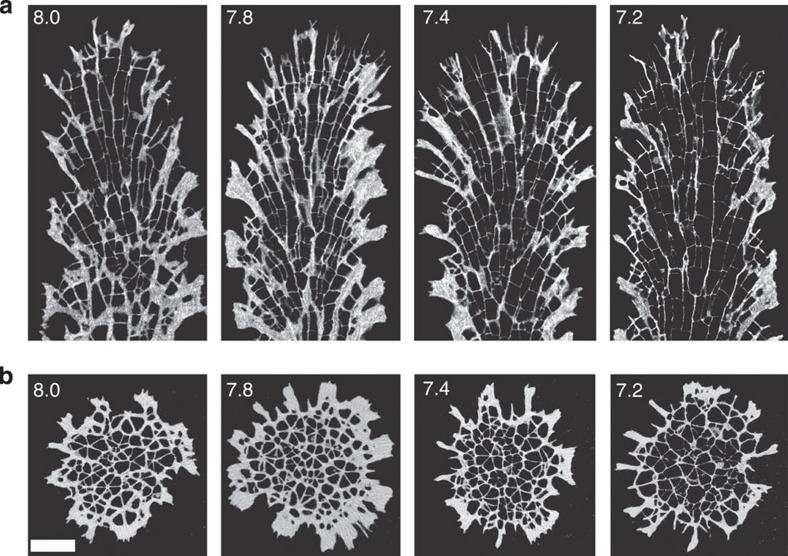
Figure 4. Coral skeleton morphology in the four pH treatments imaged by micro-CT.
(a) Representative longitudinal sections; (b) transverse sections. pH treatment is indicated in the top left corner of each image. Scale bar, 1 mm.
Figure 5
Figure 5. Organic matrix protein content of the coral skeletons in the four pH treatments.
(one way ANOVA, n=6, F3,20=3.384, P<0.05). Data are means±s.e.m. Asterisk (*) indicates values that are significantly different for treatment with pH 8 (P<0.05).
Figure 6
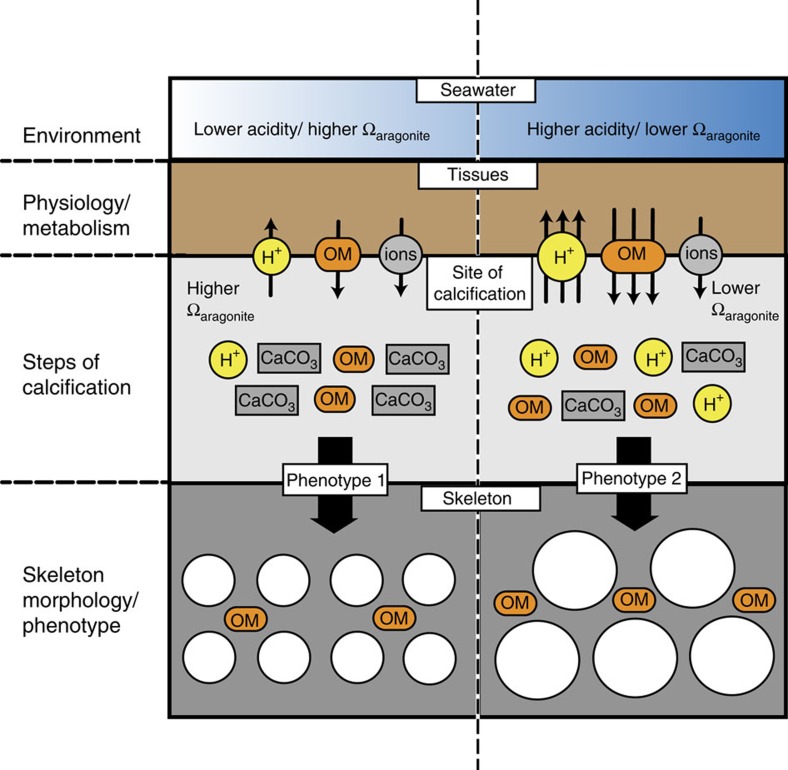
Figure 6. Schematic summary of the impact of ocean acidification on skeletal growth in Stylophora pistillata.
Environmental change in the form of seawater acidification depresses pH and Ωaragonite at the site of calcification. Coral physiology responds by increasing proton removal from the calcifying fluid to maintain elevated pH and Ωaragonite that favours calcification. S. pistillata also increases production of organic matrix proteins (OM=organic matrix) per unit mass of CaCO3. In these conditions, corals continue to calcify, and dissolution of the skeleton does not occur, even when seawater Ωaragonite <1. However, with lower saturation states in the calcifying fluid and increased energy expenditure for calcification, S. pistillata changes its skeleton phenotype to a morphology characterized by larger corallite calyxes. The resulting skeleton is more porous. ‘OM'=organic matrix. ‘Ions' represent both transcellular and paracellular transport of ions needed for the steps of calcification. White circles in skeleton represent corallites. ‘Steps of calcification' encompass steps of skeleton precipitation and assembly outlined in Tambutté et al..

References

    1. Knowlton N. et al.. in Life in the World's Oceans ed. Mcintyre A. Ch. 4, Wiley-Blackwell (2010).
    1. Caldeira K. & Wickett M. E. Oceanography: anthropogenic carbon and ocean pH. Nature 425, 365 (2003). - PubMed
    1. Orr J. C. et al.. Anthropogenic ocean acidification over the twenty-first century and its impact on calcifying organisms. Nature 437, 681–686 (2005). - PubMed
    1. Chan N. C. & Connolly S. R. Sensitivity of coral calcification to ocean acidification: a meta-analysis. Glob. Chang. Biol. 19, 282–290 (2013). - PubMed
    1. Mumby P. J. & van Woesik R. Consequences of ecological, evolutionary and biogeochemical uncertainty for coral reef responses to climatic stress. Curr. Biol. 24, R413–R423 (2014). - PubMed

Publication types

Substances

LinkOut - more resources