. 2015 Jun 12:13:38.
doi: 10.1186/s12915-015-0145-1.

DNA transposons have colonized the genome of the giant virus Pandoravirus salinus

Affiliations

DNA transposons have colonized the genome of the giant virus Pandoravirus salinus

Cheng Sun et al. BMC Biol. .

Abstract

Background: Transposable elements are mobile DNA sequences that are widely distributed in prokaryotic and eukaryotic genomes, where they represent a major force in genome evolution. However, transposable elements have rarely been documented in viruses, and their contribution to viral genome evolution remains largely unexplored. Pandoraviruses are recently described DNA viruses with genome sizes that exceed those of some prokaryotes, rivaling parasitic eukaryotes. These large genomes appear to include substantial noncoding intergenic spaces, which provide potential locations for transposable element insertions. However, no mobile genetic elements have yet been reported in pandoravirus genomes.

Results: Here, we report a family of miniature inverted-repeat transposable elements (MITEs) in the Pandoravirus salinus genome, representing the first description of a virus populated with a canonical transposable element family that proliferated by transposition within the viral genome. The MITE family, which we name Submariner, includes 30 copies with all the hallmarks of MITEs: short length, terminal inverted repeats, TA target site duplication, and no coding capacity. Submariner elements show signs of transposition and are undetectable in the genome of Pandoravirus dulcis, the closest known relative Pandoravirus salinus. We identified a DNA transposon related to Submariner in the genome of Acanthamoeba castellanii, a species thought to host pandoraviruses, which contains remnants of coding sequence for a Tc1/mariner transposase. These observations suggest that the Submariner MITEs of P. salinus belong to the widespread Tc1/mariner superfamily and may have been mobilized by an amoebozoan host. Ten of the 30 MITEs in the P. salinus genome are located within coding regions of predicted genes, while others are close to genes, suggesting that these transposons may have contributed to viral genetic novelty.

Conclusions: Our discovery highlights the remarkable ability of DNA transposons to colonize and shape genomes from all domains of life, as well as giant viruses. Our findings continue to blur the division between viral and cellular genomes, adhering to the emerging view that the content, dynamics, and evolution of the genomes of giant viruses do not substantially differ from those of cellular organisms.


Figures
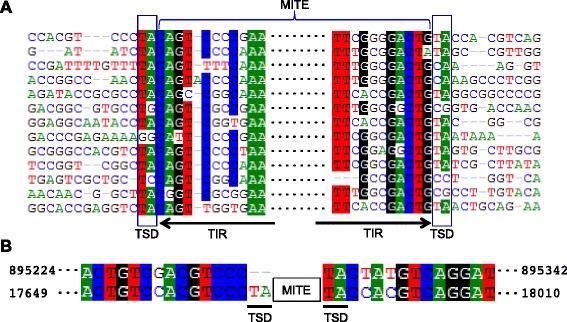
Fig. 1
Fig. 1
a ClustalW-generated multiple alignment of the 13 full-length MITEs and their flanking sequence showing partial terminal inverted repeat (TIR) sequences and target site duplication (TSD) sequences. The multiple alignment results indicate well-defined element boundaries because sequence similarity decreases dramatically outside of the MITE. b Pairwise alignment of the flanking sequences of a MITE insertion in P. salinus (bottom sequence) and a paralogous empty site elsewhere in the P. salinus genome (top sequence). TSD sequences (TA) are underlined. The paralogous empty site is evidence of transposition. Numbers of either side of the sequences indicate their coordinates in the P. salinus genome
Fig. 2
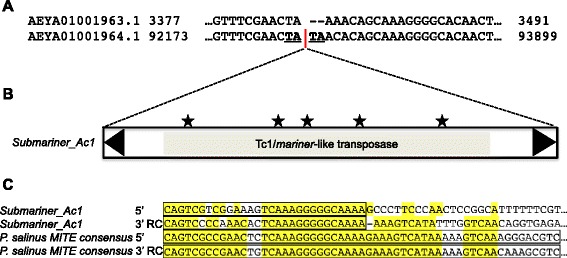
Fig. 2
Autonomous DNA transposon in the amoeba Acanthamoeba castellanii that is closely related to the MITEs in P. salinus. a Pairwise alignment of the flanking sequences of the DNA transposon insertion and a paralogous empty site elsewhere in the A. castellanii genome. Red bar indicates the transposon insertion site. Bold and underlined letters (TA) indicate TSD. The paralogous empty site is evidence of transposition. b The structure of the autonomous DNA transposon in A. castellanii. Triangles indicate TIRs. Stars indicate stop codons in the putative transposase sequence. c Alignment of the ends of the consensus sequence of the MITEs in P. salinus and the ends of the autonomous DNA transposon sequence in A. castellanii, referred to as Submariner_Ac1. TIRs for each element are boxed. Columns in the alignment are shaded when nucleotides are conserved in at least three sequences. RC stands for reverse-complement. The sequence similarity between the TIRs of the P. salinus MITE and the A. castellanii DNA transposon Submariner_Ac1 indicates that the P. salinus MITE could have been cross-mobilized in the viral genome by the A. castellanii DNA transposon
Fig. 3
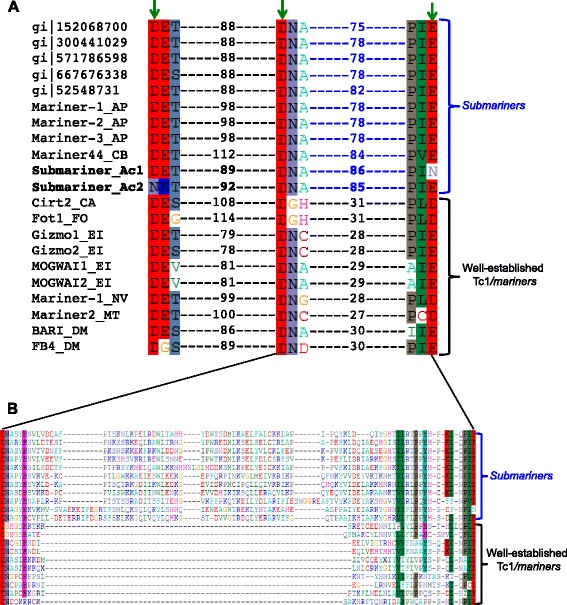
Fig. 3
The DDE signature in Submariner transposases. a Sequences are identified by their GenBank accession numbers or Repbase IDs, if applicable. These accession numbers and Repbase IDs correspond to the nucleotide sequences from which the transposase amino acid sequences were deduced. Green arrows indicate the DDE amino acid triad that coordinates metal ion (Mg2+) binding during catalysis of typical cut-and-paste transposition. The DDE residues are shown within their respective conserved motifs (DET, DNA, and PIE). Numbers flanked by dashes indicate the number of amino acid positions that separate the conserved motifs based on a multiple sequence alignment. The 11 Submariner sequences have a much longer stretch of residues between the second D and the E residues than do representatives from the well-established Tc1/mariner clades. gi|152068700, gi|300441029, gi|571786598, and gi|667676338 are bacterial sequences, and gi|52548731 is an archaeal sequence; taxon information is in the text. Mariner-1-3_AP are from Acyrthosiphon pisum (pea aphid) and Mariner44_CB is from Caenorhabditis briggsae (nematode). b Multiple sequence alignment of the amino acids between the second D and the E residues showing the length difference between the Submariners and the other Tc1/mariners. Sequences are in the same order as in (a)

References

    1. Craig NL, Craigie R, Gellert M, Mobile LAM, DNA II. Washington. DC: American Society for Microbiology Press; 2002.
    1. Wicker T, Sabot F, Hua-Van A, Bennetzen JL, Capy P, Chalhoub B, et al. A unified classification system for eukaryotic transposable elements. Nat Rev Gen. 2007;8:973–82. doi: 10.1038/nrg2165. - DOI - PubMed
    1. Bureau TE, Wessler SR. Tourist: a large family of small inverted repeat elements frequently associated with maize genes. Plant Cell. 1992;4:1283–94. doi: 10.1105/tpc.4.10.1283. - DOI - PMC - PubMed
    1. Fattash I, Rooke R, Wong A, Hui C, Luu T, Bhardwaj P, et al. Miniature inverted-repeat transposable elements: discovery, distribution, and activity. Genome. 2013;56:475–86. doi: 10.1139/gen-2012-0174. - DOI - PubMed
    1. Feschotte C, Zhang X, Wessler SR. Miniature inverted-repeat transposable elements (MITEs) and their relationship with established DNA transposons. In: Craig N, Craigie R, Gellert M, Lambowitz A, editors. Mobile DNA II. Washington, DC: American Society of Microbiology Press; 2002. pp. 1147–58.

Publication types

Substances

LinkOut - more resources