. 2015 Jun 12:15:139.
doi: 10.1186/s12870-015-0537-y.

The effect of red light and far-red light conditions on secondary metabolism in agarwood

Affiliations

The effect of red light and far-red light conditions on secondary metabolism in agarwood

Tony Chien-Yen Kuo et al. BMC Plant Biol. .

Abstract

Background: Agarwood, a heartwood derived from Aquilaria trees, is a valuable commodity that has seen prevalent use among many cultures. In particular, it is widely used in herbal medicine and many compounds in agarwood are known to exhibit medicinal properties. Although there exists much research into medicinal herbs and extraction of high value compounds, few have focused on increasing the quantity of target compounds through stimulation of its related pathways in this species.

Results: In this study, we observed that cucurbitacin yield can be increased through the use of different light conditions to stimulate related pathways and conducted three types of high-throughput sequencing experiments in order to study the effect of light conditions on secondary metabolism in agarwood. We constructed genome-wide profiles of RNA expression, small RNA, and DNA methylation under red light and far-red light conditions. With these profiles, we identified a set of small RNA which potentially regulates gene expression via the RNA-directed DNA methylation pathway.

Conclusions: We demonstrate that light conditions can be used to stimulate pathways related to secondary metabolism, increasing the yield of cucurbitacins. The genome-wide expression and methylation profiles from our study provide insight into the effect of light on gene expression for secondary metabolism in agarwood and provide compelling new candidates towards the study of functional secondary metabolic components.


Figures
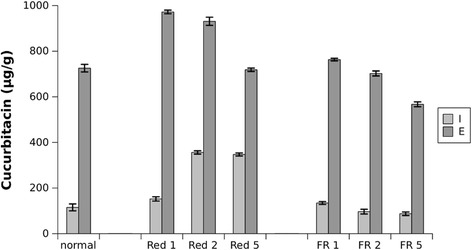
Fig. 1
Fig. 1
Endogenous cucurbitacin content of in vitro agarwood. Content was measured after red and far-red light treatment over the course of 5 days. Data is represented as mean ± standard deviation (n = 5). At peak levels under red light conditions, cucurbitacin content was significantly increased compared to normal light conditions (paired t-test p-values 1.09E-5 and 4.57E-6 for cucurbitacin I and E respectively). At the lowest levels under far-red light conditions, cucurbitacin content was significantly decreased compared to normal light conditions (paired t-test p-values 3.44E-2 and 1.32E-4 for cucurbitacin I and E respectively)
Fig. 2
Fig. 2
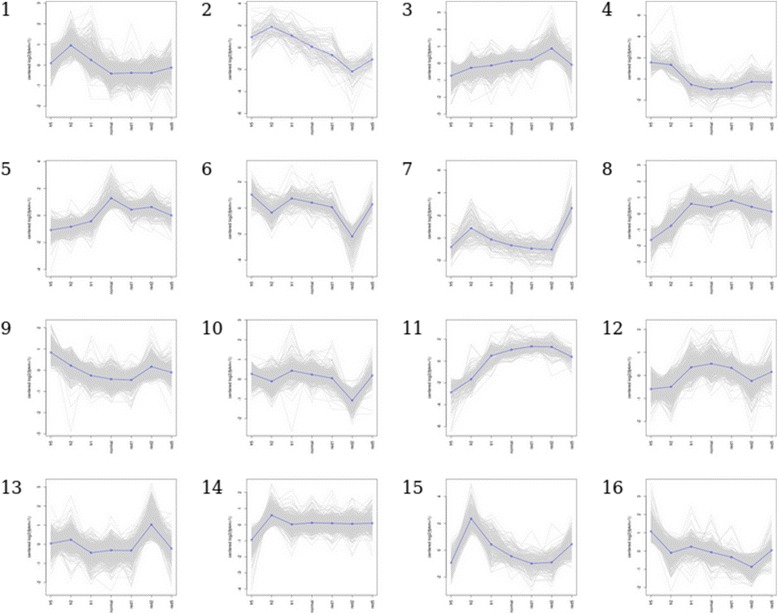
Cluster analysis of gene expression patterns in agarwood. Sixteen clusters were identified by k-means clustering. The samples are represented on the x-axis, from left to right: FR day 5, FR day 2, FR day 1, normal, R day 1, R day 2, R day 5. The centered log2 fold-change is represented on the y-axis
Fig. 3
Fig. 3
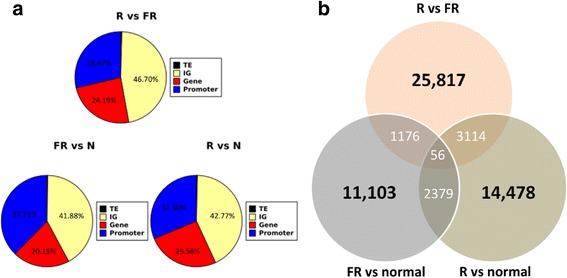
Characterization of differentially methylated regions for light conditions red light, far-red light, and normal. a Composition of DMRs in the A. agallocha genome. TE represents transposable elements, IG represents intergenic regions, Gene represents the gene body, and Promoter represents gene promoter regions. b Number of DMRs that are overlapping or unique to red light and far-red light conditions
Fig. 4
Fig. 4
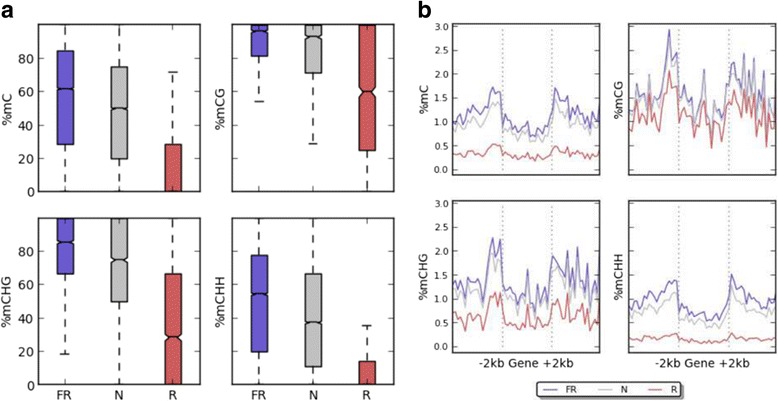
Methylation levels for hypo-DMRs under red light conditions. a Box plots displaying the distribution of average CG, CHG, and CHH methylation levels for hypo-DMRs under red light conditions. b Average methylation levels in gene bodies and flanking 2 kb regions. Each gene was aligned from start to end and divided into 20 equal bins. Upstream and downstream flanking regions were also each divided into 20 equal bins. Weighted methylation levels were calculated for each of the 60 bins across all corresponding regions
Fig. 5
Fig. 5
Light conditions regulate gene expression by the RdDM pathway. The RNA expression, DNA methylation, and sRNA expression is shown for three candidate genes: g16251 (sterol methytransferase), g23648 (hydroxysteroid dehydrogenase), and g29032 (cytochrome P450). Signals in red represent red light conditions while signals in blue represent far-red light conditions

References

    1. Chen KJ, Yu B. Certain progress of clinical research on Chinese integrative medicine. Chinese Med J-Peking. 1999;112:934–7. - PubMed
    1. Shang AJ, Huwiler K, Nartey L, Juni P, Egger M. Placebo-controlled trials of Chinese herbal medicine and conventional medicinecomparative study. Int J Epidemiol. 2007;36:1086–92. doi: 10.1093/ije/dym119. - DOI - PubMed
    1. Kumeta Y, Ito M. Characterization of delta-guaiene synthases from cultured cells of Aquilaria, responsible for the formation of the sesquiterpenes in agarwood. Plant Physiol. 2010;154:1998–2007. doi: 10.1104/pp.110.161828. - DOI - PMC - PubMed
    1. Chen H, Yang Y, Xue J, Wei J, Zhang Z. Comparison of compositions and antimicrobial activities of essential oils from chemically stimulated agarwood, wild agarwood and healthy Aquilaria sinensis (Lour.) gilg trees. Molecules. 2011;16:4884–96. doi: 10.3390/molecules16064884. - DOI - PMC - PubMed
    1. Momma K, Masuzawa Y, Nakai N, Chujo M, Murakami A, Kioka N, et al. Direct interaction of Cucurbitacin E isolated from Alsomitra macrocarpa to actin filament. Cytotechnology. 2008;56:33–9. doi: 10.1007/s10616-007-9100-5. - DOI - PMC - PubMed

Publication types

LinkOut - more resources