


Methods for assessing pre-induction cervical ripening
- PMID: 26068943
- PMCID: PMC4473357
- DOI: 10.1002/14651858.CD010762.pub2
Methods for assessing pre-induction cervical ripening
Abstract
Background: Induction of labour is the artificial initiation of labour in a pregnant woman after the age of fetal viability but without any objective evidence of active phase labour and with intact fetal membranes. The need for induction of labour may arise due to a problem in the mother, her fetus or both, and the procedure may be carried out at or before term. Obstetricians have long known that for this to be successful, it is important that the uterine cervix (the neck of the womb) has favourable characteristics in terms of readiness to go into the labour state.
Objectives: To compare Bishop score with any other method for assessing pre-induction cervical ripening in women admitted for induction of labour.
Search methods: We searched the Cochrane Pregnancy and Childbirth Group's Trials Register (31 March 2015) and reference lists of retrieved studies to identify randomised controlled trials (RCTs).
Selection criteria: All RCTs comparing Bishop score with any other methods of pre-induction cervical assessment in women admitted for induction of labour. Cluster-RCTs were eligible for inclusion but none were identified. Quasi-RCTs and studies using a cross-over design were not eligible for inclusion. Studies published in abstract form were eligible for inclusion if they provided sufficient information.Comparisons could include the following.1. Bishop score versus transvaginal ultrasound (TVUS).2. Bishop score versus Insulin-like growth factor binding protein-1 (IGFBP-1).3. Bishop score versus vaginal fetal fibronectin (fFN).However, we only identified data for a comparison of Bishop score versus TVUS.
Data collection and analysis: Two review authors independently assessed the trials for inclusion, extracted the data and assessed trial quality. Data were checked for accuracy.
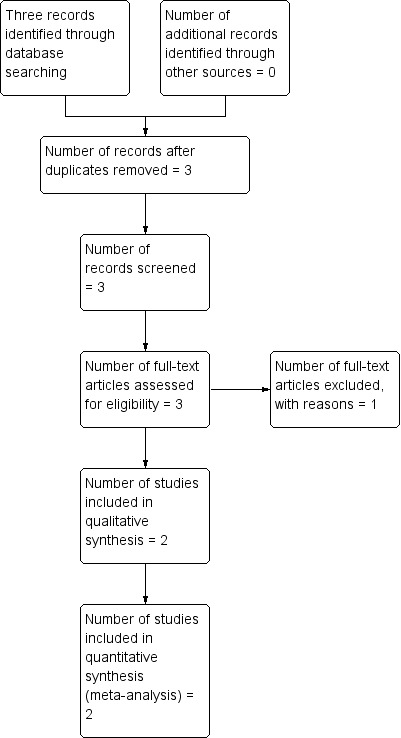
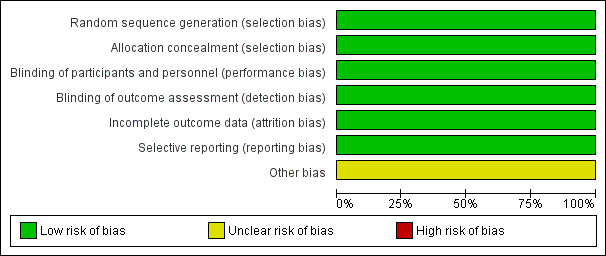
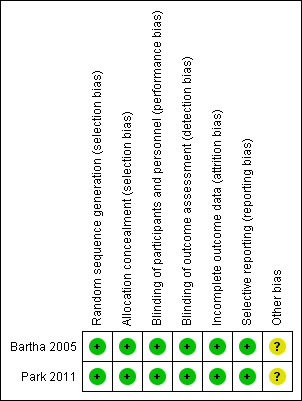
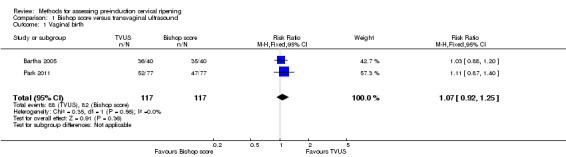
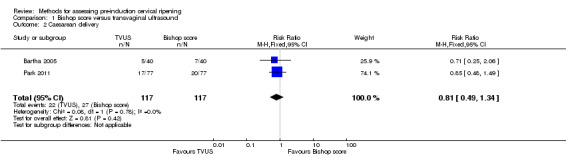
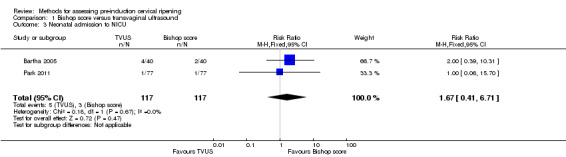
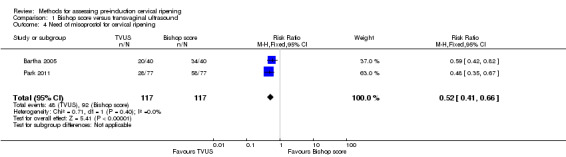
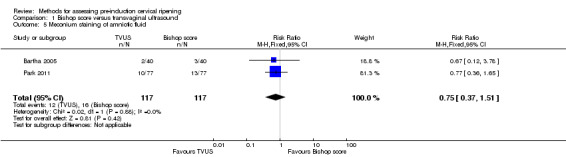
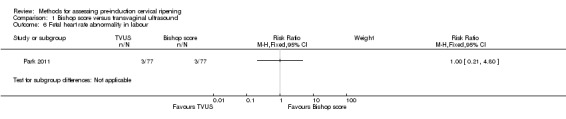
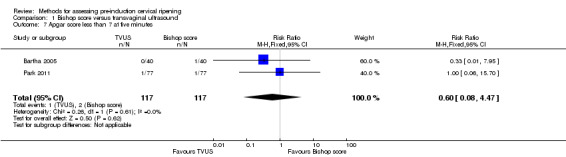
Main results: We included two trials that recruited a total of 234 women. The overall risk of bias was low for the two studies. Both studies compared Bishop score withTVUS.The two included studies did not show any clear difference between the Bishop score and TVUS groups for the following main outcomes: vaginal birth (RR 1.07, 95% CI 0.92 to 1.25, moderate quality evidence), caesarean delivery (RR 0.81, 95% CI 0.49 to 1.34, moderate quality evidence), neonatal admission into neonatal intensive care unit (RR 1.67, 95% CI 0.41 to 6.71, moderate quality evidence). Both studies only provided median data in relation to induction-delivery interval and reported no clear difference between the Bishop and TVUS groups. Perinatal mortality was not reported in the included studies.For the review's secondary outcomes, the need for misoprostol for cervical ripening was more frequent in the TVUS group compared to the Bishop score group (RR 0.52, 95% CI 0.41 to 0.66, two studies, 234 women, moderate quality evidence). In contrast, there were no clear differences between the Bishop scope and TVUS groups in terms of meconium staining of the amniotic fluid, fetal heart rate abnormality in labour, and Apgar score less than seven. Only one trial reported median data on the induction-delivery interval and induction to active phase interval, the trialist reported no difference between the Bishop group and the TVUS group for this outcome. Neither of the included studies reported on uterine rupture.
Authors' conclusions: Moderate quality evidence from two small RCTs involving 234 women that compared two different methods for assessing pre-induction cervical ripening (Bishop score and TVUS) did not demonstrate superiority of one method over the other in terms of the main outcomes assessed in this review. We did not identify any data relating to perinatal mortality. Whilst use of TVUS was associated with an increased need for misoprostol for cervical ripening, both methods could be complementary.The choice of a particular method of assessing pre-induction cervical ripening may differ depending on the environment and need where one is practicing since some methods (i.e. TVUS) may not be readily available and affordable in resource-poor settings where the sequelae of labour and its management is prevalent.The evidence in this review is based on two studies that enrolled a small number of women and there is insufficient evidence to support the use of TVUS over the standard digital vaginal assessment in pre-induction cervical ripening. Further adequately powered RCTs involving TVUS and the Bishop score and including other methods of pre-induction cervical ripening assessment are warranted. Such studies need to address uterine rupture, perinatal mortality, optimal cut-off value of the cervical length and Bishop score to classify women as having favourable or unfavourable cervices and cost should be included as an outcome.
Conflict of interest statement
None known.
Figures
Update of
References
References to studies included in this review
Bartha 2005 {published data only}
-
- Bartha JL, Romero‐Carmona R, Martinez‐Del‐Fresno P, Comino‐Delgado R. Bishop score and transvaginal ultrasound for preinduction cervical assessment: a randomised clinical trial. Ultrasound in Obstetrics and Gynecology 2005;25:155‐9. - PubMed
Park 2011 {published data only}
-
- Park KH, Kim SN, Lee SY, Jeong EH, Jung HJ, Oh KJ. Comparison between sonographic cervical length and Bishop score in preinduction cervical assessment: a randomized trial. Ultrasound in Obstetrics and Gynecology 2011;38(2):198‐204. - PubMed
References to studies excluded from this review
Ryu 2013 {published data only}
-
- Ryu A, Park KH, Lee SY, Jeong EH, Oh KJ, Kim A. Ultrasonographic cervical length versus Bishop score for preinduction cervical assessment in parous women: a randomized clinical trial. American Journal of Obstetrics and Gynecology 2013;208(Suppl 1):S134.
Additional references
Ahner 1995
-
- Ahner R, Egarter C, Kiss H, Heinzl K, Zeillinger R, Schatten C, et al. Fetal fibronectin as a selection criterion for induction of term labor. American Journal of Obstetrics and Gynecology 1995;173:1513‐7. - PubMed
Baacke 2006
-
- Baacke KA, Edwards RK. Preinduction cervical assessment. Clinical Obstetrics and Gynecology 2006;49(3):563‐72. - PubMed
Bishop 1964
-
- Bishop EH. Pelvic scoring for elective induction. Obstetrics and Gynecology 1964;24:266‐8. - PubMed
Blanch 1996
-
- Blanch G, Olah KSJ, Walkinshaw S. The presence of fetal fibronectin in cervicovaginal secretions of women at term‐Its role in the assessment of women before labor induction and in the investigation of the physiologic mechanisms of labor. American Journal of Obstetrics and Gynecology 1996;174:262‐6. - PubMed
Burnett 1966
-
- Burnett JE. Preinduction scoring: an objective approach to induction of labor. Obstetrics and Gynecology 1966;28:479‐83. - PubMed
Cooper 2012
-
- Cooper S, Lange I, Wood S, Tang S, Miller L, Ross S. Diagnostic accuracy of rapid phIGFBP‐I assay for predicting preterm labor in symptomatic patients. Journal of Perinatology 2012;32:460‐5. - PubMed
Crane 2006
-
- Crane JMG. Factors predicting labor induction success: a critical analysis. Clinical Obstetrics and Gynecology 2006;49(3):573‐84. - PubMed
Crane 2008
-
- Crane JM, Hutchens D. Transvaginal sonographic measurement of cervical length to predict preterm birth in asymptomatic women at increased risk: a systematic review. Ultrasound in Obstetrics and Gynecology 2008;31(5):579‐87. [PUBMED: 18412093] - PubMed
Edwards 2000
-
- Edwards RK, Richards DS. Preinduction cervical assessment. Clinical Obstetrics and Gynecology 2000;43(3):440‐6. - PubMed
Eggebo 2009
-
- Eggebo TM, Okland I, Heien C, Gjessing LK, Romundstad P, Salvesen SA. Can ultrasound measurements replace digitally assessed elements of the Bishop score?. Acta Obstetricia et Gynecologica 2009;88:325‐31. - PubMed
Ekman 1995
-
- Ekman G, Granstrom L, Malmstrom A, Sennstrom M, Svensson J. Cervical fetal fibronectin correlates to cervical ripening. Acta Obstetricia et Gynecologica Scandinavica 1995;74:698‐701. - PubMed
Elizur 2005
-
- Elizur SE, Yinon Y, Epstein GS, Seidman DS, Schiff E, Sivan E. Insulin‐like growth factor binding protein‐1 detection in preterm labor: evaluation of a bedside test. American Journal of Perinatology 2005;22(6):305‐9. - PubMed
Ezebialu 2013
Garite 1996
-
- Garite TJ, Casal D, Garcia‐Alonso A, Kreaden U, Jimenez G, Ayala JA, et al. Fetal fibronectin: a new tool for the prediction of successful induction of labor. American Journal of Obstetrics and Gynecology 1996;175:1516‐21. - PubMed
Goldberg 1997
-
- Goldberg J, Newman RB, Rust PF. Interobserver reliability of digital and endovaginal ultrasonographic measurements. American Journal of Obstetrics and Gynecology 1997;177:853‐8. - PubMed
Harrison 1977
-
- Harrison RF, Flynn M, Craft I. Assessment of factors constituting an ‘‘inducibility profile’’. Obstetrics and Gynecology 1977;49:270‐4. - PubMed
Hatfield 2007
-
- Hatfield AS, Sanchez‐Ramos L, Kaunitz AM. Sonographic cervical assessment to predict the success of labor induction: a systematic review with metaanalysis. American Journal of Obstetrics and Gynecology 2007;197(2):186‐92. [PUBMED: 17689645] - PubMed
Hendrix 1998
-
- Hendrix NW, Chauhan SP, Morrison JC, Magnan EF, Martin JN Jr, Devoe LD. Bishop score: a poor diagnostic test to predict failed induction versus vaginal delivery. Southern Medical Journal 1998;91:248‐52. - PubMed
Higgins 2011
-
- Higgins JPT, Green S, editors. Cochrane Handbook for Systematic Reviews of Interventions Version 5.1.0 [updated March 2011]. The Cochrane Collaboration, 2011. Available from www.cochrane‐handbook.org.
Hou 2012
Keepanasseril 2007
-
- Keepanasseril A, Suri V, Bagga R, Aggarwal N. Pre‐induction sonographic assessment of the cervix in the prediction of successful induction of labour in nulliparous women. Australian and New Zealand Journal of Obstetrics and Gynaecology 2007;47:389‐93. - PubMed
Keepanasseril 2012
-
- Keepanasseril A, Suri E, Bagga R, Aggarwal N. A new objective scoring system for the prediction of successful induction of labour. Journal of Obstetrics and Gynaecology 2012;32:145‐7. - PubMed
Lawani 2014
Leppert 1995
-
- Leppert PC. Anatomy and physiology of cervical ripening. Clinical Obstetrics and Gynecology 1995;38(2):267‐79. - PubMed
Martina 1997
-
- Martina NA, Kim E, Chitkara U, Wathen NC, Chard T, Giudice LC. Gestational age dependent expression of Insulin‐like growth factor binding protein‐1 (IGFBP‐1) phosphoforms in human extraembryonic cavity, materna serum and decidua suggests decidua as the primary source of IGFBP‐1 in these fluids during early pregnancy. Journal of Clinical Endocrinology and Metabolism 1997;82:1894‐8. - PubMed
Meijer‐Hoogeveen 2009
-
- Meijer‐Hoogeveen M, Roos C, Arabin B, Stoutenbeek P, Visser GH. Transvaginal ultrasound measurement of cervical length in the supine and upright positions versus Bishop score in predicting successful induction of labor at term. Ultrasound in Obstetrics & Gynecology 2009;33(2):213‐20. [PUBMED: 19173229] - PubMed
Mouw 1998
-
- Mouw RJC, Egberts J, Kragt H, Roosemalen JV. Cervicovaginal fetal fibronectin concentrations: predictive value of impending birth in postterm pregnancies. European Journal of Obstetrics, Gynecology, and Reproductive Biology 1998;80:67‐70. - PubMed
Nuutila 1999
-
- Nuutila M, Hiilesmaa V, Karkkainen T, Ylikorkala O, Rutanen E. Phosphorylated isoforms of insulin‐like growth factor binding protein‐1 in the cervix as a predictor of cervical ripeness. Obstetrics and Gynecology 1999;94(2):243‐9. - PubMed
Ojutiku 2002
-
- Ojutiku D, Jones G, Bewley S. Quantitative foetal fibronectin as a predictor of successful induction of labour in post‐date pregnancies. European Journal of Obstetrics, Gynecology, and Reproductive Biology 2002;101:143‐6. - PubMed
Pandis 2001
-
- Pandis GK, Papageorghiou AT, Ramanathan VG, Thompson MO, Nicolaides KH. Preinduction sonographic measurement of cervical length in the prediction of successful induction labor. Ultrasound in Obstetrics and Gynecology 2001;18:623‐8. - PubMed
Park 2007
Rane 2003
-
- Rane SM, Pandis GK, Guirgis RR, Higgins B, Nicolaides KH. Pre‐induction sonographic measurement of cervical length in prolonged pregnancy: the effect of parity in the prediction of induction‐to‐delivery interval. Ultrasound in Obstetrics and Gynecology 2003;22(1):40‐4. [PUBMED: 12858301] - PubMed
Rane 2004
-
- Rane SM, Pandis GK, Guirgis RR, Higgins B, Nicolaides KH. The value of ultrasound in the prediction of successful induction. Ultrasound in Obstetrics and Gynecology 2004;24:538‐49. - PubMed
Rane 2005
-
- Rane SM, Guirgis RR, Higgins B, Nicolaides KH. Models for the prediction of successful induction of labor based on pre‐induction sonographic measurement of cervical length. Journal of Maternal‐Fetal and Neonatal Medicine 2005;17:315‐22. - PubMed
Rath 1993
-
- Rath W, Osmers R, Adelmann‐Grill B, Stuhlsatz H, Szevereny M, Kuhn W. Biochemical changes in human cervical connective tissue after intracervical application of prostaglandin E2. Prostaglandins 1993;45(4):375‐84. - PubMed
RevMan 2014 [Computer program]
-
- The Nordic Cochrane Centre, The Cochrane Collaboration. Review Manager (RevMan). Version 5.3. Copenhagen: The Nordic Cochrane Centre, The Cochrane Collaboration, 2014.
Roman 2004
-
- Roman H, Verspyck E, Vercoustre L, Degre S, Col JY, Firmin JM, et al. The role of ultrasound and fetal fibronectin in predicting the length of induced labor when the cervix is unfavorable. Ultrasound in Obstetrics and Gynecology 2004;23:567‐73. - PubMed
Rouse 2011
Rozenberg 2000
-
- Rozenberg P, Goffinet F, Hessabi M. Comparison of the Bishop score, ultrasonographically measured cervical length, and fetal fibronectin assay in predicting time until delivery and type of delivery at term. American Journal of Obstetrics and Gynecology 2000;182:108‐13. - PubMed
Rozenberg 2005
-
- Rozenberg P, Chevret S, Chastang C, Ville Y. Comparison of digital and ultrasonographic examination of the cervix in predicting time interval from induction to delivery in women with a low Bishop score. BJOG: an international journal of obstetrics and gynaecology 2005;112:192‐6. - PubMed
Tan 2007
-
- Tan PC, Vallikkannu N, Suguna S, Quek KF, Hassan J. Transvaginal sonographic measurement of cervical length vs. Bishop score in labor induction at term: tolerability and prediction of Cesarean delivery. Ultrasound in Obstetrics and Gynecology 2007;29(5):568‐73. [PUBMED: 17444553] - PubMed
Timmons 2010
Uldbjerg 1983
-
- Uldbjerg N, Ekman G, Malmstrom A, Ulmsten U, Wingerup L. Biochemical changes in human cervical connective tissue after local application of prostaglandin E2. Gynecologic and Obstetric Investigation 1983;15(5):291‐9. - PubMed
Westwood 1994
-
- Westwood M, Gibson JM, Davies AJ, Young RJ, White A. The phosphorylation pattern of Insulin‐like growth factor binding protein‐1 in normal plasma is different from that in amniotic fluid and changes during pregnancy. Journal of Clinical Endocrinology and Metabolism 1994;79:1735‐41. - PubMed
Word 2007
-
- Word RA, Li X‐H, Hnat M, Carrick K. Dynamics of cervical remodeling during pregnancy and parturition: mechanisms and current concepts. Seminars in Reproductive Medicine 2007;25(1):69‐80. - PubMed
Yang 2004
-
- Yang SH, Roh CR, Kim JH. Transvaginal ultrasonography for cervical assessment before induction of labor. Journal of Ultrasound in Medicine 2004;23:375‐82. - PubMed
Publication types
MeSH terms
Substances
LinkOut - more resources
Full Text Sources
Medical
Research Materials
