


Concerns of parents and teachers of children with autism in elementary school
- PMID: 26069200
- PMCID: PMC4676744
- DOI: 10.1177/1362361315588199
Concerns of parents and teachers of children with autism in elementary school
Abstract
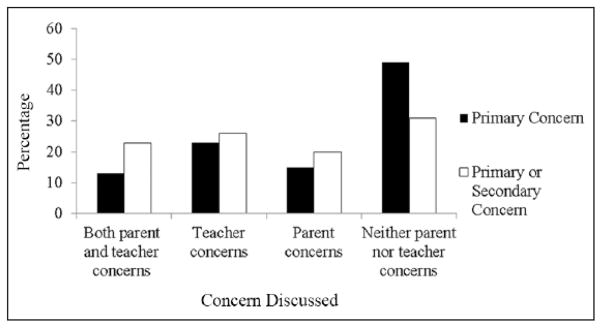
Many consensus guidelines encourage parents and teachers to openly communicate about their concerns regarding their children. These guidelines attest to the importance of achieving consensus about what issues are most critical and how to address them. The purpose of this study was to examine whether parents and teachers (1) agree about their concerns for their children with autism and (2) when given the opportunity, whether they discussed these concerns. Participants were 39 parent-teacher dyads of children with autism in kindergarten-through-fifth grade autism support classrooms. Each parent and teacher was interviewed separately about their concerns and then observed together in a discussion about the child. Parents and teachers generally agreed about their primary and secondary concerns. When given an opportunity to communicate their concerns, 49% of the parent-teacher dyads discussed problems that neither reported as their primary concern, and 31% discussed problems that neither reported as their primary or secondary concern. These findings suggest that interventions should target parent-teacher communication, rather than agreement, to facilitate home-school collaboration.
Keywords: autism; autism spectrum disorders; family–school partnerships; parent–teacher communication.
© The Author(s) 2015.
Figures
References
-
- Barnhill GP, Hagiwara T, Myles BS, et al. Parent, teacher, and self-report of problem and adaptive behaviors in children and adolescents with Asperger Syndrome. Assessment for Effective Intervention. 2000;25(2):147–167.
-
- Benson P, Karlof KL, Siperstein GN. Maternal involvement in the education of young children with spectrum disorders. Autism. 2008;12(1):47–63. - PubMed
-
- Bernheimer L, Gallimore R, Weisner T. Ecocultural theory as a context for the individual family service plan. Journal of Early Intervention. 1990;14:219–233.
-
- Blair WC, Lee I, Cho S, et al. Positive behavior support through family-school collaboration for young children with autism. Topics in Early Childhood Special Education. 2011;31(1):22–36.
-
- Cavkaytar A, Pollard E. Effectiveness of parent and therapist collaboration program (PTCP) for teaching self-care and domestic skills to individuals with autism. Education and Training in Developmental Disabilities. 2009;44(3):381–395.
Publication types
MeSH terms
Grants and funding
LinkOut - more resources
Full Text Sources
Other Literature Sources
