


The Inadmissibility of What We Eat in America and NHANES Dietary Data in Nutrition and Obesity Research and the Scientific Formulation of National Dietary Guidelines
- PMID: 26071068
- PMCID: PMC4527547
- DOI: 10.1016/j.mayocp.2015.04.009
The Inadmissibility of What We Eat in America and NHANES Dietary Data in Nutrition and Obesity Research and the Scientific Formulation of National Dietary Guidelines
Abstract
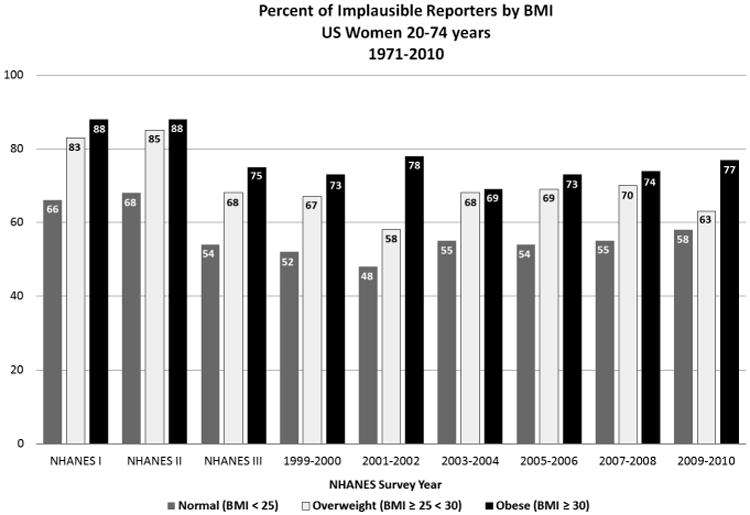
The Scientific Report of the 2015 Dietary Guidelines Advisory Committee was primarily informed by memory-based dietary assessment methods (M-BMs) (eg, interviews and surveys). The reliance on M-BMs to inform dietary policy continues despite decades of unequivocal evidence that M-BM data bear little relation to actual energy and nutrient consumption. Data from M-BMs are defended as valid and valuable despite no empirical support and no examination of the foundational assumptions regarding the validity of human memory and retrospective recall in dietary assessment. We assert that uncritical faith in the validity and value of M-BMs has wasted substantial resources and constitutes the greatest impediment to scientific progress in obesity and nutrition research. Herein, we present evidence that M-BMs are fundamentally and fatally flawed owing to well-established scientific facts and analytic truths. First, the assumption that human memory can provide accurate or precise reproductions of past ingestive behavior is indisputably false. Second, M-BMs require participants to submit to protocols that mimic procedures known to induce false recall. Third, the subjective (ie, not publicly accessible) mental phenomena (ie, memories) from which M-BM data are derived cannot be independently observed, quantified, or falsified; as such, these data are pseudoscientific and inadmissible in scientific research. Fourth, the failure to objectively measure physical activity in analyses renders inferences regarding diet-health relationships equivocal. Given the overwhelming evidence in support of our position, we conclude that M-BM data cannot be used to inform national dietary guidelines and that the continued funding of M-BMs constitutes an unscientific and major misuse of research resources.
Copyright © 2015 Mayo Foundation for Medical Education and Research. Published by Elsevier Inc. All rights reserved.
Figures
Comment in
-
The Validity of Self-reported Dietary Intake Data: Focus on the "What We Eat In America" Component of the National Health and Nutrition Examination Survey Research Initiative.Mayo Clin Proc. 2015 Jul;90(7):845-7. doi: 10.1016/j.mayocp.2015.05.009. Epub 2015 Jun 9. Mayo Clin Proc. 2015. PMID: 26071069 No abstract available.
-
A Discussion of the Refutation of Memory-Based Dietary Assessment Methods (M-BMs): The Rhetorical Defense of Pseudoscientific and Inadmissible Evidence.Mayo Clin Proc. 2015 Dec;90(12):1736-9; discussion 1739-40. doi: 10.1016/j.mayocp.2015.10.003. Mayo Clin Proc. 2015. PMID: 26653304 No abstract available.
References
-
- Samuelson P. The Keynes Centenary. The Economist. 1983;287:19.
-
- USDA. Nutrient Content of the US Food Supply, 1909-2000. Vol. 56. Washington DC: United States Department of Agriculture; Center for Nutrition Policy and Promotion, Home Economics Research Report; 2004.
-
- Rajakumar K. Pellagra in the United States: a historical perspective. Southern medical journal. 2000 Mar;93(3):272–277. - PubMed
-
- CDC. National report on biochemical indicators of diet and nutrition in the US population 1999–2002. Atlanta, GA: National Center for Environmental Health; 2008. available at http://www.cdc.gov/nutritionreport.
Publication types
MeSH terms
Grants and funding
LinkOut - more resources
Full Text Sources
Other Literature Sources
Medical
Miscellaneous
