Efficacy of fewer than three doses of an HPV-16/18 AS04-adjuvanted vaccine: combined analysis of data from the Costa Rica Vaccine and PATRICIA Trials
- PMID: 26071347
- PMCID: PMC4498478
- DOI: 10.1016/S1470-2045(15)00047-9
Efficacy of fewer than three doses of an HPV-16/18 AS04-adjuvanted vaccine: combined analysis of data from the Costa Rica Vaccine and PATRICIA Trials
Abstract
Background: There is some evidence to suggest that one or two doses of the HPV vaccine provides similar protection to the three-dose regimen. The main aim of the study was to ascertain HPV-16/18 vaccine efficacy in both full and naive cohorts and to explore protection conferred against non-vaccine HPV types, by number of doses received.
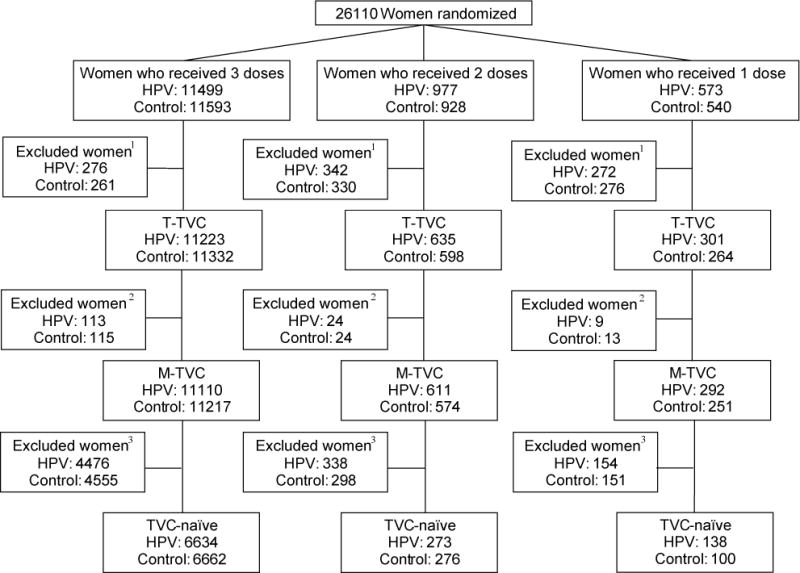
Methods: Summary data from the Costa Rica Vaccine Trial (CVT; NCT00128661) and ~the PATRICIA trial (NCT001226810), two phase 3, double-blind, randomised controlled clinical trials of the HPV-16/18 AS04-adjuvanted vaccine in young women, were combined in a post-hoc analysis (GlaxoSmithKline [GSK] e-track number 202142) to investigate the efficacy of fewer than three doses of the HPV-16/18 vaccine after 4 years of follow-up. Women were randomly assigned to receive three doses of the HPV-16/18 vaccine or to a control vaccine; yet, some received fewer doses. After exclusion of women with less than 12 months of follow-up or those who were HPV-16/18 DNA-positive at enrolment (for the HPV-16/18 endpoint), we calculated vaccine efficacy against one-time detection of incident HPV infections after three, two, and one dose(s). The primary study endpoint was one-time detection of first incident HPV-16/18 infections accumulated during the follow-up phase.
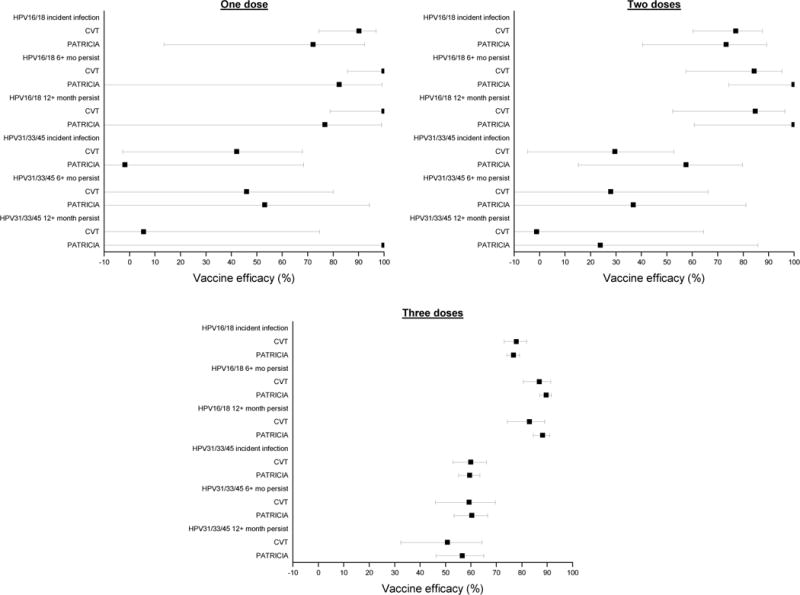
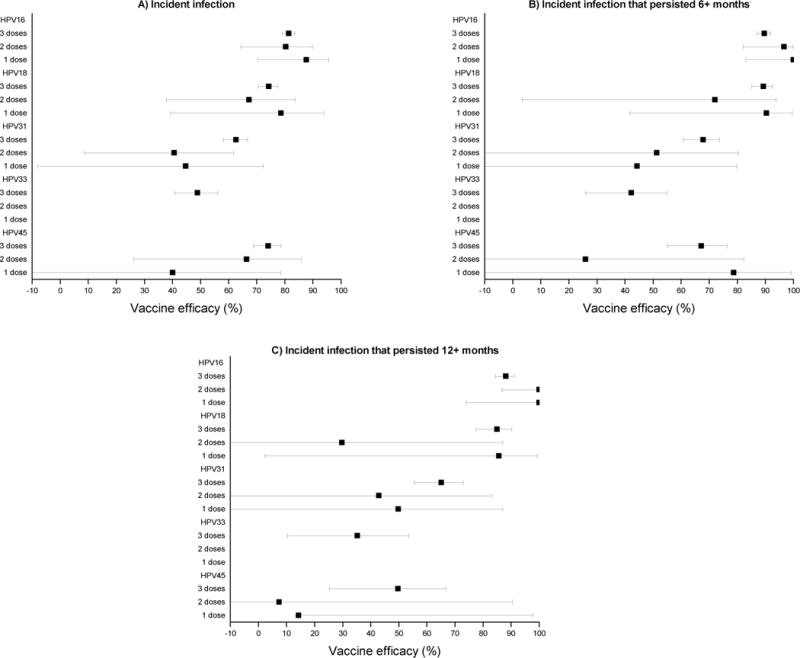
Findings: We assessed vaccine efficacy against incident HPV-16/18 infection in the modified total vaccinated cohort (22 327 received three doses, 1185 two doses, 543 one dose). Vaccine efficacy against incident HPV-16/18 infections for three doses was 77·0% (95% CI 74·7-79·1), two doses was 76·0% (62·0-85·3), and one dose was 85·7% (70·7-93·7). Vaccine efficacy against incident HPV-31/33/45 infections for three doses was 59·7% (56·0-63·0), two doses was 37·7% (12·4-55·9), and one dose was 36·6% (-5·4 to 62·2). Vaccine efficacy against incident HPV-16/18 infection for two-dose women who received their second dose at 1 month was 75·3% (54·2-87·5) and 82·6% (42·3-96·1) for those who received the second dose at 6 months (CVT data only). Vaccine efficacy against HPV-31/33/45 for two-dose women who received their second dose at 6 months (68·1%, 27·0-87·0; CVT data only), but not those receiving it at one month (10·1%, -42·0 to 43·3), was similar to the three-dose group.
Interpretation: 4 years after vaccination of women aged 15-25 years, one and two doses of the HPV-16/18 vaccine seem to protect against cervical HPV-16/18 infections, similar to the protection provided by the three-dose schedule. Two doses separated by 6 months additionally provided some cross-protection. These data argue for a direct assessment of one-dose efficacy of the HPV-16/18 vaccine.
Funding: US National Cancer Institute, National Institutes of Health Office of Research on Women's Health, and Ministry of Health of Costa Rica (CVT); GlaxoSmithKline Biologicals SA (PATRICIA).
Copyright © 2015 Elsevier Ltd. All rights reserved.
Figures
Comment in
-
One dose of HPV vaccine could prevent most cervical cancers, studies show.BMJ. 2015 Jun 11;350:h3198. doi: 10.1136/bmj.h3198. BMJ. 2015. PMID: 26067838 No abstract available.
-
Could one dose of bivalent HPV vaccine prevent cervical cancer?Lancet Oncol. 2015 Jul;16(7):739-40. doi: 10.1016/S1470-2045(15)00046-7. Epub 2015 Jun 9. Lancet Oncol. 2015. PMID: 26071348 No abstract available.
-
Fewer than three doses of HPV vaccine.Lancet Oncol. 2015 Sep;16(9):e422-e423. doi: 10.1016/S1470-2045(15)00134-5. Lancet Oncol. 2015. PMID: 26370344 No abstract available.
-
Fewer than three doses of HPV vaccine.Lancet Oncol. 2015 Sep;16(9):e423-e424. doi: 10.1016/S1470-2045(15)00229-6. Lancet Oncol. 2015. PMID: 26370345 No abstract available.
-
Fewer than three doses of HPV vaccine - Authors' reply.Lancet Oncol. 2015 Sep;16(9):e424-e425. doi: 10.1016/S1470-2045(15)00196-5. Lancet Oncol. 2015. PMID: 26370346 No abstract available.
References
-
- de Martel C, Ferlay J, Franceschi S, et al. Global burden of cancers attributable to infections in 2008: a review and synthetic analysis. Lancet Oncol. 2012;13(6):607–15. - PubMed
-
- de Sanjose S, Quint WG, Alemany L, et al. Human papillomavirus genotype attribution in invasive cervical cancer: a retrospective cross-sectional worldwide study. Lancet Oncol. 2010;11:1048–56. - PubMed
-
- Paavonen J, Naud P, Salmeron J, et al. Efficacy of human papillomavirus (HPV)-16/18 AS04-adjuvanted vaccine against cervical infection and precancer caused by oncogenic HPV types (PATRICIA): final analysis of a double-blind, randomised study in young women. Lancet. 2009;374:301–14. - PubMed
-
- Quadrivalent vaccine against human papillomavirus to prevent high-grade cervical lesions. N Engl J Med. 2007;356:1915–271. - PubMed
Publication types
MeSH terms
Substances
Associated data
Grants and funding
LinkOut - more resources
Full Text Sources
Medical