


Anticipatory coarticulation facilitates word recognition in toddlers
- PMID: 26072992
- PMCID: PMC4500663
- DOI: 10.1016/j.cognition.2015.05.009
Anticipatory coarticulation facilitates word recognition in toddlers
Abstract
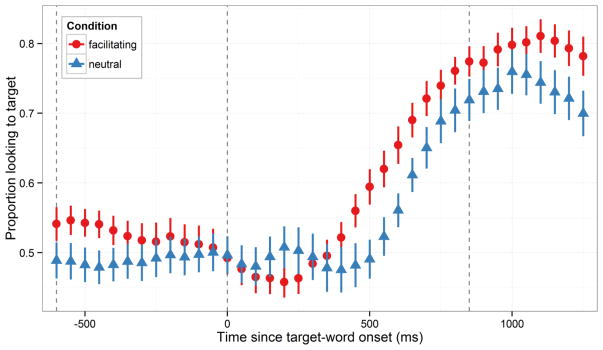
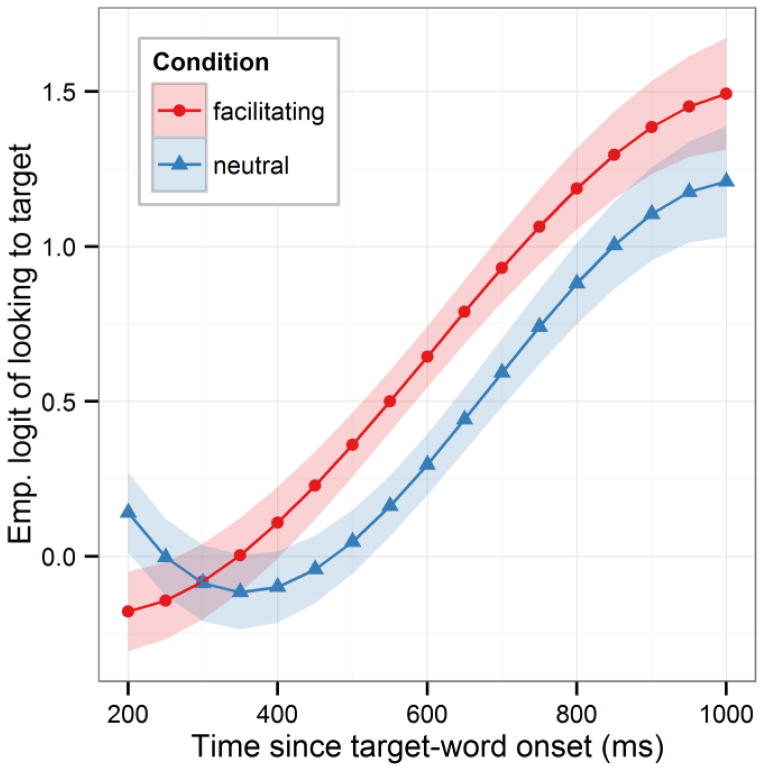
Children learn from their environments and their caregivers. To capitalize on learning opportunities, young children have to recognize familiar words efficiently by integrating contextual cues across word boundaries. Previous research has shown that adults can use phonetic cues from anticipatory coarticulation during word recognition. We asked whether 18-24 month-olds (n=29) used coarticulatory cues on the word "the" when recognizing the following noun. We performed a looking-while-listening eyetracking experiment to examine word recognition in neutral vs. facilitating coarticulatory conditions. Participants looked to the target image significantly sooner when the determiner contained facilitating coarticulatory cues. These results provide the first evidence that novice word-learners can take advantage of anticipatory sub-phonemic cues during word recognition.
Keywords: Coarticulation; Eye tracking; Language development; Lexical development; Word learning; Word recognition.
Copyright © 2015 Elsevier B.V. All rights reserved.
Figures
References
-
- Barr DJ. Analyzing “visual world” eyetracking data using multilevel logistic regression. Journal of Memory and Language. 2008;59(4):457–474. doi: 10.1016/j.jml.2007.09.002. - DOI
-
- Bates D, Mächler M, Bolker B, Walker S. lme4: linear mixed-effects models using Eigen and S4. 2014 Retrieved from http://CRAN.R-project.org/package=lme4.
-
- Dahan D, Magnuson JS, Tanenhaus MK, Hogan EM. Subcategorical mismatches and the time course of lexical access: evidence for lexical competition. Language and Cognitive Processes. 2001;16(5–6):507–534. doi: 10.1080/01690960143000074. - DOI
Publication types
MeSH terms
Grants and funding
LinkOut - more resources
Full Text Sources
Other Literature Sources
