Review
. 2015 May 26:6:73.
doi: 10.3389/fendo.2015.00073. eCollection 2015.

The Novel Functions of High-Molecular-Mass Complexes Containing Insulin Receptor Substrates in Mediation and Modulation of Insulin-Like Activities: Emerging Concept of Diverse Functions by IRS-Associated Proteins

Affiliations
Review

The Novel Functions of High-Molecular-Mass Complexes Containing Insulin Receptor Substrates in Mediation and Modulation of Insulin-Like Activities: Emerging Concept of Diverse Functions by IRS-Associated Proteins

Fumihiko Hakuno et al. Front Endocrinol (Lausanne). .

Abstract

Insulin-like peptides, such as insulin-like growth factors (IGFs) and insulin, induce a variety of bioactivities, such as growth, differentiation, survival, increased anabolism, and decreased catabolism in many cell types and in vivo. In general, IGFs or insulin bind to IGF-I receptor (IGF-IR) or insulin receptor (IR), activating the receptor tyrosine kinase. Insulin receptor substrates (IRSs) are known to be major substrates of receptor kinases, mediating IGF/insulin signals to direct bioactivities. Recently, we discovered that IRSs form high-molecular-mass complexes (referred to here as IRSomes) even without IGF/insulin stimulation. These complexes contain proteins (referred to here as IRSAPs; IRS-associated proteins), which modulate tyrosine phosphorylation of IRSs by receptor kinases, control IRS stability, and determine intracellular localization of IRSs. In addition, in these complexes, we found not only proteins that are involved in RNA metabolism but also RNAs themselves. Thus, IRSAPs possibly contribute to modulation of IGF/insulin bioactivities. Since it is established that disorder of modulation of insulin-like activities causes various age-related diseases including cancer, we could propose that the IRSome is an important target for treatment of these diseases.

Keywords: IRS-associated protein; IRSome; cancer; insulin; insulin receptor substrate; insulin-like growth factor.


Figures
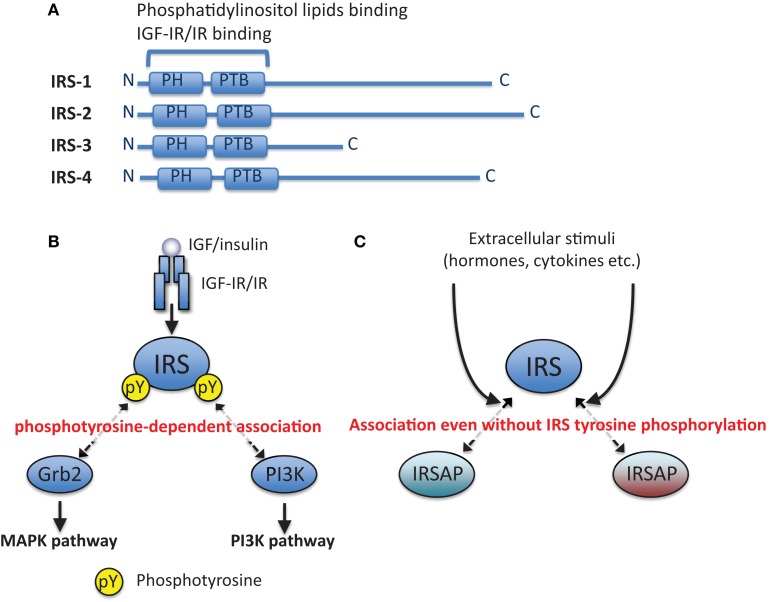
Figure 1
Figure 1
Phosphotyrosine-dependent and -independent association of IRS with other proteins. (A) Schematic illustration of IRS-1, IRS-2, IRS-3, and IRS-4. (B) Canonical IGF/insulin signaling pathways. IRSs are tyrosine-phosphorylated by IGF-IR/IR tyrosine kinase, and then they are associated with downstream signaling molecules in a phosphotyrosine (pY)-dependent manner. (C) IRSs are associated with other proteins (IRSAPs) even without their tyrosine phosphorylation, and this interaction can be changed by extracellular stimuli in addition to IGF/insulin stimulation.
Figure 2
Figure 2
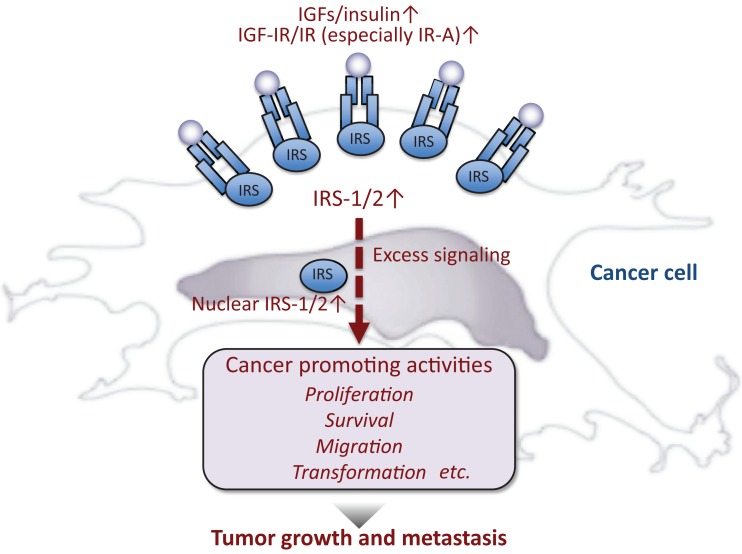
Insulin-like activities and cancer. In general, cancer cells produce or are exposed to high levels of insulin-like peptides and/or IGF/insulin signals are enhanced in these cells, resulting in maintenance of cancer phenotypes.
Figure 3
Figure 3
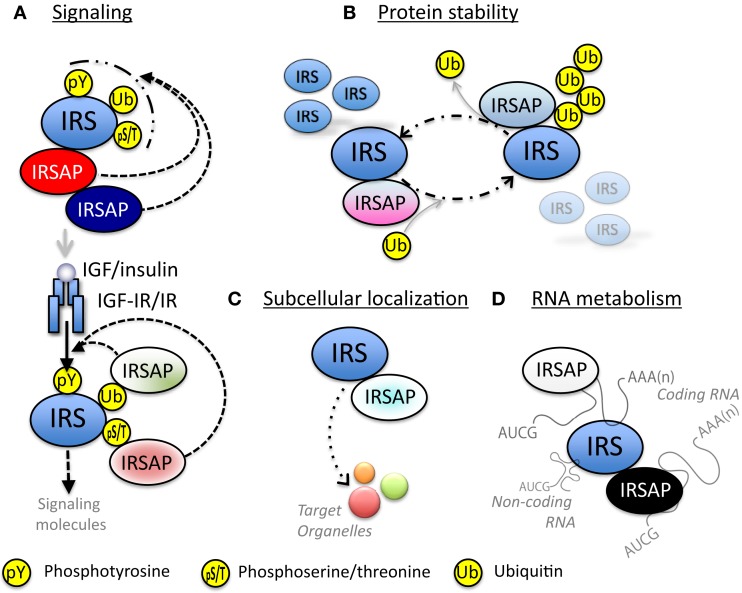
Possible functions of IRS-associated proteins (IRSAPs). (A) IRS-associated proteins modulate IGF/insulin signal intensity through various mechanisms. Some IRSAPs regulate post-translational modification of IRSs. Other IRSAPs interact with IRSs through recognition of post-translationally modified IRSs. These modification and/or protein-interaction regulate the availability to IGF-IR or IR. (B) IRS-associated proteins control stability of IRSs proteins. (C) IRS-associated proteins transport IRSs to specific organelles. (D) IRSs interact with RNA directly or through RNA-binding protein. This complex might control RNA metabolism.
Figure 4
Figure 4
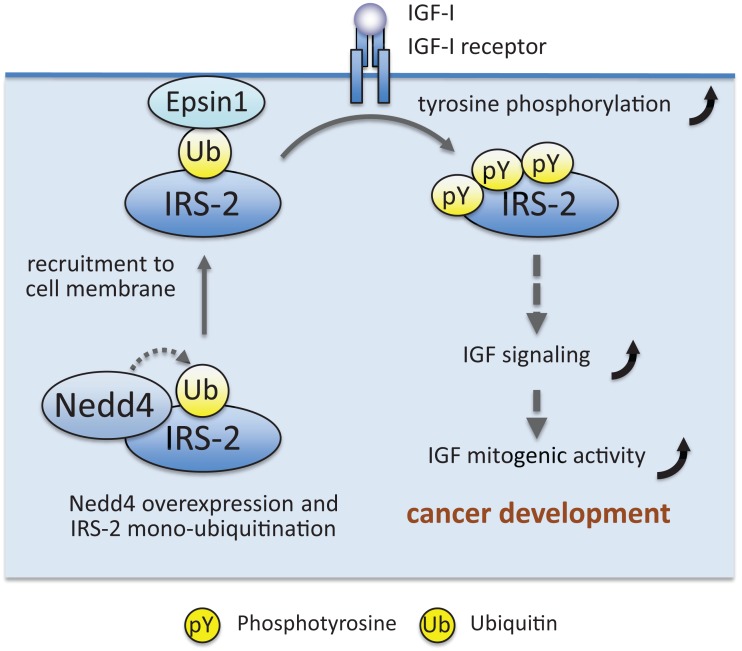
Working model showing how Nedd4 enhances IGF signaling and mitogenic activity, leading to maintenance of cancer phenotype. A detailed explanation is given in the text.

References

    1. Thissen JP, Ketelslegers JM, Underwood LE. Nutritional regulation of the insulin-like growth factors. Endocr Rev (1994) 15(1):80–101.10.1210/edrv-15-1-80 - DOI - PubMed
    1. Jones JI, Clemmons DR. Insulin-like growth factors and their binding proteins: biological actions. Endocr Rev (1995) 16(1):3–34.10.1210/er.16.1.3 - DOI - PubMed
    1. Nakae J, Kido Y, Accili D. Distinct and overlapping functions of insulin and IGF-I receptors. Endocr Rev (2001) 22(6):818–35.10.1210/edrv.22.6.0452 - DOI - PubMed
    1. Rui L. Energy metabolism in the liver. Compr Physiol (2014) 4(1):177–97.10.1002/cphy.c130024 - DOI - PMC - PubMed
    1. Newsholme P, Cruzat V, Arfuso F, Keane K. Nutrient regulation of insulin secretion and action. J Endocrinol (2014) 221(3):R105–20.10.1530/JOE-13-0616 - DOI - PubMed

LinkOut - more resources