. 2015:2015:876348.
doi: 10.1155/2015/876348. Epub 2015 May 14.

3p14 De Novo Interstitial Microdeletion in a Patient with Intellectual Disability and Autistic Features with Language Impairment: A Comparison with Similar Cases

Affiliations

3p14 De Novo Interstitial Microdeletion in a Patient with Intellectual Disability and Autistic Features with Language Impairment: A Comparison with Similar Cases

Ana Belén de la Hoz et al. Case Rep Genet. 2015.

Abstract

To date, few cases of 3p proximal interstitial deletions have been reported and the phenotype and genotype correlation is not well understood. Here, we report a new case of a 3p proximal interstitial deletion. The patient is an 11-year-old female with speech and social interaction difficulties, learning disability, and slight facial dysmorphism, but no other major malformations. An 8 Mb de novo interstitial deletion at 3p14.2-p14.1, from position 60.461.316 to 68.515.453, was revealed by means of array comparative genomic hybridization and confirmed using quantitative reverse-transcription polymerase chain reaction assays. This region includes six genes: FEZF2, CADPS, SYNPR, ATXN7, PRICKLE, and MAGI1, that are known to have a role in neurodevelopment. These genes are located on the proximal side of the deletion. We compare our case with previously well-defined patients reported in the literature and databases.


Figures
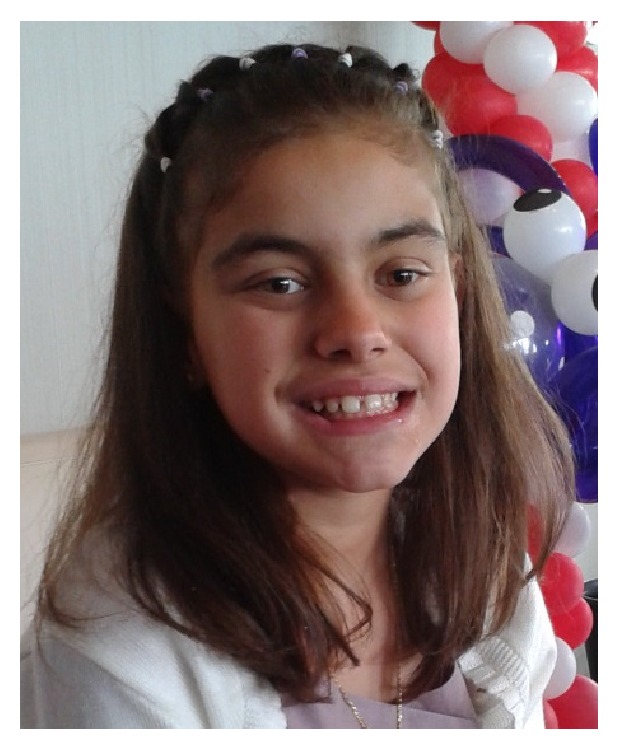
Figure 1
Figure 1
The facial photograph of the patient does not show any remarkable phenotypic features. Only slight facial dysmorphism could be observed: a long face with a prominent chin; broad forehead; and a broad, large mouth with widely spaced upper front teeth. Although not visible in this photograph, she has slightly protruding prominent ears.
Figure 2
Figure 2
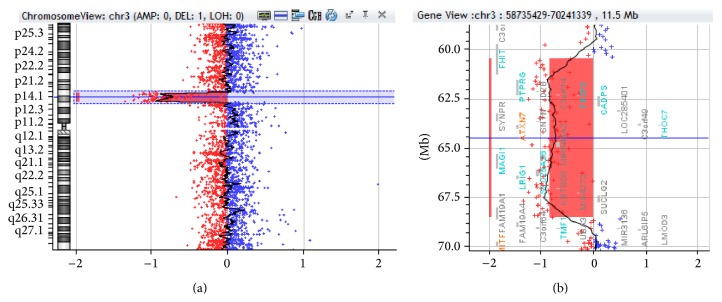
The array comparative genomic hybridization (CGH) profile of chromosome 3 showing an interstitial deletion. (a) View of chromosome 3 and (b) the enlarged view of the rearrangement as generated by CytoGenomics v.2.7 (Agilent Technologies). The deletion breakpoint was between 60.461.316 and 68.515.453 (3p14.2-p14.1). The size of the deletion was ~8 Mb.
Figure 3
Figure 3
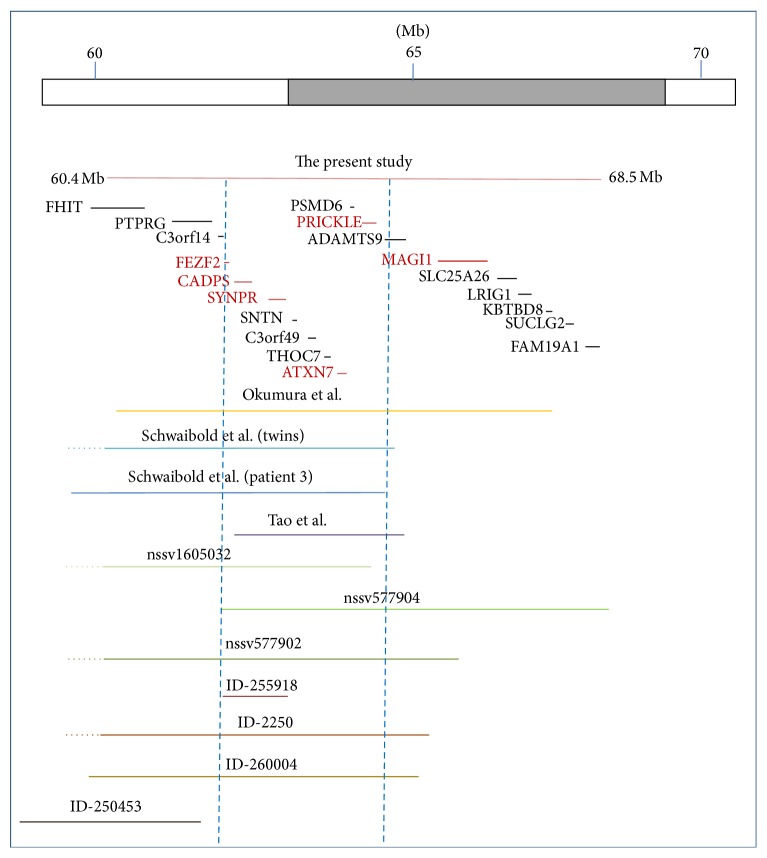
Schematic representation of the 3p14 deletions. The orange line represents the deletion in our patient. The deletions found by Okumura et al., Schwaibold et al., and Tao et al. are represented by lines in yellow, blue, and purple, respectively. The green and brown lines are deletions described previously in ISCA Consortium and DECIPHER databases, respectively. The thin red and black horizontal lines indicate the genes that are located in the 3p14 deleted region, the red ones being those that might be responsible for the phenotypic features given their known biological functions. The blue vertical dashed lines indicate the region in which the candidate genes are located and the overlapping deleted regions in 10 of the 11 cases.

References

    1. Kogame K., Kudo H. Interstitial deletion 3p associated with t(3p−;18q+) translocation. The Japanese Journal of Human Genetics. 1979;24(4):245–252. doi: 10.1007/bf01907824. - DOI - PubMed
    1. Carr C. W., Moreno-De-Luca D., Parker C., et al. Chiari i malformation, delayed gross motor skills, severe speech delay, and epileptiform discharges in a child with FOXP1 haploinsufficiency. European Journal of Human Genetics. 2010;18(11):1216–1220. doi: 10.1038/ejhg.2010.96. - DOI - PMC - PubMed
    1. Hamdan F. F., Daoud H., Rochefort D., et al. De novo mutations in FOXP1 in cases with intellectual disability, autism, and language impairment. American Journal of Human Genetics. 2010;87(5):671–678. doi: 10.1016/j.ajhg.2010.09.017. - DOI - PMC - PubMed
    1. Horn D., Kapeller J., Rivera-Brugués N., et al. Identification of FOXP1 deletions in three unrelated patients with mental retardation and significant speech and language deficits. Human Mutation. 2010;31(11):E1851–E1860. doi: 10.1002/humu.21362. - DOI - PMC - PubMed
    1. Palumbo O., D'Agruma L., Minenna A. F., et al. 3p14.1 de novo microdeletion involving the FOXP1 gene in an adult patient with autism, severe speech delay and deficit of motor coordination. Gene. 2013;516(1):107–113. doi: 10.1016/j.gene.2012.12.073. - DOI - PubMed

LinkOut - more resources