Ketamine and phencyclidine: the good, the bad and the unexpected
- PMID: 26075331
- PMCID: PMC4556466
- DOI: 10.1111/bph.13222
Ketamine and phencyclidine: the good, the bad and the unexpected
Abstract
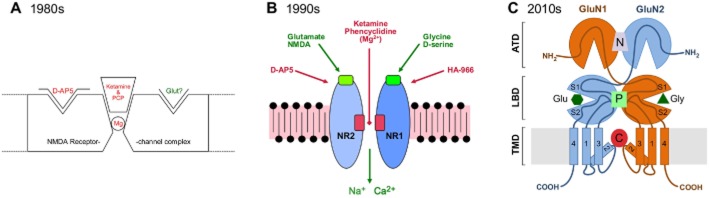
The history of ketamine and phencyclidine from their development as potential clinical anaesthetics through drugs of abuse and animal models of schizophrenia to potential rapidly acting antidepressants is reviewed. The discovery in 1983 of the NMDA receptor antagonist property of ketamine and phencyclidine was a key step to understanding their pharmacology, including their psychotomimetic effects in man. This review describes the historical context and the course of that discovery and its expansion into other hallucinatory drugs. The relevance of these findings to modern hypotheses of schizophrenia and the implications for drug discovery are reviewed. The findings of the rapidly acting antidepressant effects of ketamine in man are discussed in relation to other glutamatergic mechanisms.
© 2015 The British Pharmacological Society.
Figures
References
-
- Abe S, Suzuki T, Ito T, Baba A, Hori T, Kurita H, et al. Differential expression of GABA(A) receptor subunit mRNAs and ligand binding sites in rat brain following phencyclidine administration. Synapse. 2000;38:51–60. - PubMed
-
- Akbarian S, Huntsman MM, Kim JJ, Tafazzoli A, Potkin SG, Bunney WE, et al. GABAA receptor subunit gene expression in human prefrontal cortex: comparison of schizophrenics and controls. Cereb Cortex. 1995;5:550–560. - PubMed
Publication types
MeSH terms
Substances
Grants and funding
LinkOut - more resources
Full Text Sources
Other Literature Sources
Medical
Research Materials