


High-Throughput Sequencing Identifies Novel and Conserved Cucumber (Cucumis sativus L.) microRNAs in Response to Cucumber Green Mottle Mosaic Virus Infection
- PMID: 26076360
- PMCID: PMC4468104
- DOI: 10.1371/journal.pone.0129002
High-Throughput Sequencing Identifies Novel and Conserved Cucumber (Cucumis sativus L.) microRNAs in Response to Cucumber Green Mottle Mosaic Virus Infection
Abstract
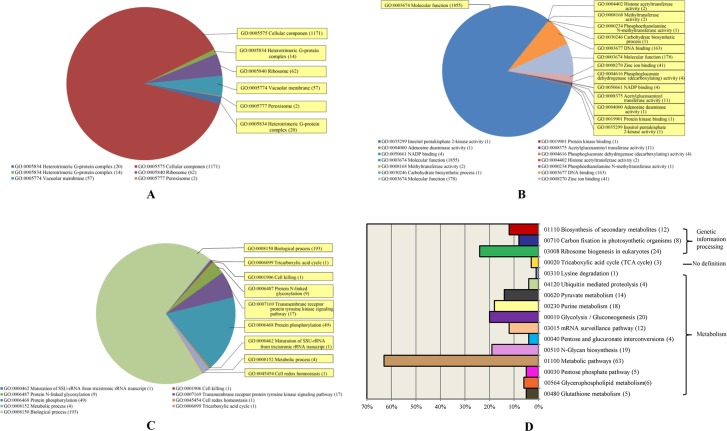
Seedlings of Cucumis sativus L. (cv. 'Zhongnong 16') were artificially inoculated with Cucumber green mottle mosaic virus (CGMMV) at the three-true-leaf stage. Leaf and flower samples were collected at different time points post-inoculation (10, 30 and 50 d), and processed by high throughput sequencing analysis to identify candidate miRNA sequences. Bioinformatic analysis using screening criteria, and secondary structure prediction, indicated that 8 novel and 23 known miRNAs (including 15 miRNAs described for the first time in vivo) were produced by cucumber plants in response to CGMMV infection. Moreover, gene expression profiles (p-value <0.01) validated the expression of 3 of the novel miRNAs and 3 of the putative candidate miRNAs and identified a further 82 conserved miRNAs in CGMMV-infected cucumbers. Gene ontology (GO) analysis revealed that the predicted target genes of these 88 miRNAs, which were screened using the psRNATarget and miRanda algorithms, were involved in three functional categories: 2265 in molecular function, 1362 as cellular components and 276 in biological process. The subsequent Kyoto Encyclopedia of Genes and Genomes (KEGG) pathway analysis revealed that the predicted target genes were frequently involved in metabolic processes (166 pathways) and genetic information processes (40 pathways) and to a lesser degree the biosynthesis of secondary metabolites (12 pathways). These results could provide useful clues to help elucidate host-pathogen interactions in CGMMV and cucumber, as well as for the screening of resistance genes.
Conflict of interest statement
Figures

Similar articles
-
Expression profiling and regulatory network of cucumber microRNAs and their putative target genes in response to cucumber green mottle mosaic virus infection.Arch Virol. 2019 Apr;164(4):1121-1134. doi: 10.1007/s00705-019-04152-w. Epub 2019 Feb 24. Arch Virol. 2019. PMID: 30799510 Free PMC article.
-
Artificial microRNA-mediated resistance to cucumber green mottle mosaic virus in Nicotiana benthamiana.Planta. 2019 Nov;250(5):1591-1601. doi: 10.1007/s00425-019-03252-w. Epub 2019 Aug 6. Planta. 2019. PMID: 31388829
-
Quantitative proteomics identifies 38 proteins that are differentially expressed in cucumber in response to cucumber green mottle mosaic virus infection.Virol J. 2015 Dec 15;12:216. doi: 10.1186/s12985-015-0442-x. Virol J. 2015. PMID: 26666291 Free PMC article.
-
Cucumber green mottle mosaic virus: Rapidly Increasing Global Distribution, Etiology, Epidemiology, and Management.Annu Rev Phytopathol. 2017 Aug 4;55:231-256. doi: 10.1146/annurev-phyto-080516-035349. Epub 2017 Jun 7. Annu Rev Phytopathol. 2017. PMID: 28590876 Review.
-
The selection of mosaic (MSC) phenotype after passage of cucumber (Cucumis sativus L.) through cell culture - a method to obtain plant mitochondrial mutants.J Appl Genet. 2007;48(1):1-9. doi: 10.1007/BF03194652. J Appl Genet. 2007. PMID: 17272856 Review.
Cited by
-
New early phenotypic markers for cucumber green mottle mosaic virus disease in cucumbers exposed to fluctuating extreme temperatures.Sci Rep. 2021 Sep 24;11(1):19060. doi: 10.1038/s41598-021-98595-4. Sci Rep. 2021. PMID: 34561518 Free PMC article.
-
DNA Methylation Analysis of the Citrullus lanatus Response to Cucumber GreenMottle Mosaic Virus Infection by Whole-Genome Bisulfite Sequencing.Genes (Basel). 2019 May 7;10(5):344. doi: 10.3390/genes10050344. Genes (Basel). 2019. PMID: 31067797 Free PMC article.
-
Identification of protoplast-isolation responsive microRNAs in Citrus reticulata Blanco by high-throughput sequencing.PLoS One. 2017 Aug 22;12(8):e0183524. doi: 10.1371/journal.pone.0183524. eCollection 2017. PLoS One. 2017. PMID: 28829800 Free PMC article.
-
Transcriptome Analysis of Watermelon Leaves Reveals Candidate Genes Responsive to Cucumber green mottle mosaic virus Infection.Int J Mol Sci. 2019 Jan 31;20(3):610. doi: 10.3390/ijms20030610. Int J Mol Sci. 2019. PMID: 30708960 Free PMC article.
-
Suppression of nbe-miR166h-p5 attenuates leaf yellowing symptoms of potato virus X on Nicotiana benthamiana and reduces virus accumulation.Mol Plant Pathol. 2018 Nov;19(11):2384-2396. doi: 10.1111/mpp.12717. Epub 2018 Sep 28. Mol Plant Pathol. 2018. PMID: 30011130 Free PMC article.
References
-
- Zhang BH, Pan XP, Cannon CH, Cobb GP, Anderson TA. Conservation and divergence of plant microRNA genes. Plant J. 2006a;46 (2): 243–259. - PubMed
-
- Lee RC, Feinbaum RL, Ambros V. The C. elegans heterochronic gene lin-4 encodes small RNAs with antisense complementarity to lin-14. Cell. 1993;75: 843–854. - PubMed
-
- Zhang BH, Pan XP, Cobb GP, Anderson TA. Plant microRNA: A small regulatory molecule with big impact. Developmental Biology. 2006b;289: 3–16. - PubMed
-
- Bartel DP. MicroRNAs: genomics, biogenesis, mechanism, and function. Cell. 2004;116: 281–297. - PubMed
Publication types
MeSH terms
Substances
LinkOut - more resources
Full Text Sources
Other Literature Sources
