Review
. 2015 Jun 16;16(1):125.
doi: 10.1186/s13059-015-0689-y.

Rewriting the blueprint of life by synthetic genomics and genome engineering

Affiliations
Review

Rewriting the blueprint of life by synthetic genomics and genome engineering

Narayana Annaluru et al. Genome Biol. .

Erratum in

Abstract

Advances in DNA synthesis and assembly methods over the past decade have made it possible to construct genome-size fragments from oligonucleotides. Early work focused on synthesis of small viral genomes, followed by hierarchical synthesis of wild-type bacterial genomes and subsequently on transplantation of synthesized bacterial genomes into closely related recipient strains. More recently, a synthetic designer version of yeast Saccharomyces cerevisiae chromosome III has been generated, with numerous changes from the wild-type sequence without having an impact on cell fitness and phenotype, suggesting plasticity of the yeast genome. A project to generate the first synthetic yeast genome--the Sc2.0 Project--is currently underway.


Figures
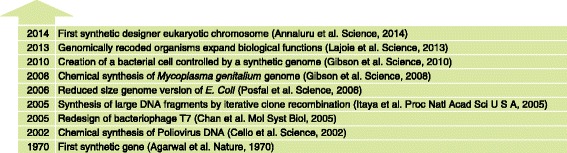
Fig. 1
Fig. 1
Timeline of publication milestones for synthetic genomics
Fig. 2
Fig. 2
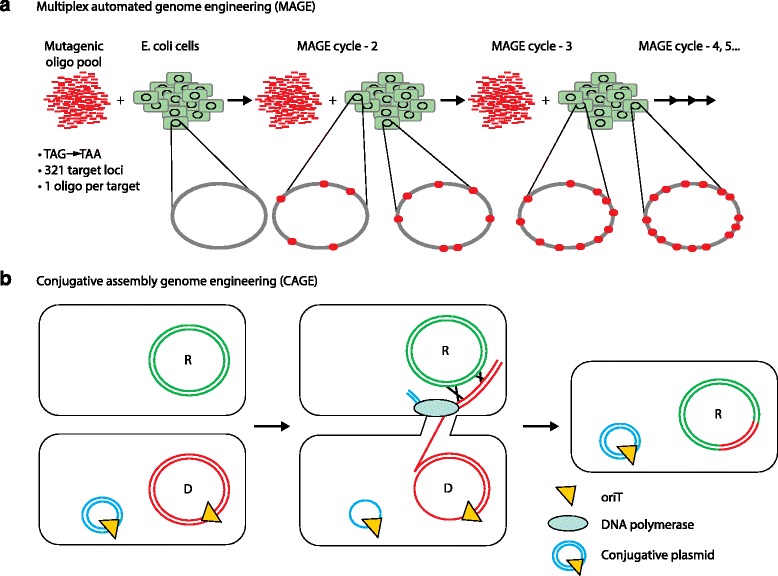
Multiplex automated genome engineering (MAGE) and conjugative assembly genome engineering (CAGE). a Use of MAGE (refer to [8] for more details) to replace all TAG codons with TAA in E. coli. b Use of CAGE (refer to [24] for more details) to incorporate a donor (D) into a recipient (R) genome. oriT in the donor genome serves as the transfer initiation point
Fig. 3
Fig. 3
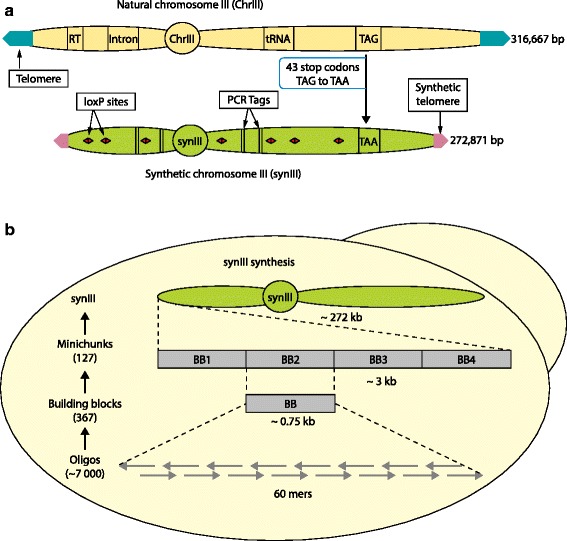
synIII design and synthesis. a synIII design. Twenty-one retrotransposons (RT) and seven introns were removed. Forty-three TAG stop codons were changed to TAA stop codons. Ninety-eight loxPsym sites were introduced to enable SCRaMbLE analysis. The two natural telomeres were replaced with shorter universal telomere caps. A single copy of essential tRNA gene SUP61, which codes for tRNASer (CGA), was deleted and moved to a tRNA neochromosome. Numerous PCR-Tags were incorporated into synIII to distinguish it from the natural counterpart. As a result, synIII is about 13.8 % smaller than the native yeast chromosome III (Box 2). For the complete set of additions, deletions and other genome modifications to synIII, see Annaluru et al. [32]. b synIII synthesis. synIII was constructed in three steps (shown in the flow diagram on the left, from bottom to top). In step 1, 750 bp building blocks (BB) were synthesized from 60-mer oligonucleotides at Johns Hopkins University by undergraduate students in the Build-A-Genome course [33]. In step 2, three to five BB were assembled into 2–4 kb minichunks by homologous recombination in Saccharomyces cerevisiae [35]. Adjacent minichunks were designed to encode overlap of one BB to facilitate downstream assembly. In step 3, direct replacement of native yeast chromosome III with pools of synthetic minichunks was performed. Eleven iterative one-step assemblies and replacements of native genomic segments of yeast chromosome III were carried out using pools of overlapping synthetic DNA minichunks, encoding alternating genetic markers (LEU2 or URA3), which enabled complete replacement of native III with synIII in yeast [32]. The number of oligonucleotides, BBs, and minichunks needed to construct synIII are shown in parentheses. SynIII is 272,871 bp long, compared with the 316,667 bp long native yeast chromosome III
Fig. 4
Fig. 4
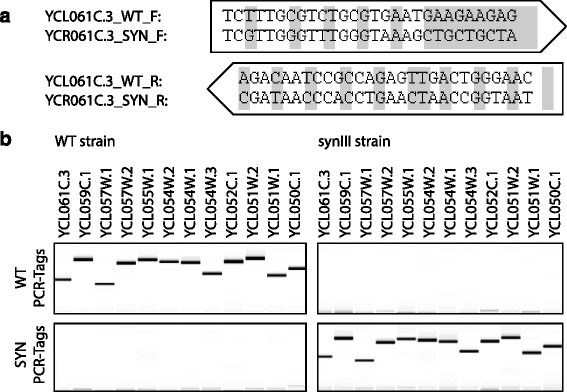
PCR-Tag analysis of a synIII segment. a The YCL061C.3 locus-specific PCR-Tag forward (F) and reverse (R) primers for the wild type (WT) and synIII are shown. The changes between the two are shaded. PCR-Tags are short pairs of recoded segments used as genetic markers to verify introduction of a synthetic sequence and removal of native sequence. Pairs of 25–28 bp sequences about 500 bp apart were recoded with synonymous codons such that >33 % of the bases were changed; the first and last base PCR-Tag primers were coded to be different between the WT and synIII sequences. b Agarose gel profiles of PCR-Tag analysis of a WT DNA segment and the corresponding synthetic synIII segment (YCL061C.3 to YCL050C.1). A virtual gel image was generated using LabChip GX software version 4.0.1418.0
Fig. 5
Fig. 5
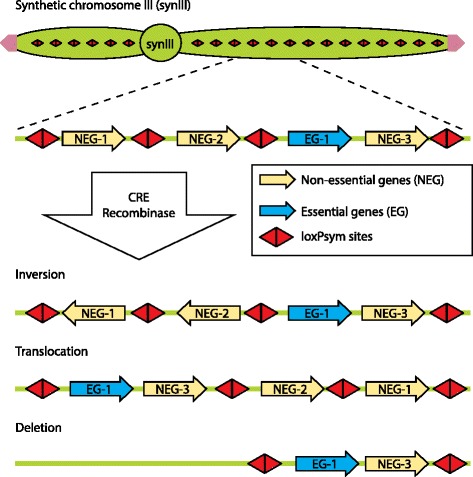
Synthetic chromosome rearrangement and modification by loxP-mediated evolution (SCRaMbLE) of the synIII strain. Examples of inversion, translocation and deletion products resulting from Cre recombinase treatment of synIII strain are shown

References

    1. Agarwal KL, Buchi H, Caruthers MH, Gupta N, Khorana HG, Kleppe K, et al. Total synthesis of the gene for an alanine transfer ribonucleic acid from yeast. Nature. 1970;227:27–34. doi: 10.1038/227027a0. - DOI - PubMed
    1. Menzella HG, Reid R, Carney JR, Chandran SS, Reisinger SJ, Patel KG, et al. Combinatorial polyketide biosynthesis by de novo design and rearrangement of modular polyketide synthase genes. Nat Biotechnol. 2005;23:1171–1176. doi: 10.1038/nbt1128. - DOI - PubMed
    1. Ro DK, Paradise EM, Ouellet M, Fisher KJ, Newman KL, Ndungu JM, et al. Production of the antimalarial drug precursor artemisinic acid in engineered yeast. Nature. 2006;440:940–943. doi: 10.1038/nature04640. - DOI - PubMed
    1. Posfai G, Plunkett G, 3rd, Feher T, Frisch D, Keil GM, Umenhoffer K, et al. Emergent properties of reduced-genome Escherichia coli. Science. 2006;312:1044–1046. doi: 10.1126/science.1126439. - DOI - PubMed
    1. Gibson DG, Benders GA, Andrews-Pfannkoch C, Denisova EA, Baden-Tillson H, Zaveri J, et al. Complete chemical synthesis, assembly, and cloning of a Mycoplasma genitalium genome. Science. 2008;319:1215–1220. doi: 10.1126/science.1151721. - DOI - PubMed

Publication types

MeSH terms

LinkOut - more resources