


Fire in the vein: Heroin acidity and its proximal effect on users' health
- PMID: 26077143
- PMCID: PMC5152678
- DOI: 10.1016/j.drugpo.2015.04.009
Fire in the vein: Heroin acidity and its proximal effect on users' health
Abstract
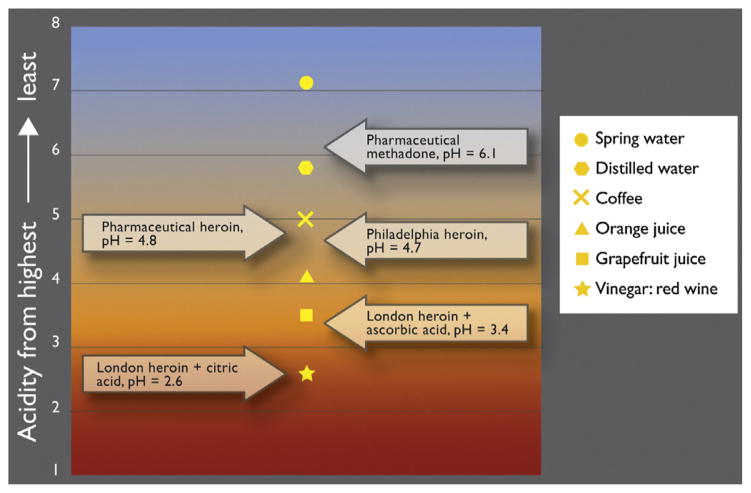
The loss of functioning veins (venous sclerosis) is a root cause of suffering for long-term heroin injectors. In addition to perpetual frustration and loss of pleasure/esteem, venous sclerosis leads to myriad medical consequences including skin infections, for example, abscess, and possibly elevated HIV/HCV risks due to injection into larger jugular and femoral veins. The etiology of venous sclerosis is unknown and users' perceptions of cause/meaning unexplored. This commentary stems from our hypothesis that venous sclerosis is causally related to heroin acidity, which varies by heroin source-form and preparation. We report pilot study data on first ever in vivo measurements of heroin pH and as well as qualitative data on users' concerns and perceptions regarding the caustic nature of heroin and its effects. Heroin pH testing in natural settings is feasible and a useful tool for further research. Our preliminary findings, for example, that different heroin source-forms and preparations have a two log difference in acidity, have potentially broad, vital and readily implementable harm reduction implications.
Keywords: Heroin; Injection drug use; Risk environment; Skin and soft tissue infection; Vein care; Vein damage; Vein loss; Venous sclerosis.
Copyright © 2015. Published by Elsevier B.V.
Figures
Comment in
-
On the science of heroin injection preparation: A response to Ciccarone and Harris.Int J Drug Policy. 2015 Nov;26(11):1111-2. doi: 10.1016/j.drugpo.2015.08.009. Epub 2015 Aug 19. Int J Drug Policy. 2015. PMID: 26337723 No abstract available.
-
Comment on: "Fire in the vein: Heroin acidity and its proximal effect on users' health" by Ciccarone and Harris.Int J Drug Policy. 2016 Jan;27:182-3. doi: 10.1016/j.drugpo.2015.09.008. Epub 2015 Oct 19. Int J Drug Policy. 2016. PMID: 26746356 No abstract available.
References
-
- Bangsberg DR, Rosen JI, Aragon T, Campbell A, Weir L, Perdreau-Remington F. Clostridial myonecrosis cluster among injection drug users: A molecular epidemiology investigation. Archives of Internal Medicine. 2002;162(5):517–522. - PubMed
-
- Bassetti S, Wolfisberg L, Jaussi B, Frei R, Kuntze MF, Battegay M, et al. Carriage of Staphylococcus aureus among injection drug users: Lower prevalence in an injection heroin maintenance program than in an oral methadone program. Infection Control and Hospital Epidemiology: The Official Journal of the Society of Hospital Epidemiologists of America. 2004;25(2):133–137. http://dx.doi.org/10.1086/502364. - DOI - PubMed
-
- Binswanger IA, Kral AH, Bluthenthal RN, Rybold DJ, Edlin BR. High prevalence of abscesses and cellulitis among community-recruited injection drug users in San Francisco. Clinical Infectious Diseases: An Official Publication of the Infectious Diseases Society of America. 2000;30(3):579–581. http://dx.doi.org/10.1086/313703. - DOI - PubMed
-
- Bisbe J, Miro JM, Latorre X, Moreno A, Mallolas J, Gatell JM, et al. Disseminated candidiasis in addicts who use brown heroin: Report of 83 cases and review. Clinical Infectious Diseases: An Official Publication of the Infectious Diseases Society of America. 1992;15(6):910–923. - PubMed
-
- Bobashev GV, Zule WA. Modeling the effect of high dead-space syringes on the human immunodeficiency virus (HIV) epidemic among injecting drug users. Addiction. 2010;105(8):1439–1447. http://dx.doi.org/10.1111/j.1360-0443.2010.02976.x. - DOI - PubMed
MeSH terms
Substances
Grants and funding
LinkOut - more resources
Full Text Sources
Other Literature Sources
Medical
