. 2015 Jun 16:6:7375.
doi: 10.1038/ncomms8375.

Neutralization and clearance of GM-CSF by autoantibodies in pulmonary alveolar proteinosis

Affiliations

Neutralization and clearance of GM-CSF by autoantibodies in pulmonary alveolar proteinosis

Luca Piccoli et al. Nat Commun. .

Abstract

Pulmonary alveolar proteinosis (PAP) is a severe autoimmune disease caused by autoantibodies that neutralize GM-CSF resulting in impaired function of alveolar macrophages. In this study, we characterize 21 GM-CSF autoantibodies from PAP patients and find that somatic mutations critically determine their specificity for the self-antigen. Individual antibodies only partially neutralize GM-CSF activity using an in vitro bioassay, depending on the experimental conditions, while, when injected in mice together with human GM-CSF, they lead to the accumulation of a large pool of circulating GM-CSF that remains partially bioavailable. In contrast, a combination of three non-cross-competing antibodies completely neutralizes GM-CSF activity in vitro by sequestering the cytokine in high-molecular-weight complexes, and in vivo promotes the rapid degradation of GM-CSF-containing immune complexes in an Fc-dependent manner. Taken together, these findings provide a plausible explanation for the severe phenotype of PAP patients and for the safety of treatments based on single anti-GM-CSF monoclonal antibodies.


Conflict of interest statement

A.L. is the scientific founder of Humabs BioMed, a company that develops human antibodies for treatment of infectious diseases. D.C. is CSO of Humabs BioMed. A.L. and F.S. hold shares in Humabs BioMed. The remaining authors declare no competing financial interests.

Figures
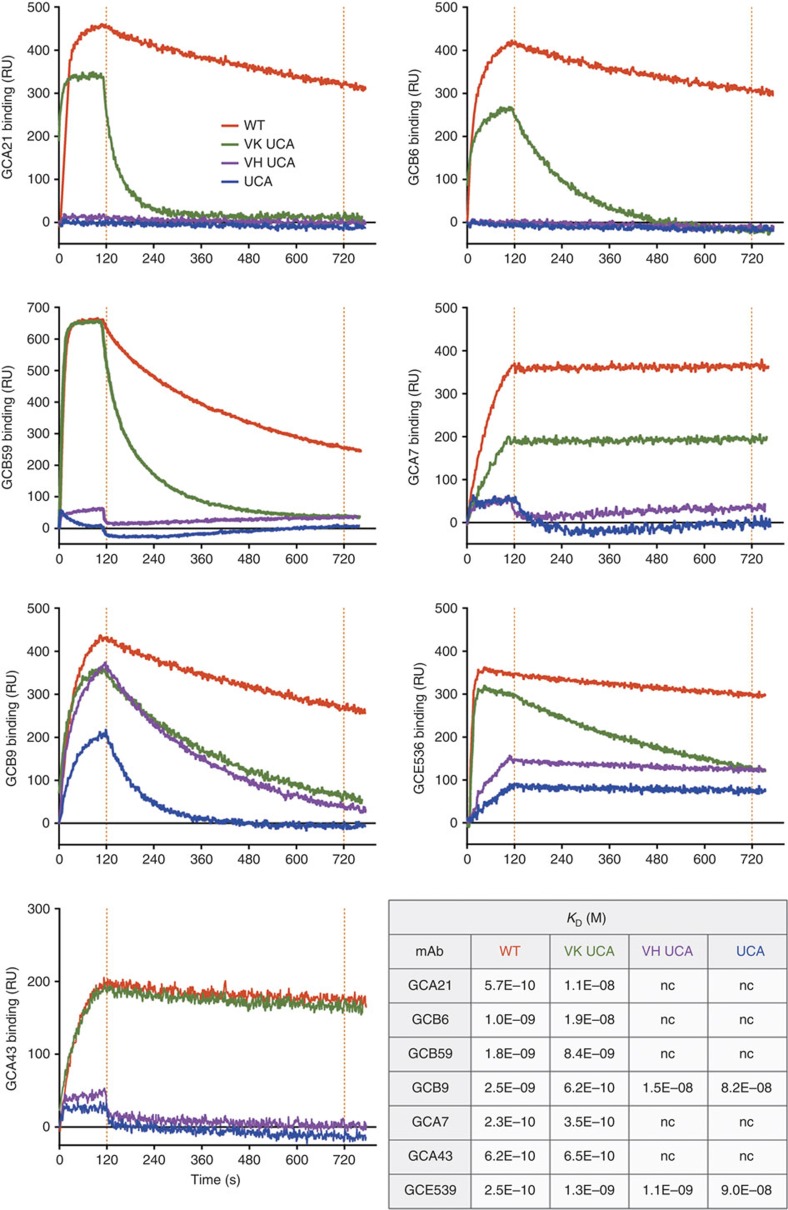
Figure 1
Figure 1. Somatic mutations critically contribute to the specificity of GM-CSF autoantibodies.
Binding of WT (red), UCA (blue) and shuffled variants VK UCA (green) and VH UCA (violet) to GM-CSF as measured with SPR. The table shows equilibrium dissociation constants (KD).
Figure 2
Figure 2. GM-CSF autoantibodies form high-molecular-weight complexes.
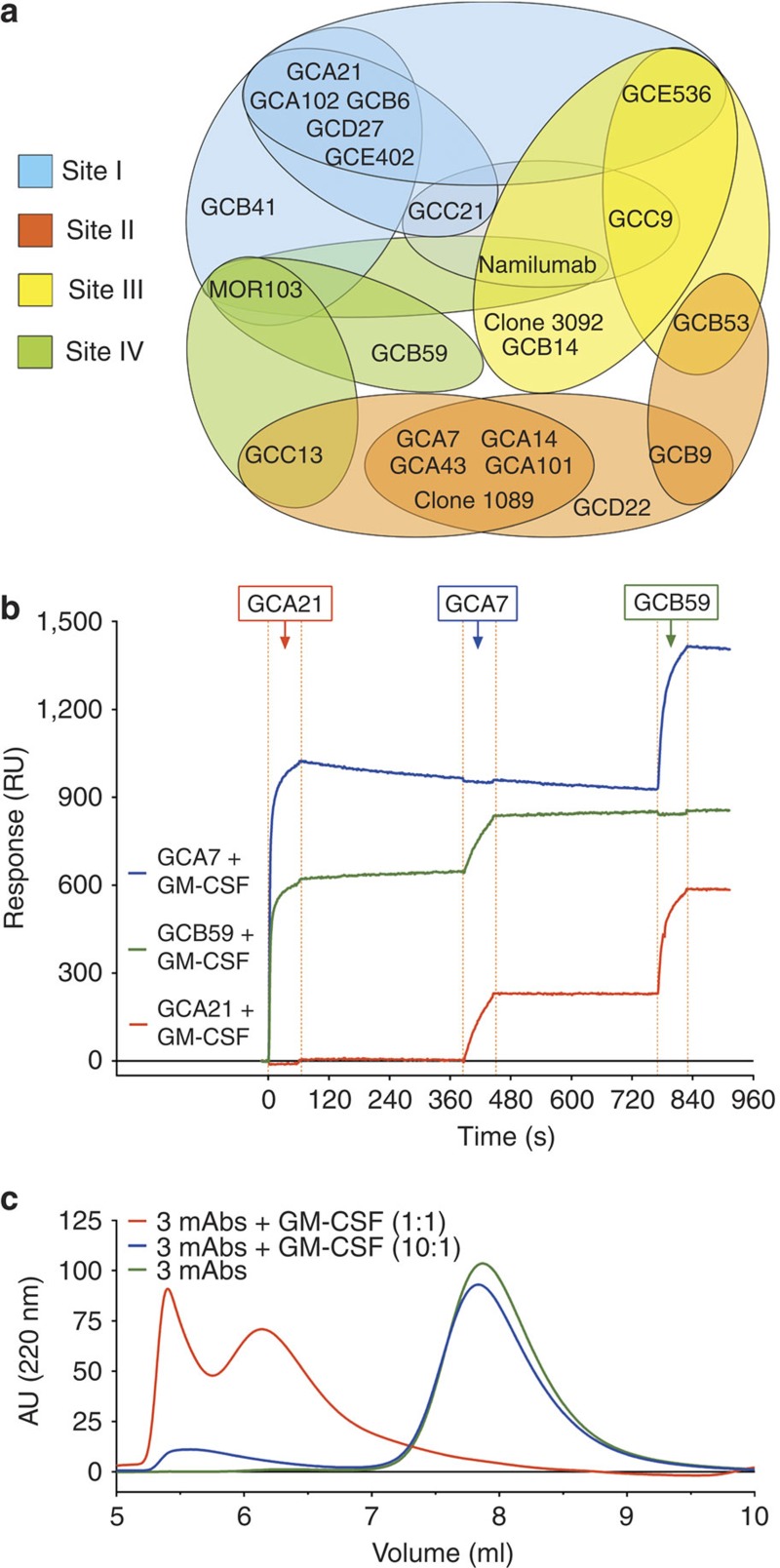
(a) Map of the antigenic sites targeted by GM-CSF-specific autoantibodies as defined using SPR cross-competition. Four reference antibodies are in bold. (b) A multichannel chip coated with antibodies to site I (GCA21, red line), site II (GCA7, blue line) or site IV (GCB59, green line) was saturated with GM-CSF and serially exposed to an excess of the same antibodies. (c) The SEC-HPLC profile of samples containing the three non-cross-competing antibodies, alone or with GM-CSF added in equimolar concentrations (1:1) or in 10-fold antibody excess (10:1).
Figure 3
Figure 3. Potent in vitro neutralization of GM-CSF by a combination of three antibodies.
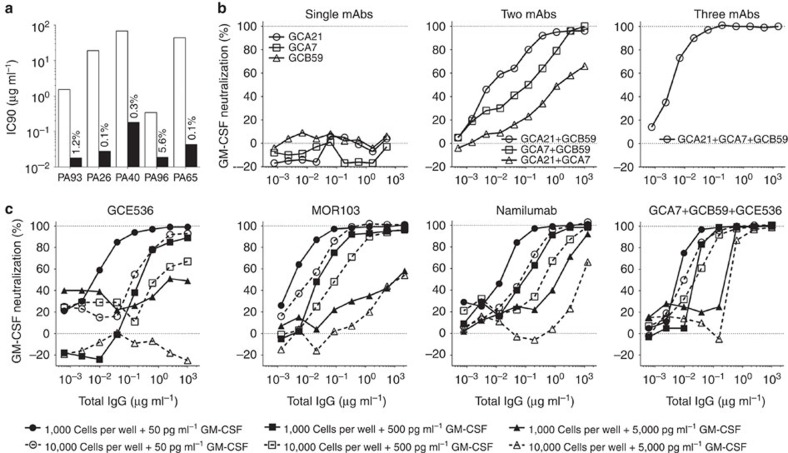
A fixed amount of GM-CSF (final concentration 50 pg ml−1) was incubated with serial dilutions of one or more antibodies, added to TF-1 cells (10,000 per well), and cell proliferation was measured on day 3 by thymidine incorporation. (a) IC90 values of polyclonal IgG and affinity-purified polyclonal antibodies isolated from the serum of five PAP patients. The numbers indicate the percentage of anti-GM-CSF antibodies relative to total IgG. (b) Serial dilutions of single monoclonal antibodies or mixtures of two and three non-cross-competing antibodies were tested for their capacity to neutralize GM-CSF. (c) The sensitivity of the test was changed by varying the number of cells and the concentration of GM-CSF as indicated. Shown is for each experimental condition the inhibition obtained using single antibodies or a combination of three non-cross-competing antibodies.
Figure 4
Figure 4. Fc-dependent clearance of GM-CSF immune complexes in vivo.
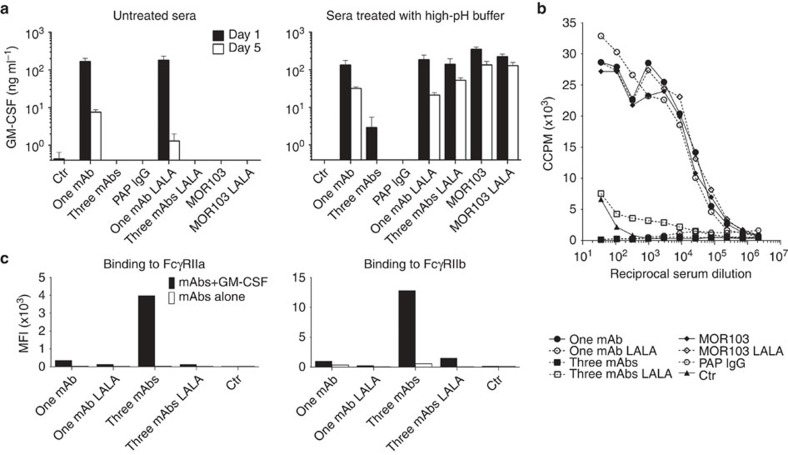
(a) Female Balb/c mice (five per group) were injected with 100 μg of mAb, either GCA21 (one mAb) or GCA21+GCA7+GCB59 (three mAbs) in the IgG or IgG-LALA format, or with 2 mg total IgG from a PAP patient, followed by 2 μg GM-CSF after 16 h. Sera were collected after 1 or 5 days, and GM-CSF concentrations were measured using ELISA in untreated serum and in serum treated at pH 11.6 to dissociate immune complexes. Shown is the GM-CSF concentration on day 1 and on day 5 in untreated serum (left) or alkaline-treated serum (right);error bars indicate s.d. (b) Proliferation of TF-1 cells in response to different dilutions of serum of mice injected 24 h before with GM-CSF and the indicated antibodies. (c) Binding of GM-CSF immune complexes formed by one or three antibodies (in the IgG1 or IgG1-LALA format) to TZM-bl cells expressing FcγRIIa or FcγRIIb, as measured with flow cytometry using an anti-IgG Fc-specific antibody.
Figure 5
Figure 5. Detection of low levels of GM-CSF autoantibodies in healthy donors using a complementation assay.
(a,b) IgG purified from the serum of two healthy donors (D10 and D6) were tested in the presence or absence of single monoclonal antibodies for their capacity to neutralize GM-CSF using the TF-1 bioassay (50 pg ml−1 GM-CSF and 10,000 cells per well).

References

    1. Watanabe M., Uchida K., Nakagaki K., Trapnell B. C. & Nakata K. High avidity cytokine autoantibodies in health and disease: pathogenesis and mechanisms. Cytokine Growth Factor Rev. 21, 263–273 (2010). - PubMed
    1. Puel A. et al. Autoantibodies against IL-17A, IL-17F, and IL-22 in patients with chronic mucocutaneous candidiasis and autoimmune polyendocrine syndrome type I. J. Exp. Med. 207, 291–297 (2010). - PMC - PubMed
    1. Madariaga L. et al. Detection of anti-interferon-gamma autoantibodies in subjects infected by Mycobacterium tuberculosis. Int. J. Tuberc. Lung Dis. 2, 62–68 (1998). - PubMed
    1. Patel S. Y. et al. Anti-IFN-gamma autoantibodies in disseminated nontuberculous mycobacterial infections. J. Immunol. 175, 4769–4776 (2005). - PubMed
    1. Trapnell B. C., Carey B. C., Uchida K. & Suzuki T. Pulmonary alveolar proteinosis, a primary immunodeficiency of impaired GM-CSF stimulation of macrophages. Curr. Opin. Immunol. 21, 514–521 (2009). - PMC - PubMed

Publication types

MeSH terms

Supplementary concepts