


Opioid Overdose Deaths in the City and County of San Francisco: Prevalence, Distribution, and Disparities
- PMID: 26077643
- PMCID: PMC4524842
- DOI: 10.1007/s11524-015-9967-y
Opioid Overdose Deaths in the City and County of San Francisco: Prevalence, Distribution, and Disparities
Abstract
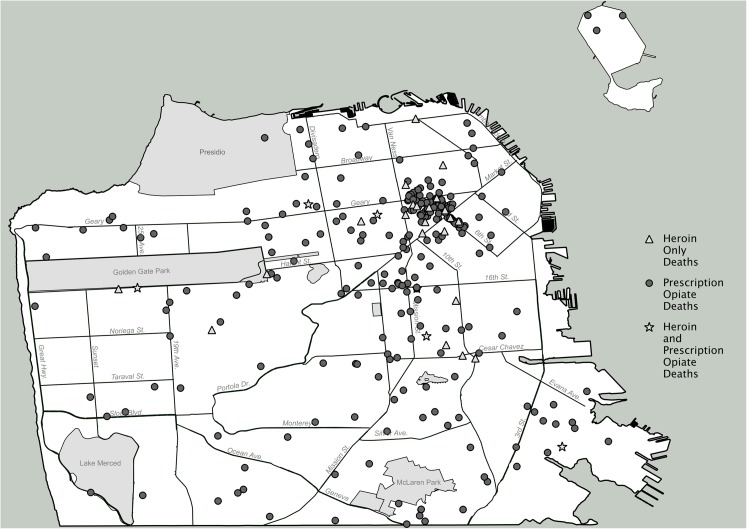
Drug overdose is now the leading cause of unintentional death nationwide, driven by increased prescription opioid overdoses. To better understand urban opioid overdose deaths, this paper examines geographic, demographic, and clinical differences between heroin-related decedents and prescription opioid decedents in San Francisco from 2010 to 2012. During this time period, 331 individuals died from accidental overdose caused by opioids (310 involving prescription opioids and 31 involving heroin). Deaths most commonly involved methadone (45.9%), morphine (26.9%), and oxycodone (21.8%). Most deaths also involved other substances (74.9%), most commonly cocaine (35.3%), benzodiazepines (27.5%), antidepressants (22.7%), and alcohol (19.6%). Deaths were concentrated in a small, high-poverty, central area of San Francisco and disproportionately affected African-American individuals. Decedents in high-poverty areas were significantly more likely to die from methadone and cocaine, whereas individuals from more affluent areas were more likely die from oxycodone and benzodiazepines. Heroin decedents were more likely to be within a younger age demographic, die in public spaces, and have illicit substances rather than other prescription opioids. Overall, heroin overdose death, previously common in San Francisco, is now rare. Prescription opioid overdose has emerged as a significant concern, particularly among individuals in high-poverty areas. Deaths in poor and affluent regions involve different causative opioids and co-occurring substances.
Figures

References
-
- Centers for Disease Control and Prevention. National Vital Statistics System. Multiple Cause of Death File. Hyattsville, MD: US Department of Health and Human Services, Centers for Disease Control and Prevention; 2012.
-
- Paulozzi LJ, J. C, Mack K, Rudd R, Centers for Disease Control and Pre- vention (CDC). Vital signs: overdoses of prescription opioid pain relievers---United States, 1999--2008. MMWR Morb Mortal Wkly Rep. 2011; 60(43), 1487–1492. - PubMed
Publication types
MeSH terms
Substances
Grants and funding
LinkOut - more resources
Full Text Sources
Other Literature Sources
Medical
