. 2015 Jun 15;22(7):323-35.
doi: 10.1101/lm.037820.114. Print 2015 Jul.

The sodium-activated potassium channel Slack is required for optimal cognitive flexibility in mice

Affiliations

The sodium-activated potassium channel Slack is required for optimal cognitive flexibility in mice

Anne E Bausch et al. Learn Mem. .

Abstract

Kcnt1 encoded sodium-activated potassium channels (Slack channels) are highly expressed throughout the brain where they modulate the firing patterns and general excitability of many types of neurons. Increasing evidence suggests that Slack channels may be important for higher brain functions such as cognition and normal intellectual development. In particular, recent findings have shown that human Slack mutations produce very severe intellectual disability and that Slack channels interact directly with the Fragile X mental retardation protein (FMRP), a protein that when missing or mutated results in Fragile X syndrome (FXS), the most common form of inherited intellectual disability and autism in humans. We have now analyzed a recently developed Kcnt1 null mouse model in several behavioral tasks to assess which aspects of memory and learning are dependent on Slack. We demonstrate that Slack deficiency results in mildly altered general locomotor activity, but normal working memory, reference memory, as well as cerebellar control of motor functions. In contrast, we find that Slack channels are required for cognitive flexibility, including reversal learning processes and the ability to adapt quickly to unfamiliar situations and environments. Our data reveal that hippocampal-dependent spatial learning capabilities require the proper function of Slack channels.


Figures

Figure 1.
Figure 1.
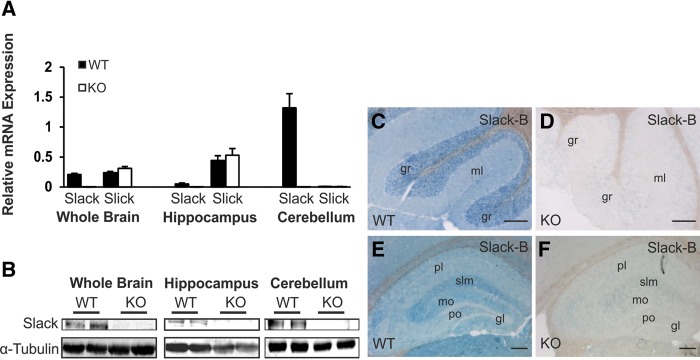
Slack expression in cerebellum and hippocampus. (A) Quantitative RT-PCR showed high Slack mRNA levels in the cerebellum (n = 6) and lower levels in the hippocampus (n = 3) of WT mice, whereas Slack transcripts were not detectable in the respective brain regions derived from Slack null mutants (n = 2–3) and Slack deficiency did not alter Slick mRNA abundance (n = 2–6). HPRT mRNA levels were used as a reference to normalize the data. All data are means + SEM. (B) Western blot analyses of membrane enriched protein lysates confirmed absence of the Slack channel proteins in different Slack KO brain regions. (C) Immunohistochemical stainings (blue) confirmed high Slack-B expression in the cerebellar granular (gr) and molecular layer (ml) of WT animals, whereas (D) Slack-B is not detectable in cerebellar sections of Slack KOs. (E) In the hippocampus of WT mice high Slack-B immunoreactivity was found in the stratum-lacunosum moleculare (slm) of the CA subfields and the molecular layer (mo) as well as the polymorph layer (po) of the dentate gyrus. (F) No specific Slack-B staining was found in the hippocampal formation of Slack KO mice ((gl) granular layer of the dentate gyrus, (pl) pyramidal layer of CA1). Scale bars, 200 µm.
Figure 2.
Figure 2.
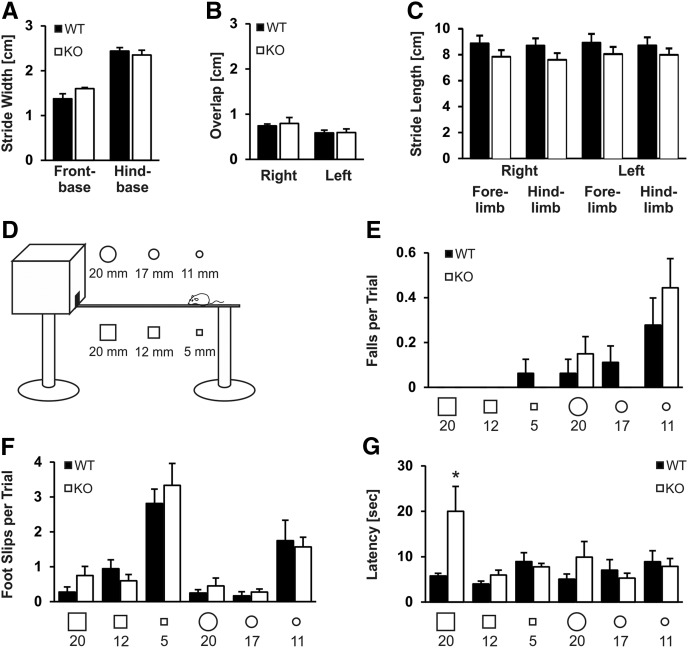
Motor coordination is normal in Slack KOs but Slack-deficient mice show an altered motivation phenotype in an elevated-beam walk test. Foot print analyses revealed no differences in (A) stride width, (B) overlap of the front paw and the ipsilateral hind paw, and (C) stride length between WT (n = 5) and Slack-deficient mice (n = 5). (D) Schematic view of the beam walk apparatus. (E) Number of falls and (F) foot slips with the hind limbs did not differ between WT (n = 10) and Slack KOs (n = 9). (G) Mean latency to cross the squared beam with 20 mm diameter was significantly increased in Slack KOs, but this difference in performance disappeared as the task was getting more difficult, i.e., when the mice crossed a beam with smaller or round diameter. All data are presented as mean + SEM. (*) P < 0.05 indicating significant difference between genotypes.
Figure 3.
Figure 3.
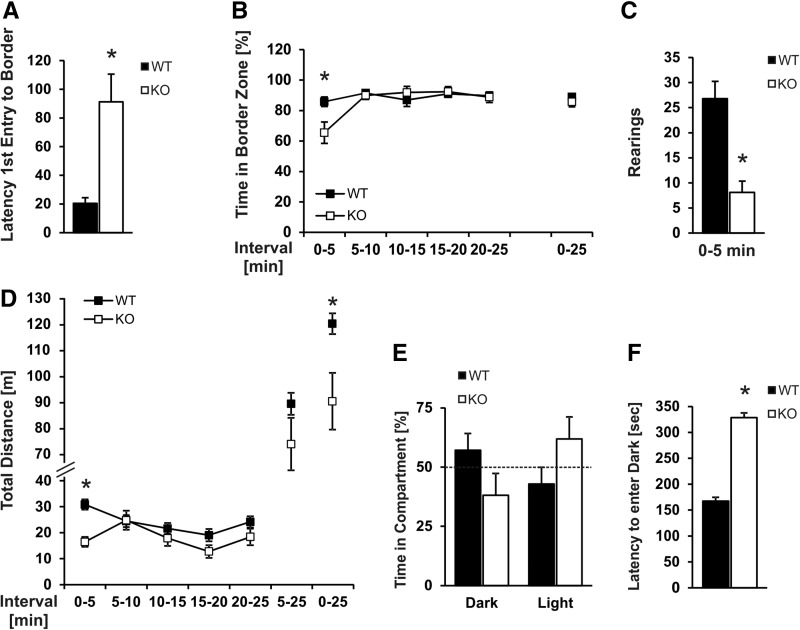
Slack ablation leads to an altered explorative behavior, decreased locomotor activity, an atypic initial response in an open field test and affects dark–light transition. (A) Latency to enter the virtual border zone during the open field test was significantly increased for Slack KOs, hence (B) initially Slack KOs spent less time in the border zone. (C) Number of rearing events during the first 5 min of the open field test was decreased in Slack KO mice. (D) Slack KOs moved less during the 25 min open field test. The behavior of the animals was tracked for 25 min and data were integrated in 5 min periods as well as for the whole 25 min of the test. (E) Time spent in the dark and light compartments during the dark–light-box test. (F) Latency to enter the dark compartment is significantly increased in Slack-deficient mice. All data are shown as mean ± SEM. (*) P < 0.05, indicating significant difference between WT and Slack KO mice (open field test: n = 10; dark–light-box test: n = 12–13).
Figure 4.
Figure 4.
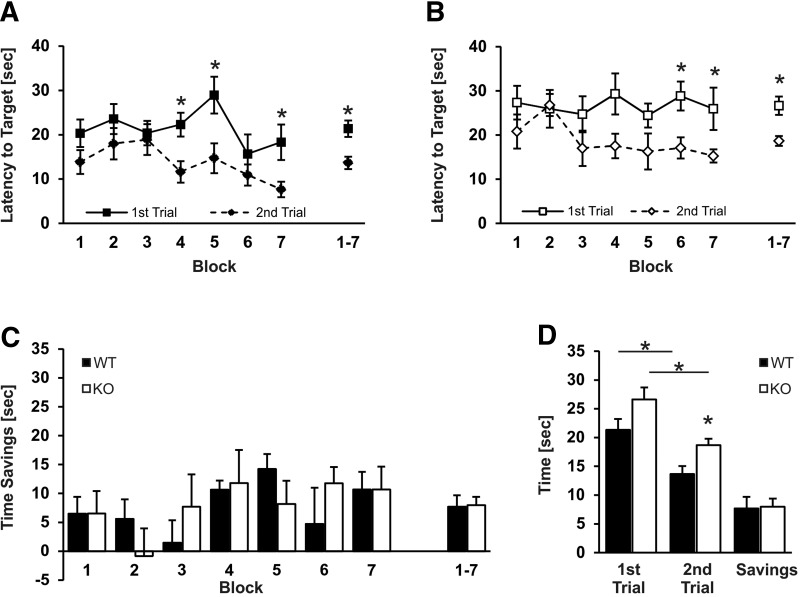
Slack deficiency does not affect working memory capabilities in a matching-to-sample version of the Morris water maze. Nine WT mice (A) and eight Slack KOs (B) were subjected to a matching-to-sample version of the Morris Water maze. Both genotypes reached the hidden platform earlier during the second trial (matching trial) as compared with the first trial (sample trial). Each data point represents average latencies of a 3 d block with one sample and one matching trial per day and a daily changing platform position. (*) P < 0.05, comparison first trial with second trial. (C) Time savings of WT and Slack KO mice were identical across the whole test duration. (D) Mean latencies to reach the platform during the first and second trial and time savings averaged over the whole test duration (21 d). Mean latencies to target during the first trial and the second trial were increased for Slack KOs while time savings are not different compared with WT mice. (*) P < 0.05, comparison as indicated. All data are shown as mean ± SEM. For illustrative purposes, the data were grouped in 3-d blocks.
Figure 5.
Figure 5.
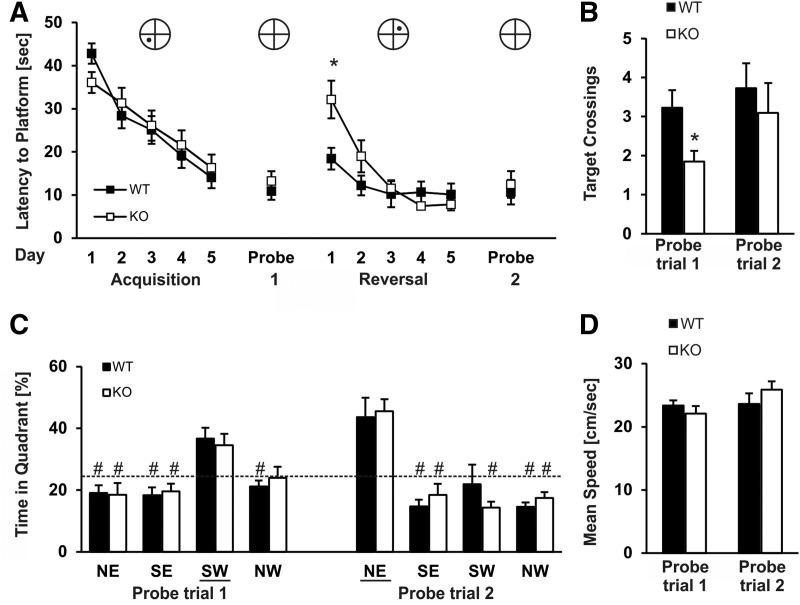
Slack-deficient mice show normal reference memory but delayed reversal learning in the Morris water maze. (A) Mean latencies to reach the hidden platform or original platform position during the training phases and probe trials, respectively. During the first reversal training day Slack KOs reached the platform with an increased latency as compared with WT mice. Each individual data point represents the averaged latency of four daily trials. (*) P < 0.05, indicating significant difference between WT and Slack KO mice. (B) Mean number of crossings over the previous platform position during the acquisition probe trial (1) and the reversal probe trial (2), conducted on Day 6 and 12, respectively. Slack KOs crossed the original platform position less frequently during probe trial 1. This difference was not apparent during probe trial 2. (*) P < 0.05, indicating significant difference between WT and Slack KOs. (C) Both, WT and Slack-deficient mice showed a clear platform quadrant preference during both probe trials. Note, during the acquisition training phase the platform was located in the SW quadrant of the maze and during the reversal training phase in the opposite quadrant (NE). (#) P < 0.05, comparison target quadrant with nontarget quadrant. (D) Both genotypes moved with a similar velocity during the probe trials. n = 20–22 WT and Slack KO were subjected to the acquisition phase of the test, n = 11 animals per genotype conducted the additional reversal learning phase. All data are presented as mean ± SEM.
Figure 6.
Figure 6.
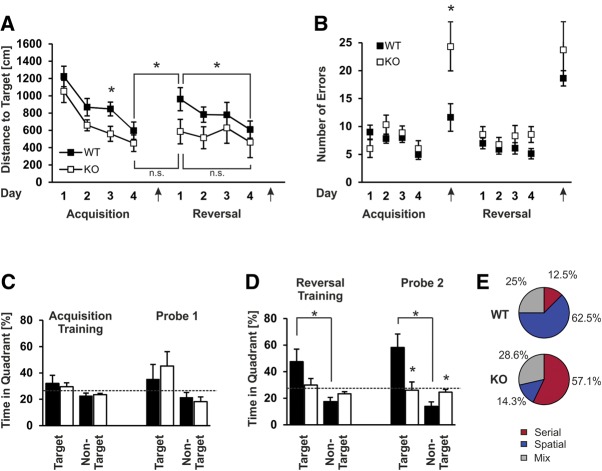
Slack KO and WT mice use different search/escape strategies during the reversal phase in a modified Barnes maze task. (A) Mean distances traveled by WT and Slack KO mice until entering the target hole during the acquisition and reversal training phases of the test. On repositioning of the target hole location at Day 6 only the WT group performed worse as expected. Moreover, WT mice but not Slack KOs improved across the 4 d of reversal training. Arrows indicate the time points of the 1st and 2nd probe trials. (B) Mean numbers of total errors during the different phases of the test. Arrows indicate time points of the 1st and 2nd probe trials. (C) Percentage of time spent in the target quadrant versus the averaged nontarget quadrants during the acquisition training phase (average of all four training days) and during probe trial 1. (D) Percentage of time spent in the target quadrant versus the averaged nontarget quadrants during the reversal training phase (average of all four training days) and during probe trial 2. (E) During probe trial 2 (conducted at Day 10), the search strategy of each individual mouse was categorized either as serial (red), spatial (blue), or mixed (gray). Data represent the percentage of animals that used the different search strategies. (*) P < 0.05 and n.s. (P ≥ 0.05) indicate significant or nonsignificant differences between WT (n = 8) and Slack KO (n = 7) mice, respectively, or as indicated. All data are presented as mean ± SEM.

References

    1. Adhikari A. 2014. Distributed circuits underlying anxiety. Front Behav Neurosci 8: 112. - PMC - PubMed
    1. Aminkeng F. 2012. KCNT1 mutations in ADNFLE and MMPSI: a new driver in the etiology and pathophysiology of early-onset epileptic syndromes. Clin Genet 83: 319–320. - PubMed
    1. Baker KB, Wray SP, Ritter R, Mason S, Lanthorn TH, Savelieva KV. 2010. Male and female Fmr1 knockout mice on C57 albino background exhibit spatial learning and memory impairments. Genes Brain Behav 9: 562–574. - PubMed
    1. Bakker CE, Oostra BA. 2003. Understanding fragile X syndrome: insights from animal models. Cytogenet Genome Res 100: 111–123. - PubMed
    1. Banke TG, Bowie D, Lee H, Huganir RL, Schousboe A, Traynelis SF. 2000. Control of GluR1 AMPA receptor function by cAMP-dependent protein kinase. J Neurosci 20: 89–102. - PMC - PubMed

MeSH terms