Reactive oxygen species a double-edged sword for mesothelioma
- PMID: 26078352
- PMCID: PMC4627278
- DOI: 10.18632/oncotarget.4253
Reactive oxygen species a double-edged sword for mesothelioma
Abstract
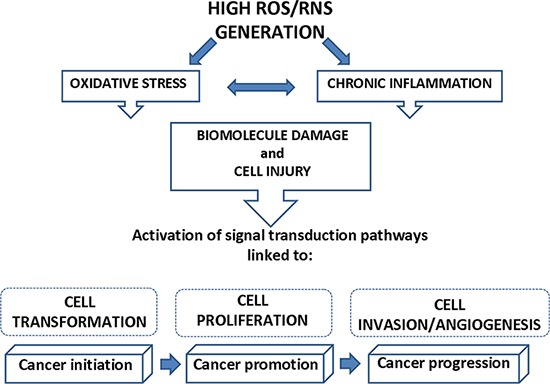
It is well known that oxidative stress can lead to chronic inflammation which, in turn, could mediate most chronic diseases including cancer. Oxidants have been implicated in the activity of crocidolite and amosite, the most powerful types of asbestos associated to the occurrence of mesothelioma. Currently rates of mesothelioma are rising and estimates indicate that the incidence of mesothelioma will peak within the next 10-15 years in the western world, while in Japan the peak is predicted not to occur until 40 years from now. Although the use of asbestos has been banned in many countries around the world, production of and the potentially hazardous exposure to asbestos is still present with locally high incidences of mesothelioma. Today a new man-made material, carbon nanotubes, has arisen as a concern; carbon nanotubes may display 'asbestos-like' pathogenicity with mesothelioma induction potential. Carbon nanotubes resulted in the greatest reactive oxygen species generation. How oxidative stress activates inflammatory pathways leading to the transformation of a normal cell to a tumor cell, to tumor cell survival, proliferation, invasion, angiogenesis, chemoresistance, and radioresistance, is the aim of this review.
Keywords: cell proliferation; cell trasformation; mesothelioma; reactive oxygen species; therapy.
Conflict of interest statement
The authors declare no conflict of interest.
Figures
References
-
- Durackova Z. Some current insights into oxidative stress. Physiol Res. 2010;59:459–69. - PubMed
-
- Richter C, Gogvadze V, Laffranchi R, Schlapbach R, Schweizer M, Suter M, Walter P, Yaffee M. Oxidants in mitochondria: from physiology to diseases. Biochim Biophys Acta. 1995;1271:67–74. - PubMed
-
- Goossens V, De Vos K, Vercammen D, Steemans M, Vancompernolle K, Fiers W, Vandenabeele P, Grooten J. Redox regulation of TNF signalling. Biofactors. 1999;10:145–56. - PubMed
-
- Poyton RO, Ball KA, Castello PR. Mitochondrial generation of free radicals and hypoxic signalling. Trends Endocrinol Metab. 2009;20:332–40. - PubMed
Publication types
MeSH terms
Substances
LinkOut - more resources
Full Text Sources
Other Literature Sources
Medical