Review
. 2015:2015:940131.
doi: 10.1155/2015/940131. Epub 2015 May 11.

Oxidative Stress and Protein Quality Control Systems in the Aged Canine Brain as a Model for Human Neurodegenerative Disorders

Affiliations
Review

Oxidative Stress and Protein Quality Control Systems in the Aged Canine Brain as a Model for Human Neurodegenerative Disorders

Mariarita Romanucci et al. Oxid Med Cell Longev. 2015.

Abstract

Aged dogs are considered the most suitable spontaneous animal model for studying normal aging and neurodegenerative diseases. Elderly canines naturally develop cognitive dysfunction and neuropathological hallmarks similar to those seen in humans, especially Alzheimer's disease-like pathology. Pet dogs also share similar living conditions and diets to humans. Oxidative damage accumulates in the canine brain during aging, making dogs a valid model for translational antioxidant treatment/prevention studies. Evidence suggests the presence of detective protein quality control systems, involving ubiquitin-proteasome system (UPS) and Heat Shock Proteins (HSPs), in the aged canine brain. Further studies on the canine model are needed to clarify the role of age-related changes in UPS activity and HSP expression in neurodegeneration in order to design novel treatment strategies, such as HSP-based therapies, aimed at improving chaperone defences against proteotoxic stress affecting brain during aging.


Figures
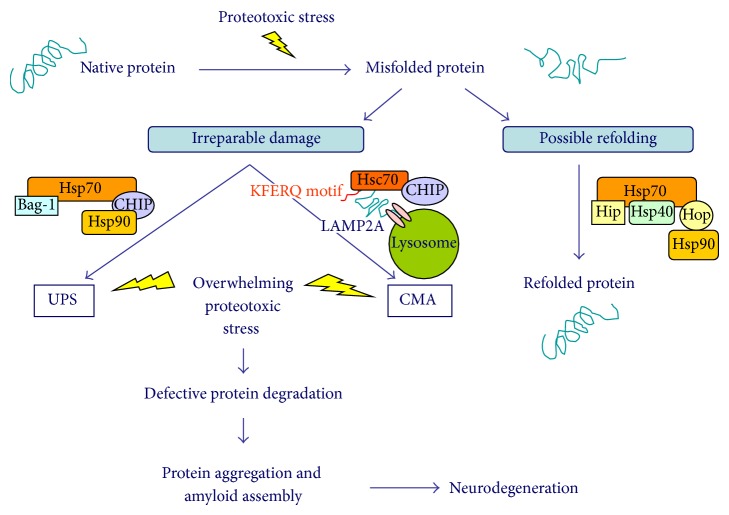
Figure 1
Figure 1
Intracellular protein quality control systems fighting against proteotoxic stress to avoid disruption of cellular functions by unfolded proteins. Under normal conditions, misfolded proteins can induce Hsp70 gene expression in order to be either refolded to native conformation or targeted for degradation if they are damaged beyond repair. The main cytosolic protein degradation pathway is represented by the ubiquitin-proteasome system (UPS). During protein degradation, both Hsp70 and Hsp90 bind to the cochaperone CHIP (carboxyl terminus of Hsp70-interacting protein), which serves as an E3 ubiquitin ligase by attaching a polyubiquitin chain to the irreparably damaged protein so that it can be targeted for proteasomal degradation. The proteasomal degradation process also requires the binding of BAG-1 (Bcl-2-associated athanogene) to the ATPase, N-terminal domain of Hsp70. Alternatively, CHIP may target misfolded proteins with a KFERQ motif for chaperone-mediated autophagy (CMA) by binding the heat shock cognate 70 (Hsc70 or Hsp73), which then guides the damaged proteins into the lysosome through the lysosomal-associated membrane transporter (LAMP2A). On the other hand, if proteins can be refolded into their native shape, BAG-1 binding to Hsp70 is blocked by the cochaperone Hip (Hsp70-interacting protein), whereas CHIP binding is blocked by the cochaperone Hop (Hsp70/90-organizing protein). Hsp40 and Hsp90 also bind to this protein refolding complex, promoting an ATP-dependent folding activity. Under conditions of overwhelming proteotoxic stress and defective protein degradation machineries, misfolded, damaged proteins may dramatically accumulate, aggregate, and kill cells.

References

    1. Head E. A canine model of human aging and Alzheimer's disease. Biochimica et Biophysica Acta. 2013;1832(9):1384–1389. doi: 10.1016/j.bbadis.2013.03.016. - DOI - PMC - PubMed
    1. Davis P. R., Head E. Prevention approaches in a preclinical canine model of Alzheimer's disease: benefits and challenges. Frontiers in Pharmacology. 2014;5, article 47 doi: 10.3389/fphar.2014.00047. - DOI - PMC - PubMed
    1. Borràs D., Ferrer I., Pumarola M., Murcia B. Age-related changes in the brain of the dog. Veterinary Pathology. 1999;36(3):202–211. doi: 10.1354/vp.36-3-202. - DOI - PubMed
    1. Su M.-Y., Head E., Brooks W. M., et al. Magnetic resonance imaging of anatomic and vascular characteristics in a canine model of human aging. Neurobiology of Aging. 1998;19(5):479–485. doi: 10.1016/s0197-4580(98)00081-5. - DOI - PubMed
    1. González-Soriano J., García P. M., Contreras-Rodríguez J., Martínez-Sainz P., Rodríguez-Veiga E. Age-related changes in the ventricular system of the dog brain. Annals of Anatomy. 2001;183(3):283–291. doi: 10.1016/s0940-9602(01)80236-3. - DOI - PubMed

LinkOut - more resources
