Review
. 2015 Sep;8(5):969-978.
doi: 10.1038/mi.2015.49. Epub 2015 Jun 17.

Regulatory immune cells in regulation of intestinal inflammatory response to microbiota

Affiliations
Review

Regulatory immune cells in regulation of intestinal inflammatory response to microbiota

M Sun et al. Mucosal Immunol. 2015 Sep.

Abstract

The intestinal lumen harbors nearly 100 trillion commensal bacteria that exert crucial function for health. An elaborate balance between immune responses and tolerance to intestinal microbiota is required to maintain intestinal homeostasis. This process depends on diverse regulatory mechanisms, including both innate and adaptive immunity. Dysregulation of the homeostasis between intestinal immune systems and microbiota has been shown to be associated with the development of inflammatory bowel diseases (IBD) in genetically susceptible populations. In this review, we discuss the recent progress reported in studies of distinct types of regulatory immune cells in the gut, including intestinal intraepithelial lymphocytes, Foxp3(+) regulatory T cells, regulatory B cells, alternatively activated macrophages, dendritic cells, and innate lymphoid cells, and how dysfunction of this immune regulatory system contributes to intestinal diseases such as IBD. Moreover, we discuss the manipulation of these regulatory immune cells as a potential therapeutic method for management of intestinal inflammatory disorders.


Figures
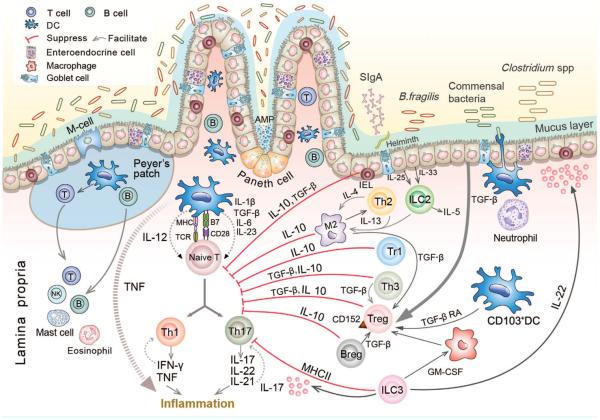
Figure 1
Figure 1
Microbiota and immune regulatory cells in gut. Schematic shows the location of immune regulatory cells and other immune cells and their signaling cascades in the lamina propria of gut. The luminal microbiome lies adjacent to the intestinal epithelium. The microbiota plays an important role in the maintenance of mucosa homeostasis. Breach of the tolerance leads to the development of inflammatory bowel diseases (IBD), inflammation, and tumor. Intestinal epithelial barrier is the first line of defense to prevent the pathogens invasion, including the epithelial tight junction complexes, mucus layer secretion by goblet cell, secretory immunoglobulin A (sIgA), antimicrobial protein (AMP) secretion by plasma cells, and Paneth cells. With regard to the innate immune response in intestine, neutrophils could be earlier recruited to inflammatory sites to clear the pathogens. In addition, macrophages, dendritic cells (DCs), and innate lymphoid cells (ILCs) could sense antigens and then secrete cytokines or chemokines to regulate the inflammatory responses. Some innate immune regulatory cells such as M2 induced by interleukin (IL)-4 and IL-13 could directly inhibit effector T cells through IL-10 secretion and promote regulatory T cell (Treg) suppressive function by producing transforming growth factor-β (TGF-β). CD103+ DCs could regulate intestinal inflammation via facilitating Treg differentiation in a TGF-β- and retinoic acid (RA)-dependent manner. ILC3 serve as an antigen-presenting cell (APC) that uniquely restrain the CD4+ T-cell response in a major histocompatibility complex (MHC) II-dependent manner, and could secrete IL-22 that participates in the repair of impaired epithelium. In response to epithelium-derived IL-25 and IL-33, ILC2 could produce IL-5 and IL-13 to play the role of anti-helminth. The primarily regulatory cells are Tregs that suppress effector T-cell differentiation and proliferation by producing IL-10 and TGF-β or expressing CD152. The IL-10-producing type 1 regulatory T (Tr1) cells perform the anti-inflammatory function. Moreover, T helper type 3 (Th3) cells, regulatory B cells (Bregs), and intraepithelial lymphocytes (IELs) have the capacity of suppressing the excessive Th1 and Th17 responses through IL-10 and TGF-β production. Therefore, these immune regulatory cells collectively maintain the intestinal homeostasis by interacting with each other.

References

    1. Garrett WS, Gordon JI, Glimcher LH. Homeostasis and inflammation in the intestine. Cell. 2010;140:859–870. - PMC - PubMed
    1. Bernstein CN, Wajda A, Blanchard JF. The clustering of other chronic inflammatory diseases in inflammatory bowel disease: a population-based study. Gastroenterology. 2005;129:827–836. - PubMed
    1. Wu W, et al. miR-10a inhibits dendritic cell activation and Th1/Th17 cell immune responses in IBD. Gut. 2014 Oct 3; advance online publication. 2014; doi:10.1136/gutjnl-2014-307980. - PubMed
    1. Liu Z, et al. Interleukin (IL)-23 suppresses IL-10 in inflammatory bowel disease. J. Biol. Chem. 2012;287:3591–3597. - PMC - PubMed
    1. Liu Z, et al. The increased expression of IL-23 in inflammatory bowel disease promotes intraepithelial and lamina propria lymphocyte inflammatory responses and cytotoxicity. J. Leukoc. Biol. 2011;89:597–606. - PubMed

Publication types

MeSH terms
