. 2015 Jun 16;6(3):e00648.
doi: 10.1128/mBio.00648-15.

Covalent Modification of Bacteriophage T4 DNA Inhibits CRISPR-Cas9

Affiliations

Covalent Modification of Bacteriophage T4 DNA Inhibits CRISPR-Cas9

Alexandra L Bryson et al. mBio. .

Abstract

The genomic DNAs of tailed bacteriophages are commonly modified by the attachment of chemical groups. Some forms of DNA modification are known to protect phage DNA from cleavage by restriction enzymes, but others are of unknown function. Recently, the CRISPR-Cas nuclease complexes were shown to mediate bacterial adaptive immunity by RNA-guided target recognition, raising the question of whether phage DNA modifications may also block attack by CRISPR-Cas9. We investigated phage T4 as a model system, where cytosine is replaced with glucosyl-hydroxymethylcytosine (glc-HMC). We first quantified the extent and distribution of covalent modifications in T4 DNA by single-molecule DNA sequencing and enzymatic probing. We then designed CRISPR spacer sequences targeting T4 and found that wild-type T4 containing glc-HMC was insensitive to attack by CRISPR-Cas9 but mutants with unmodified cytosine were sensitive. Phage with HMC showed only intermediate sensitivity. While this work was in progress, another group reported examples of heavily engineered CRISRP-Cas9 complexes that could, in fact, overcome the effects of T4 DNA modification, indicating that modifications can inhibit but do not always fully block attack.

Importance: Bacteria were recently found to have a form of adaptive immunity, the CRISPR-Cas systems, which use nucleic acid pairing to recognize and cleave genomic DNA of invaders such as bacteriophage. Historic work with tailed phages has shown that phage DNA is often modified by covalent attachment of large chemical groups. Here we demonstrate that DNA modification in phage T4 inhibits attack by the CRISPR-Cas9 system. This finding provides insight into mechanisms of host-virus competition and also a new set of tools that may be useful in modulating the activity of CRISPR-Cas9 in genome engineering applications.


Figures

FIG 1
FIG 1
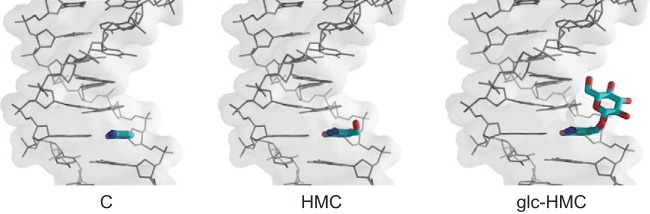
DNA modification in phage T4 showing C-containing DNA (left), HMC-containing DNA (middle), and glc-HMC DNA (right).
FIG 2
FIG 2
Characterization of phage T4 DNA modification. (A) Phage T4(glc-HMC), T4(HMC), and T4(C) DNA left untreated (−) or treated with (+) restriction enzymes AluI (top), which cleaves unmodified DNA; MspJI (middle), which cleaves HMC-containing DNA; or T4 glucosyltransferase (bottom), which increases the mobility of HMC-containing DNA by the addition of glucose groups. The arrows indicate the mobility shift due to glucose attachment. (B) Analysis of phage T4 DNA modification by single-molecule sequencing. Results are summarized for each genome by mapping IPD ratios at each base for each of the T4 strains studied. The coloration of each base is shown by the key at the bottom left. The T4 nucleotide sequence runs from top to bottom for each of the four genomes. The distance each colored point is displaced from the center indicates the IPD ratio (scale at bottom; leftward for the reverse strand, rightward for the forward strand). Examples of interpulse distances (indicative of modification) are shown to the right for a short segment of the T4 genome. Bars indicate the magnitude of the IPD ratio (upward for the forward strand and downward for the reverse strand). A 5′ GATC 3′ site of DAM methylation is highlighted in yellow. (C) Violin plot showing IPD ratios of A residues at 5′ GATC 3′ sequences.
FIG 3
FIG 3
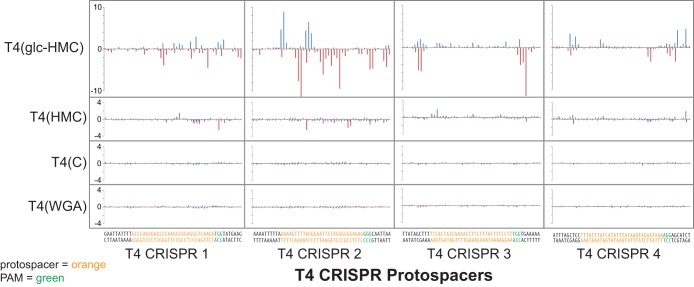
IPD modification profiles of T4(glc-HMC), T4(HMC), and T4(C) phage protospacers. IPD ratios for the forward strand (blue) and reverse strand (red) of T4(glc-HMC), T4(HMC), and T4(C) are depicted for the regions of the T4 genome targeted by spacers 1 to 4 along with the surrounding nucleotides. The nucleotide sequences of the phage protospacer (orange), the PAM (green), and the surrounding nucleotides (black) are along the x axis. The top strand of the protospacer is identical in sequence to the crRNA/spacer, and the bottom strand is the target strand, which is complementary to the spacer and will base pair with the crRNA.
FIG 4
FIG 4
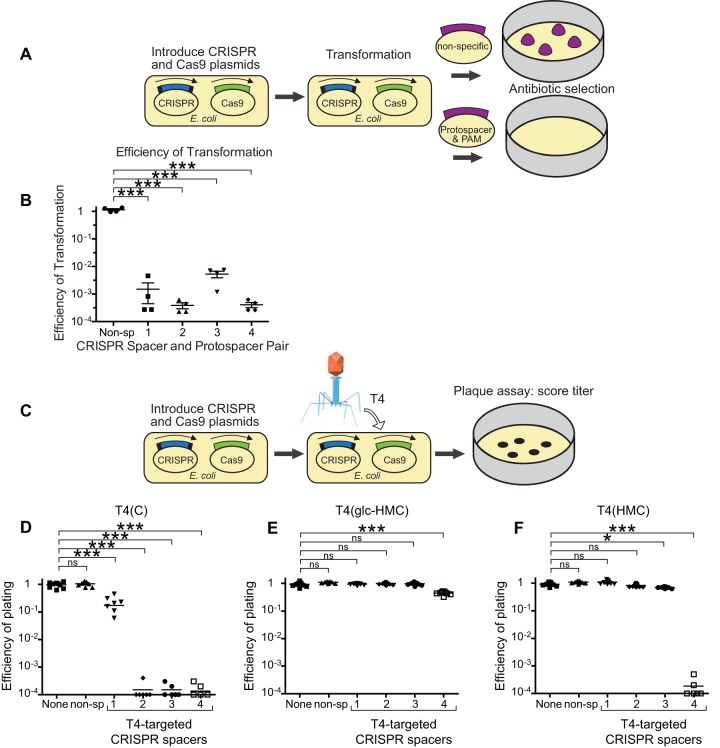
Glc-HMC and HMC modifications inhibit attack by the CRISPR-Cas9 system on phage T4. (A) Diagram of the strategy used to validate CRISPR spacers in a transformation assay. Bacteria containing the type II CRISPR system were transformed with a pUC19 plasmid containing either a T4 protospacer and PAM sequence or a nonspecific DNA sequence. Antibiotic selection for the pUC19 plasmid and quantification of the efficiency of transformation reveal the efficacy of CRISPR system cleavage of unmodified DNA containing a protospacer and PAM. (B) Results of plasmid challenge tests. The efficiency of transformation is the ratio of colony counts of cells transformed with equal amounts of pUC19 that contain a protospacer targeting the plasmid (numerator) to the colony counts of cells transformed with pUC19 (denominator). (C) Diagram of plaque assays to assess inhibition of T4 infection with CRISPR-Cas9. (D to F) Results of plaque assays in which the E. coli strains indicated were infected with up to 1 × 10⁴ PFU of T4(C) (panel D), T4(glc-HMC) (panel E), or T4(HMC) (panel F). E. coli strains expressed Cas9 and crRNAs targeting T4 or controls. Starting from the left in each panel, None indicates no crRNA or Cas9, non-sp indicates nonspecific crRNA, 1 contained the maximum number of cytosines in the target strand and seed sequence, 2 contained the maximum number of cytosines in the target and complementary strands, 3 contained no cytosines in the target strand and seven cytosines in the complementary strand, and 4 contained the fewest cytosines in the target and complementary strands. Mean values were compared with the Kruskal-Wallis test. *, P < 0.01; ***, P < 0.0001; ns, not significant.

References

    1. Luria SE, Human ML. 1952. A nonhereditary, host-induced variation of bacterial viruses. J Bacteriol 64:557–569. - PMC - PubMed
    1. Hattman S. 2009. The first recognized epigenetic signal: DNA glucosylation of T-even bacteriopages [sic]. Epigenetics 4:150–151. doi:10.4161/epi.4.3.8444. - DOI - PubMed
    1. Karam JD, Drake JW. 1994. Molecular biology of bacteriophage T4. American Society for Microbiology, Washington, DC.
    1. Josse J, Kornberg A. 1962. Glucosylation of deoxyribonucleic acid. III. Alpha- and beta-glucosyl transferases from T4-infected Escherichia coli. J Biol Chem 237:1968–1976. - PubMed
    1. Pratt EA, Kuo S, Lehman IR. 1963. Glucosylation of the deoxyribonucleic acid in hybrids of coliphages T2 and T4. Biochim Biophys Acta 68:108–111. doi:10.1016/0926-6550(63)90413-4. - DOI - PubMed

Publication types

Associated data

LinkOut - more resources