Colorectal Cancer Risk Following Adenoma Removal: A Large Prospective Population-Based Cohort Study
- PMID: 26082403
- PMCID: PMC4560642
- DOI: 10.1158/1055-9965.EPI-15-0085
Colorectal Cancer Risk Following Adenoma Removal: A Large Prospective Population-Based Cohort Study
Abstract
Background: Randomized controlled trials have demonstrated significant reductions in colorectal cancer incidence and mortality associated with polypectomy. However, little is known about whether polypectomy is effective at reducing colorectal cancer risk in routine clinical practice. The aim of this investigation was to quantify colorectal cancer risk following polypectomy in a large prospective population-based cohort study.
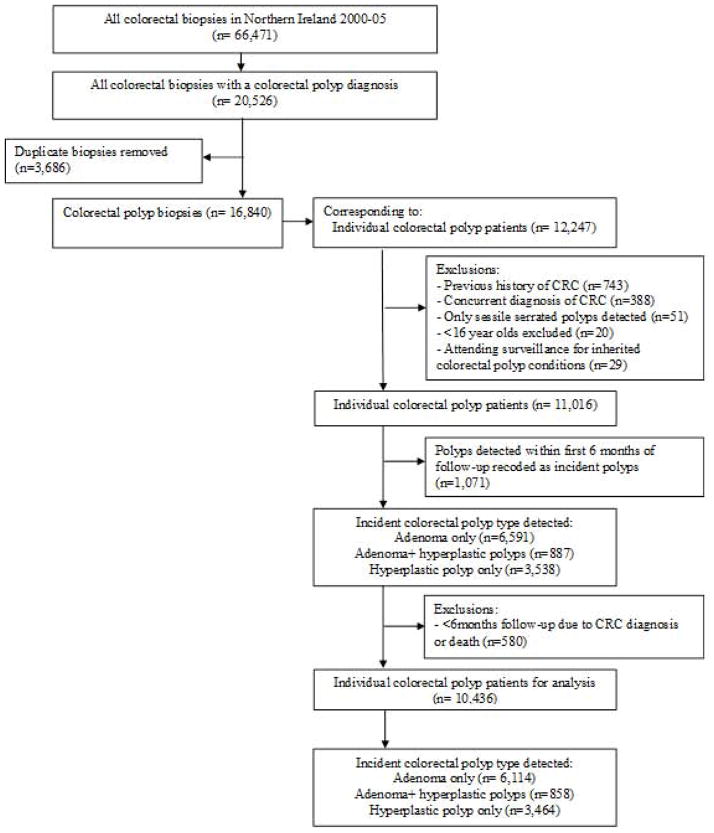
Methods: Patients with incident colorectal polyps between 2000 and 2005 in Northern Ireland were identified via electronic pathology reports received to the Northern Ireland Cancer Registry. Patients were matched to the Northern Ireland Cancer Registry to detect colorectal cancer and deaths up to December 31, 2010. Colorectal cancer standardized incidence ratios (SIR) were calculated and Cox proportional hazards modeling applied to determine colorectal cancer risk.
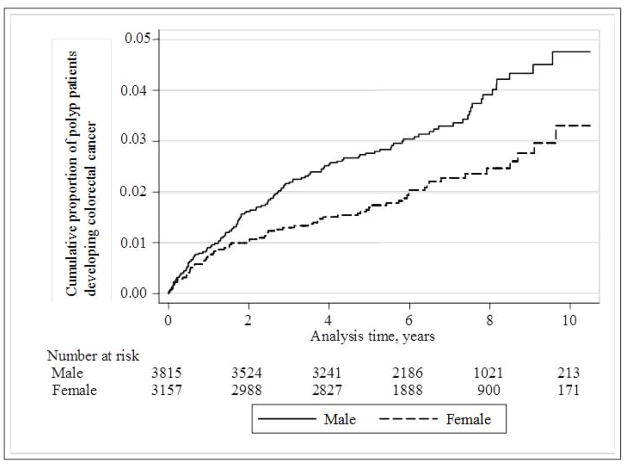
Results: During 44,724 person-years of follow-up, 193 colorectal cancer cases were diagnosed among 6,972 adenoma patients, representing an annual progression rate of 0.43%. Colorectal cancer risk was significantly elevated in patients who had an adenoma removed (SIR, 2.85; 95% CI, 2.61-3.25) compared with the general population. Male sex, older age, rectal site, and villous architecture were associated with an increased colorectal cancer risk in adenoma patients. Further analysis suggested that not having a full colonoscopy performed at, or following, incident polypectomy contributed to the excess colorectal cancer risk.
Conclusions: Colorectal cancer risk was elevated in individuals following polypectomy for adenoma, outside of screening programs.
Impact: This finding emphasizes the need for full colonoscopy and adenoma clearance, and appropriate surveillance, after endoscopic diagnosis of adenoma.
©2015 American Association for Cancer Research.
Conflict of interest statement
Figures
References
-
- Cancer Research UK. [Accessed August 28, 2013];Bowel Cancer Statistics. 2013 Available at: http://www.cancerresearchuk.org/cancer-info/cancerstats/types/bowel/
-
- Coleman MP, Forman D, Bryant H, Butler J, Rachet B, Maringe C, et al. Cancer survival in Australia, Canada, Denmark, Norway, Sweden, and the UK, 1995–2007 (the International Cancer Benchmarking Partnership): An analysis of population-based cancer registry data. Lancet. 2011;377:127–38. - PMC - PubMed
-
- Morris EJ, Sandin F, Lambert PC, Bray F, Klint A, Linklater K, et al. A population-based comparison of the survival of patients with colorectal cancer in England, Norway and Sweden between 1996 and 2004. Gut. 2011;60:1087–93. - PubMed
-
- Hamilton SR, Bosman FT, Boffetta P, Ilyas M, Morreau H, Nakamura SI, et al. Carcinoma of the colon and rectum. In: Bosman FT, Carniero F, Hruban RH, Theise ND, editors. WHO Classification of Tumours of the Digestive System. 4. Lyon: IARC; 2010.
Publication types
MeSH terms
Grants and funding
LinkOut - more resources
Full Text Sources
Medical