Comparative Study
. 2015 Aug;21(8):1948-56.
doi: 10.1097/MIB.0000000000000454.

Fungal Signature in the Gut Microbiota of Pediatric Patients With Inflammatory Bowel Disease

Affiliations
Comparative Study

Fungal Signature in the Gut Microbiota of Pediatric Patients With Inflammatory Bowel Disease

Christel Chehoud et al. Inflamm Bowel Dis. 2015 Aug.

Abstract

Background: Inflammatory bowel disease (IBD) involves dysregulation of mucosal immunity in response to environmental factors such as the gut microbiota. The bacterial microbiota is often altered in IBD, but the connection to disease is not fully clarified and gut fungi have recently been suggested to play a role as well. In this study, we compared microbes from all 3 domains of life-bacteria, archaea, and eukaryota-in pediatric patients with IBD and healthy controls.

Methods: A stool sample was collected from patients with IBD (n = 32) or healthy control subjects (n = 90), and bacterial, archaeal, and fungal communities were characterized by deep sequencing of rRNA gene segments specific to each domain.

Results: Patients with IBD (Crohn's disease or ulcerative colitis) had lower bacterial diversity and distinctive fungal communities. Two lineages annotating as Candida were significantly more abundant in patients with IBD (P = 0.0034 and P = 0.00038, respectively), whereas a lineage annotating as Cladosporium was more abundant in healthy subjects (P = 0.0025). There were no statistically significant differences in archaea, which were rare in pediatric samples compared with those from adults.

Conclusions: Pediatric IBD is associated with reduced diversity in both fungal and bacterial gut microbiota. Specific Candida taxa were found to be increased in abundance in the IBD samples. These data emphasize the potential importance of fungal microbiota signatures as biomarkers of pediatric IBD, supporting their possible role in disease pathogenesis.


Conflict of interest statement

Disclosures: None of the authors have disclosures related to this manuscript.

Figures
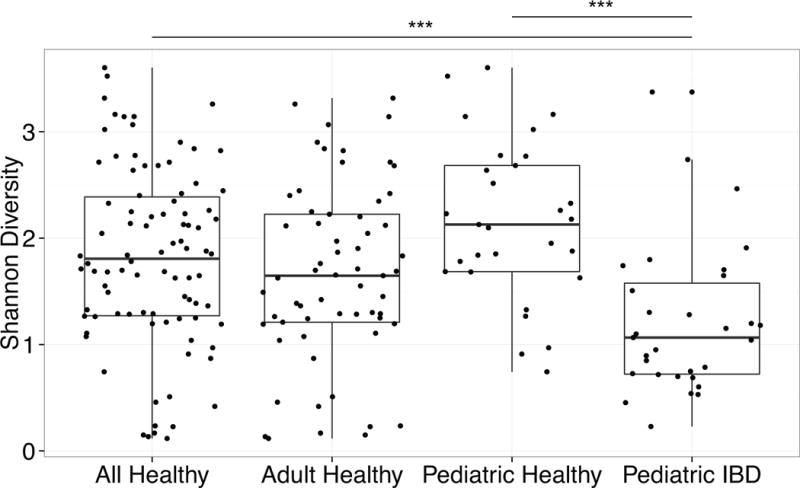
Figure 1
Figure 1
Diversity of fungal communities is decreased in IBD patients compared to healthy subjects. The Shannon diversity index was calculated based on the OTU-level classification tables. The boxplots show the distribution of diversity values for: (1) all healthy subjects, (2) only the adult healthy subjects, (3) only the pediatric healthy subjects, and (4) the pediatric IBD subjects. Each black dot represents a different subject. *** p<0.0005 on Wilcox test.
Figure 2
Figure 2
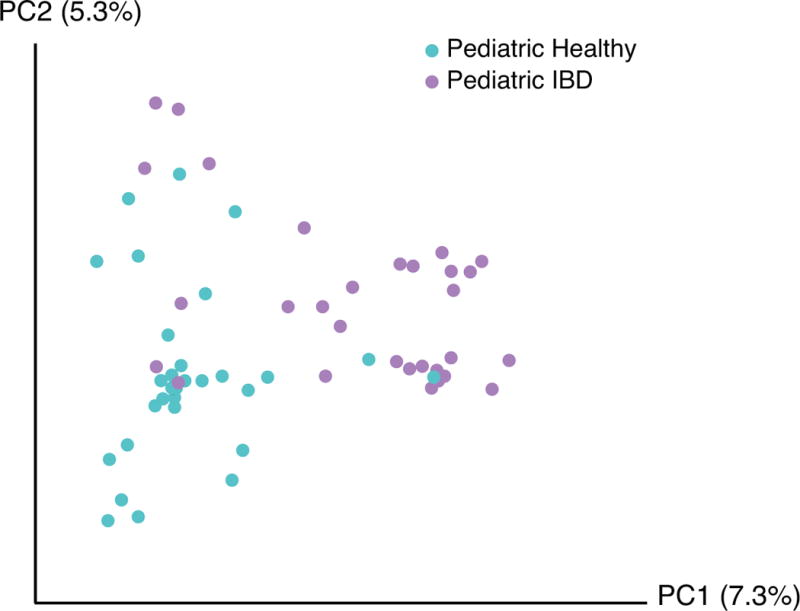
Comparison of pediatric healthy and pediatric IBD subjects’ fungal community composition using principal coordinate ordination. Principal coordinate analysis was used to depict the relatedness of fungal communities based on presence or absence. The axes represent the two most discriminating axes using the binary Jaccard index distance metric. Pediatric healthy subjects are depicted in cyan and pediatric IBD subjects are depicted in lavender. The two groups clustered separately (p=0.004).
Figure 3
Figure 3
Taxonomic heatmap of fungal community members in healthy and IBD subjects. Proportions of fungal OTUs in adult healthy, pediatric healthy, and IBD subjects. The color bar on the top indicates the health status of each subject. Each column indicates a different subject. The color bar on the right side indicates the average relative abundances of these genera in each subject.
Figure 4
Figure 4
Abundance of selected fungal OTUs Barcharts showing the number of reads from three selected fungal OTUs: (A) Candida (accession KP132001), (B) Candida (accession EF197997) and (C) Cladosporium (accession KJ596320). Adult healthy subjects, pediatric healthy subjects, and pediatric IBD subjects are shown in red, blue, and purple respectively. A negative control sample (NC) that was processed alongside the samples is shown at the right in green. No reads matching any of the three lineages mentioned above were found in the negative control sample.
Figure 5
Figure 5
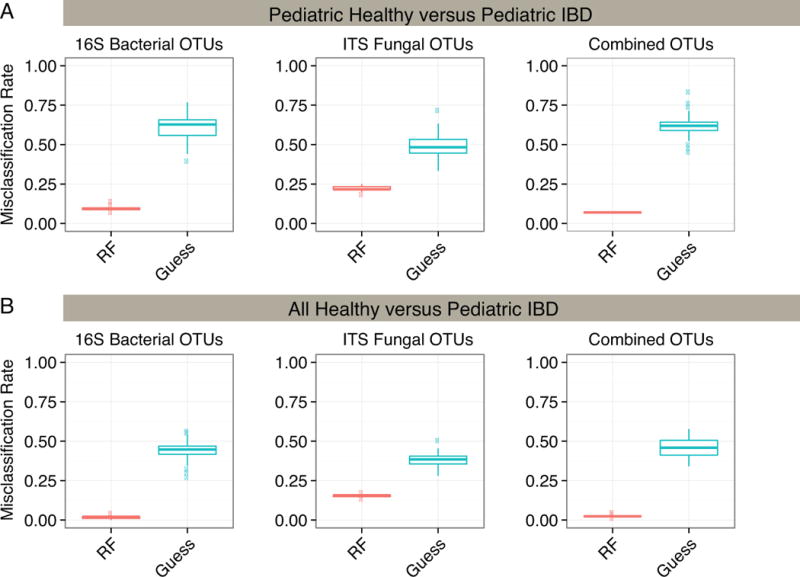
Random Forest Classification Accuracy for Healthy and IBD subjects. A random forest classifier was used to group samples into either healthy or IBD categories. Random forest accuracy (red) was compared to random guessing (blue) with misclassification rate indicated on the y-axis. The classifier was run using 16S bacterial OTUs, ITS fungal OTUs and the combination of both bacterial and fungal OTUs. Results were also compared using (A) pediatric healthy and pediatric IBD subjects or (B) both adult and pediatric healthy subjects and IBD subjects.
Figure 6
Figure 6
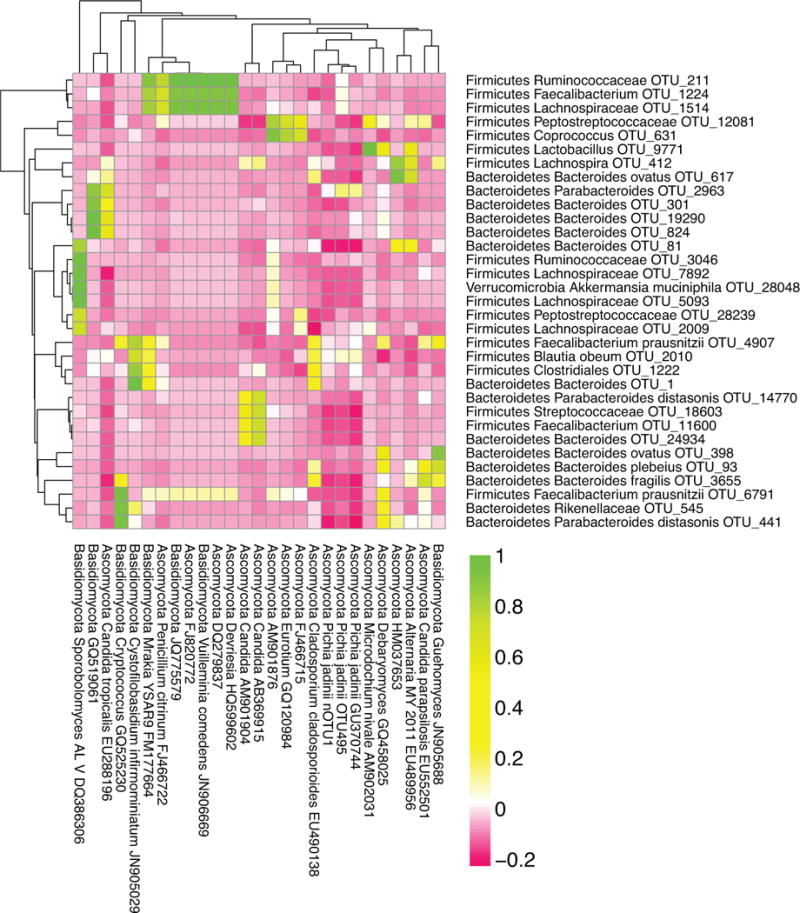
Correlations between Bacterial and Fungal OTUs in pediatric IBD. The Pearson correlation coefficient between fungal and bacterial OTUs in pediatric IBD patients was calculated. OTUs were included in this heatmap if they had greater than 100 sequences in pediatric IBD patients. OTUs were included if they significantly correlated with at least one other OTU (two-sided correlation, where the p-value exceeded 0.05 after Bonferroni correction).

References

    1. Arumugam M, Raes J, Pelletier E, et al. Enterotypes of the human gut microbiome. Nature. 2011;473:174–180. - PMC - PubMed
    1. Richard ML, Lamas B, Liguori G, et al. Gut Fungal Microbiota: The Yin and Yang of Inflammatory Bowel Disease. Inflamm Bowel Dis. 2014 - PubMed
    1. Hansen EE, Lozupone CA, Rey FE, et al. Pan-genome of the dominant human gut-associated archaeon, Methanobrevibacter smithii, studied in twins. Proc Natl Acad Sci U S A. 2011;108(Suppl 1):4599–4606. - PMC - PubMed
    1. Samuel BS, Hansen EE, Manchester JK, et al. Genomic and metabolic adaptations of Methanobrevibacter smithii to the human gut. Proc Natl Acad Sci U S A. 2007;104:10643–10648. - PMC - PubMed
    1. Hoffmann C, Dollive S, Grunberg S, et al. Archaea and fungi of the human gut microbiome: correlations with diet and bacterial residents. PLoS One. 2013;8:e66019. - PMC - PubMed

Publication types

MeSH terms

Substances