


Long-Term Outcomes of Early Intervention in 6-Year-Old Children With Autism Spectrum Disorder
- PMID: 26088663
- PMCID: PMC4475272
- DOI: 10.1016/j.jaac.2015.04.005
Long-Term Outcomes of Early Intervention in 6-Year-Old Children With Autism Spectrum Disorder
Abstract
Objective: We prospectively examined evidence for the sustained effects of early intervention based on a follow-up study of 39 children with ASD who began participation in a randomized clinical trial testing the effectiveness of the Early Start Denver Model (ESDM) at age 18 to 30 months. The intervention, conducted at a high level of intensity in-home for 2 years, showed evidence of efficacy immediately posttreatment.
Method: This group of children was assessed at age 6 years, 2 years after the intervention ended, across multiple domains of functioning by clinicians naive to previous intervention group status.
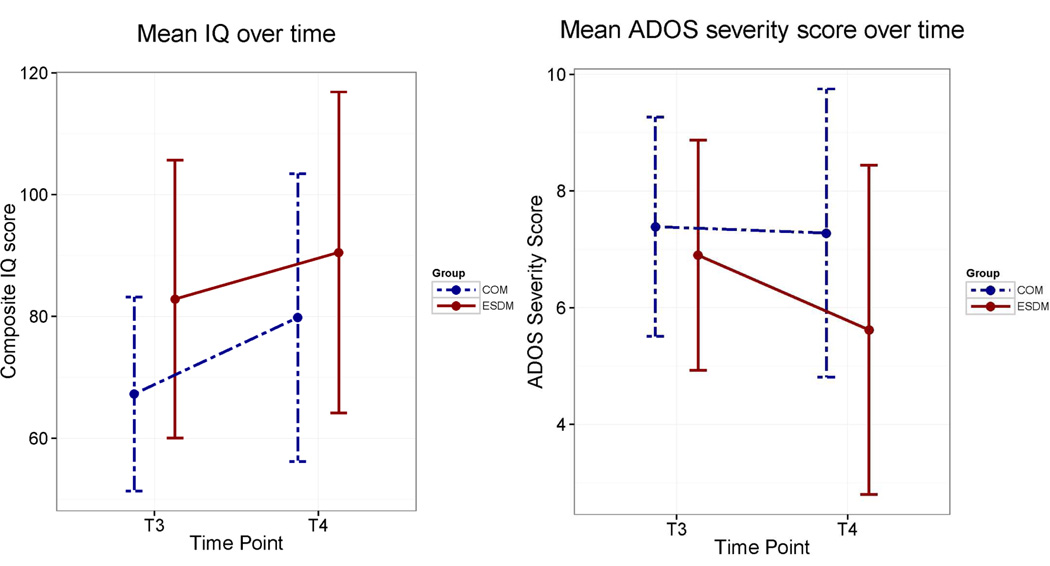
Results: The ESDM group, on average, maintained gains made in early intervention during the 2-year follow-up period in overall intellectual ability, adaptive behavior, symptom severity, and challenging behavior. No group differences in core autism symptoms were found immediately posttreatment; however, 2 years later, the ESDM group demonstrated improved core autism symptoms and adaptive behavior as compared with the community-intervention-as-usual (COM) group. The 2 groups were not significantly different in terms of intellectual functioning at age 6 years. Both groups received equivalent intervention hours during the original study, but the ESDM group received fewer hours during the follow-up period.
Conclusion: These results provide evidence that gains from early intensive intervention are maintained 2 years later. Notably, core autism symptoms improved in the ESDM group over the follow-up period relative to the COM group. This improvement occurred at the same time that the ESDM group received significantly fewer services. This is the first study to examine the role of early ESDM behavioral intervention initiated at less than 30 months of age in altering the longer-term developmental course of autism.
Keywords: autism; early; intervention; long-term; outcomes.
Copyright © 2015 American Academy of Child and Adolescent Psychiatry. Published by Elsevier Inc. All rights reserved.
Conflict of interest statement
Disclosure: Drs. Munson, Greenson, and Winter report no biomedical financial interests or potential conflicts of interest.
Figures
References
-
- Lovaas O. Behavioral treatment and normal educational and intellectual functioning in young autistic children. Journal of Consulting and Clinical Psychology. 1987;55(1):3–9. - PubMed
-
- Smith T, Groen A, Wynn J. Randomized trial of intensive early intervention for children with pervasive developmental disorder. American Journal on Mental Retardation. 2000;105(4):269–285. - PubMed
-
- Tonge B, Bull K, Brereton A, Wilson R. A review of evidence-based early intervention for behavioural problems in children with autism spectrum disorder: the core components of effective programs, child-focused interventions and comprehensive treatment models. Current Opinion in Psychiatry. 2014;27(2):158–165. - PubMed
-
- Magiati I, Tay XW, Howlin P. Early comprehensive behaviorally based interventions for children with autism spectrum disorders: a summary of findings from recent reviews and meta-analyses. Neuropsychiatry. 2012;2:543–570.
Publication types
MeSH terms
Grants and funding
LinkOut - more resources
Full Text Sources
Other Literature Sources
Medical
