


Critical analysis of the stringent complete response in multiple myeloma: contribution of sFLC and bone marrow clonality
- PMID: 26089396
- PMCID: PMC4543912
- DOI: 10.1182/blood-2015-04-638742
Critical analysis of the stringent complete response in multiple myeloma: contribution of sFLC and bone marrow clonality
Abstract
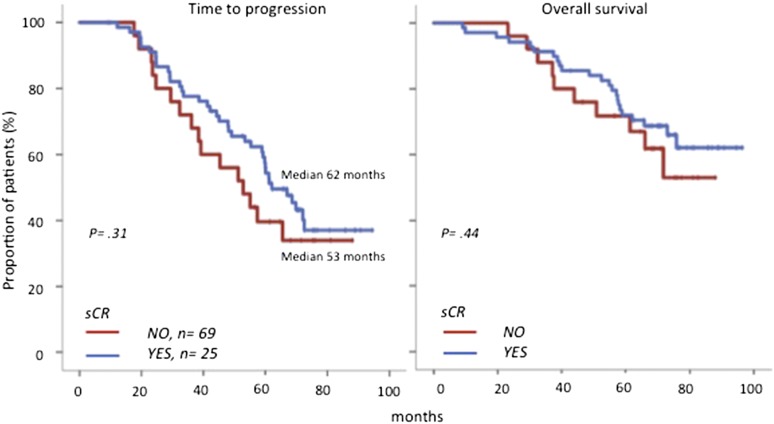
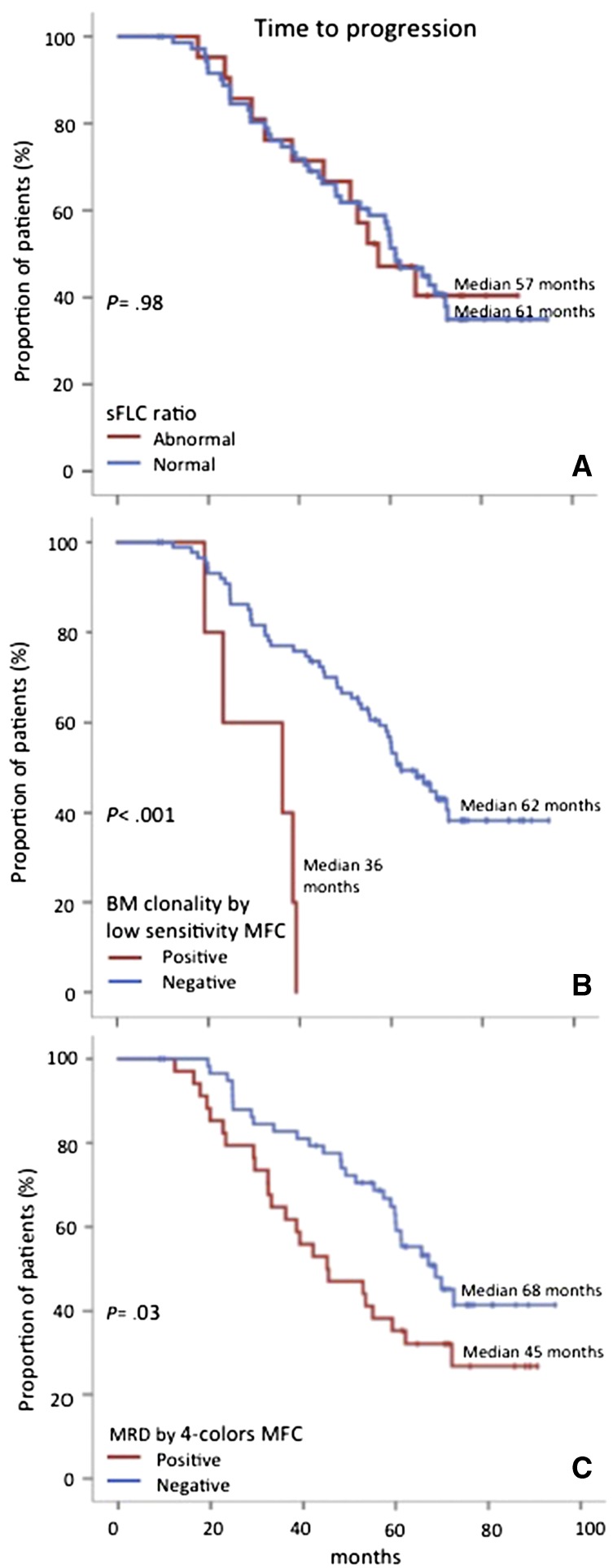
Stringent complete response (sCR) criteria are used in multiple myeloma as a deeper response category compared with CR, but prospective validation is lacking, it is not always clear how evaluation of clonality is performed, and is it not known what the relative clinical influence is of the serum free light chain ratio (sFLCr) and bone marrow (BM) clonality to define more sCR. To clarify this controversy, we focused on 94 patients that reached CR, of which 69 (73%) also fulfilled the sCR criteria. Patients with sCR displayed slightly longer time to progression (median, 62 vs 53 months, respectively; P = .31). On analyzing this contribution to the prognosis of sFLCr or clonality, it was found that the sFLCr does not identify patients in CR at distinct risk; by contrast, low-sensitive multiparametric flow cytometry (MFC) immunophenotyping (2 colors), which is equivalent to immunohistochemistry, identifies a small number of patients (5 cases) with high residual tumor burden and dismal outcome; nevertheless, using traditional 4-color MFC, persistent clonal BM disease was detectable in 36% of patients, who, compared with minimal residual disease-negative cases, had a significantly inferior outcome. These results show that the current definition of sCR should be revised.
© 2015 by The American Society of Hematology.
Figures
References
-
- Harousseau JL, Attal M, Avet-Loiseau H. The role of complete response in multiple myeloma. Blood. 2009;114(15):3139–3146. - PubMed
-
- van de Velde HJ, Liu X, Chen G, Cakana A, Deraedt W, Bayssas M. Complete response correlates with long-term survival and progression-free survival in high-dose therapy in multiple myeloma. Haematologica. 2007;92(10):1399–1406. - PubMed
-
- Durie BG, Harousseau JL, Miguel JS, et al. International Myeloma Working Group. International uniform response criteria for multiple myeloma. Leukemia. 2006;20(9):1467–1473. - PubMed
Publication types
MeSH terms
Substances
LinkOut - more resources
Full Text Sources
Other Literature Sources
Medical
