Review
. 2015:2015:816460.
doi: 10.1155/2015/816460. Epub 2015 May 18.

Understanding the Mysterious M2 Macrophage through Activation Markers and Effector Mechanisms

Affiliations
Review

Understanding the Mysterious M2 Macrophage through Activation Markers and Effector Mechanisms

Tamás Rőszer. Mediators Inflamm. 2015.

Abstract

The alternatively activated or M2 macrophages are immune cells with high phenotypic heterogeneity and are governing functions at the interface of immunity, tissue homeostasis, metabolism, and endocrine signaling. Today the M2 macrophages are identified based on the expression pattern of a set of M2 markers. These markers are transmembrane glycoproteins, scavenger receptors, enzymes, growth factors, hormones, cytokines, and cytokine receptors with diverse and often yet unexplored functions. This review discusses whether these M2 markers can be reliably used to identify M2 macrophages and define their functional subdivisions. Also, it provides an update on the novel signals of the tissue environment and the neuroendocrine system which shape the M2 activation. The possible evolutionary roots of the M2 macrophage functions are also discussed.


Figures
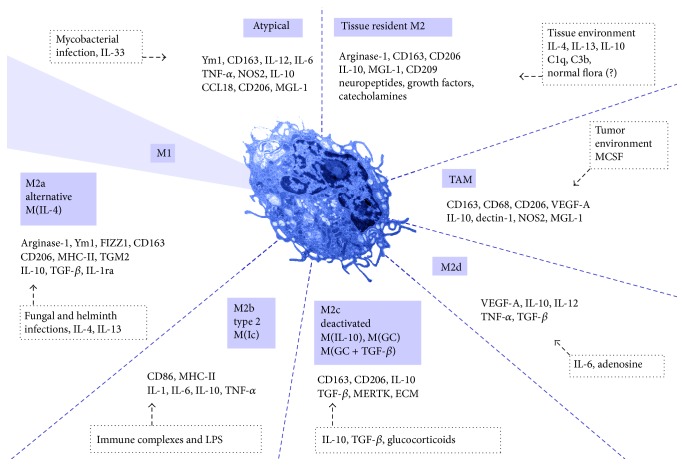
Figure 1
Figure 1
Overview of the macrophage activation states. Macrophage activation is widely considered as a polarization towards M1 or M2 states. However, the M2 activation state involves heterogeneous and functionally distinct macrophages. The diagram represents the most prevalent examples of the M2 activation and lists the markers associated with the distinct activation phenotypes. The upstream signals are labeled in dotted frames. Abbreviations are defined in the text.
Figure 2
Figure 2
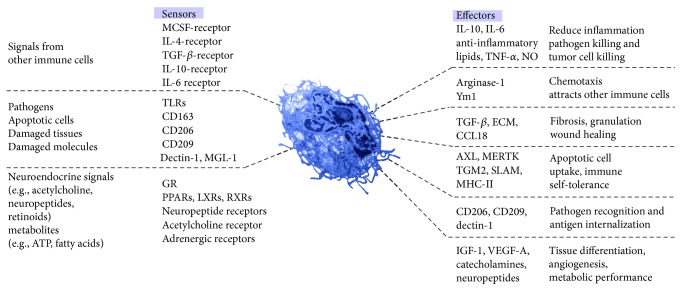
Alternative model depicting sensor and effector functions of the M2 macrophages. The macrophage phenotype is principally determined by eliciting signals, derived from immune cells, pathogens, apoptotic or damaged cells, and a wide range of chemical mediators. They act through receptors and signal pathways which elicit a wide range of effector functions. Abbreviations are defined in the text.

References

    1. Chang Z.-L. Recent development of the mononuclear phagocyte system: in memory of Metchnikoff and Ehrlich on the 100th Anniversary of the 1908 Nobel Prize in Physiology or Medicine. Biology of the Cell. 2009;101(12):709–721. doi: 10.1042/bc20080227. - DOI - PubMed
    1. Pollard J. W. Trophic macrophages in development and disease. Nature Reviews Immunology. 2009;9(4):259–270. doi: 10.1038/nri2528. - DOI - PMC - PubMed
    1. Osborn O., Olefsky J. M. The cellular and signaling networks linking the immune system and metabolism in disease. Nature Medicine. 2012;18(3):363–374. doi: 10.1038/nm.2627. - DOI - PubMed
    1. Martinez F. O., Gordon S. The M1 and M2 paradigm of macrophage activation: time for reassessment. F1000Prime Reports. 2014;6, article 13 doi: 10.12703/p6-13. - DOI - PMC - PubMed
    1. Colin S., Chinetti-Gbaguidi G., Staels B. Macrophage phenotypes in atherosclerosis. Immunological Reviews. 2014;262(1):153–166. doi: 10.1111/imr.12218. - DOI - PubMed

Publication types

MeSH terms