Review
. 2015 Jun 5:9:1001-15.
doi: 10.2147/OPTH.S74959. eCollection 2015.

Management of neovascular age-related macular degeneration: current state-of-the-art care for optimizing visual outcomes and therapies in development

Affiliations
Review

Management of neovascular age-related macular degeneration: current state-of-the-art care for optimizing visual outcomes and therapies in development

Aniruddha Agarwal et al. Clin Ophthalmol. .

Abstract

Contemporary management of neovascular age-related macular degeneration (AMD) has evolved significantly over the last few years. The goal of treatment is shifting from merely salvaging vision to maintaining a high quality of life. There have been significant breakthroughs in the identification of viable drug targets and gene therapies. Imaging tools with near-histological precision have enhanced our knowledge about pathophysiological mechanisms that play a role in vision loss due to AMD. Visual, social, and vocational rehabilitation are all important treatment goals. In this review, evidence from landmark clinical trials is summarized to elucidate the optimum modern-day management of neovascular AMD. Therapeutic strategies currently under development, such as gene therapy and personalized medicine, are also described.

Keywords: AMD; VEGF; choroidal neovascular membrane; gene therapy; low-vision rehabilitation; neovascular AMD; pharmacogenomics.


Figures

Figure 1
Figure 1
Summary of various strategies used to manage patients with neovascular age-related macular degeneration. Notes: The active stage of the disease can be managed with improved treatment regimens along with newer modalities such as gene therapy, combination therapies, and pharmacogenomic principles. The management of the patient should also focus on the visual rehabilitation and screening of the fellow eye for changes in the stages of age-related macular degeneration. Abbreviations: DARPins, designed ankyrin repeat proteins; PDGF, platelet-derived growth factor; PDT, photodynamic therapy; VEGF, vascular endothelial growth factor.
Figure 2
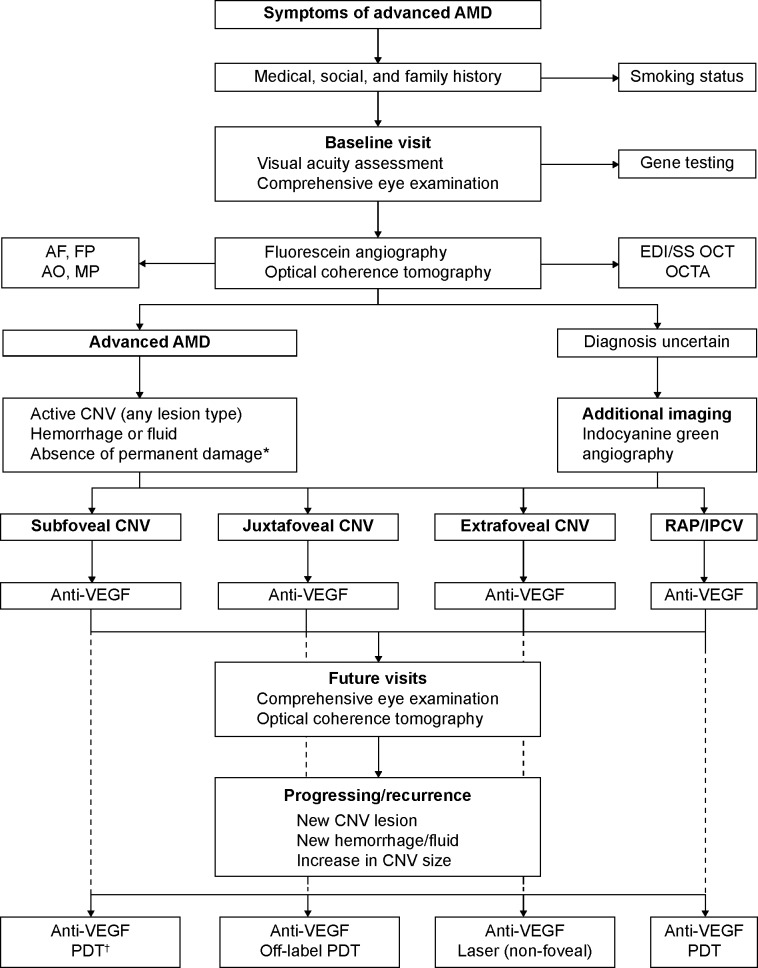
Figure 2
Flowchart of the optimal management of patients with advanced age-related macular degeneration (AMD). Notes: Anti-vascular endothelial growth factor (anti-VEGF) therapy forms the first-line therapy for various morphological forms of choroidal neovascular membranes (CNVs) in AMD. In unresponsive or resistant cases, other modalities may be considered as a monotherapy or in combination with anti-VEGF agents. Photodynamic therapy (PDT) has been approved for a subfoveal CNV; however, it may be used off-label in a juxtafoveal CNV, as per the American Academy of Ophthalmology Preferred Practice Pattern® 2014 update. Laser photocoagulation may be used in an extra-foveal CNV as a second- or third-line therapy. *Permanent damage of the fovea indicates presence of a longstanding fibrosis or atrophy of the fovea or a chronic disciform scar, which, in the opinion of the treating physician, would prevent the patient from deriving any functional benefit from treatment. PDT with verteporfin is approved by the US Food and Drug Administration for the treatment of AMD-related, predominantly classic, subfoveal CNVs. Abbreviations: AF, autofluorescence; AO, adaptive optics imaging; EDI, enhanced depth imaging; FP, fundus photography; IPCV, idiopathic polypoidal choroidal vasculopathy; MP, microperimetry; OCT, optical coherence tomography; OCTA, optical coherence tomography angiography; RAP, retinal angiomatous proliferation; SS, swept source; VEGF, vascular endothelial growth factor.

References

    1. Klein R, Klein BE, Linton KL. Prevalence of age-related maculopathy. The Beaver Dam Eye Study. Ophthalmology. 1992;99(6):933–943. - PubMed
    1. Congdon N, O’Colmain B, Klaver CC, et al. Eye Diseases Prevalence Research Group Causes and prevalence of visual impairment among adults in the United States. Arch Ophthalmol. 2004;122(4):477–485. - PubMed
    1. Friedman DS, O’Colmain BJ, Muñoz B, et al. Eye Diseases Prevalence Research Group Prevalence of age-related macular degeneration in the United States. Arch Ophthalmol. 2004;122(4):564–572. - PubMed
    1. Wong WL, Su X, Li X, et al. Global prevalence of age-related macular degeneration and disease burden projection for 2020 and 2040: a systematic review and meta-analysis. Lancet Glob Health. 2014;2(2):e106–e116. - PubMed
    1. Stein JD, Newman-Casey PA, Mrinalini T, Lee PP, Hutton DW. Cost-effectiveness of bevacizumab and ranibizumab for newly diagnosed neovascular macular degeneration. Ophthalmology. 2014;121(4):936–945. - PMC - PubMed