


Patient preference and willingness to pay for knee osteoarthritis treatments
- PMID: 26089650
- PMCID: PMC4468999
- DOI: 10.2147/PPA.S84251
Patient preference and willingness to pay for knee osteoarthritis treatments
Abstract
Purpose: To review treatments for osteoarthritis of the knee (OAK) received by patients across five European countries, and to obtain patients' perceptions and willingness to pay for current treatments.
Patients and methods: A prospective, internet-based, double-blind survey of adults with OAK was conducted in France, Germany, Italy, Spain, and the United Kingdom. The questionnaire included questions about diagnosis, treatment history, and perceptions of OAK treatments, followed by a discrete choice-based conjoint exercise to identify preferred attributes of OAK treatments, evaluating 14 sets of four unbranded products.
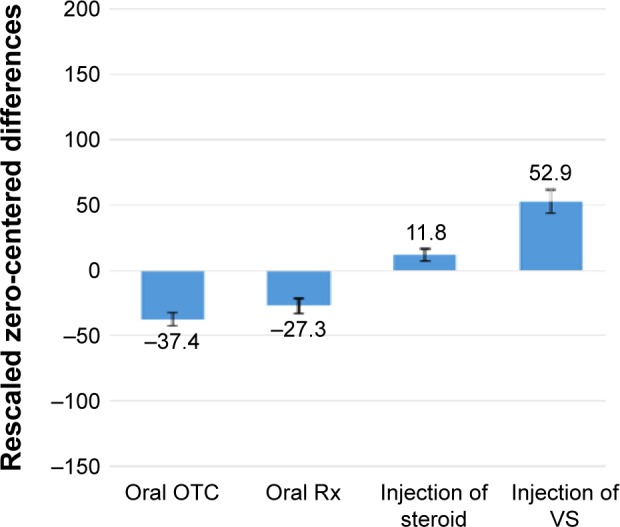
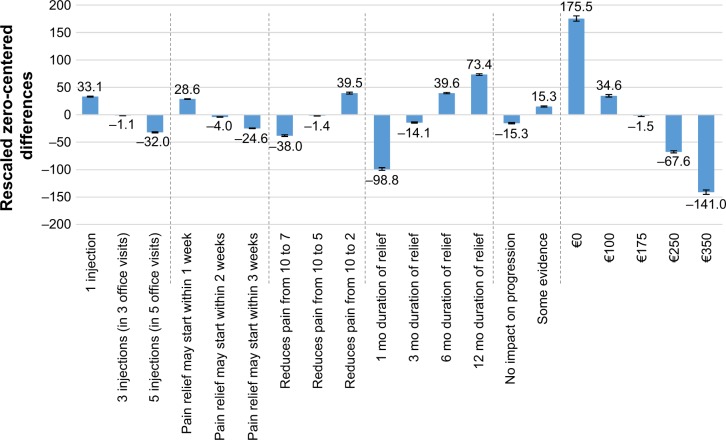
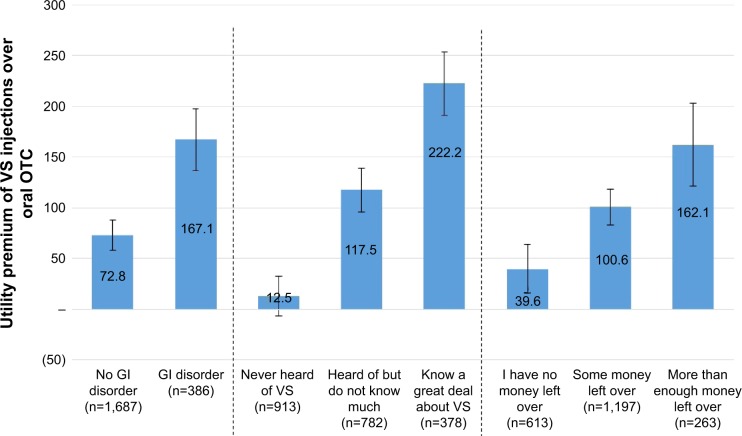
Results: Two thousand and seventy-three patients with self-reported OAK completed the survey; 17.4% of patients rated their knee pain as drastically affecting their ability to perform normal daily activities, and 39.3% of employed patients reported that they had lost work time because of OAK. The most common treatments were exercise (69.7%), physical therapy (68.2%), and nonprescription oral pain medication (73.9%). Treatments perceived as most effective were: viscosupplement injections (74.1%), narcotics (67.8%), and steroid injection (67.6%). Patient co-pay, duration of pain relief, and type of therapy exhibited the largest impact on patient preference for OAK treatments. The average patient was willing to pay €35 and €64 more in co-pay for steroid and viscosupplement injections, respectively, over the cost of oral over-the-counter painkillers (per treatment course, per knee) (each P<0.05).
Conclusion: OAK is a debilitating condition that affects normal daily activities. In general, treatments most commonly offered to patients are not those perceived as being the most effective. Patients are willing to pay a premium for treatments that they perceive as being more effective and result in longer-lasting pain relief, and those that can be administered with fewer visits to a physician.
Keywords: osteoarthritis; survey; treatment; viscosupplementation.
Figures
References
-
- Felson DT, Lawrence RC, Dieppe PA, et al. Osteoarthritis: new insights. Part 1: the disease and its risk factors. Ann Intern Med. 2000;133:635–646. - PubMed
-
- Kingsbury SR, Gross HJ, Isherwood G, Conaghan PG. Osteoarthritis in Europe: impact on health status, work productivity and use of pharmacotherapies in five European countries. Rheumatology (Oxford) 2014;53:937–947. - PubMed
-
- Salaffi F, De Angelis R, Grassi W, MArche Pain Prevalence. INvestigation Group (MAPPING) study Prevalence of musculoskeletal conditions in an Italian population sample: results of a regional community-based study. I. The MAPPING study. Clin Exp Rheumatol. 2005;23:819–828. - PubMed
-
- Guillemin F, Rat AC, Mazieres B, et al. 3000 Osteoarthritis group Prevalence of symptomatic hip and knee osteoarthritis: a two-phase population-based survey. Osteoarthritis Cartilage. 2011;19:1314–1322. - PubMed
-
- Fernandez-Lopez JC, Laffon A, Blanco FJ, Carmona L, EPISER Study Group Prevalence, risk factors, and impact of knee pain suggesting osteoarthritis in Spain. Clin Exp Rheumatol. 2008;26:324–332. - PubMed
LinkOut - more resources
Full Text Sources
