Review
. 2015:2015:482171.
doi: 10.1155/2015/482171. Epub 2015 May 21.

Exosomes for Intramyocardial Intercellular Communication

Affiliations
Review

Exosomes for Intramyocardial Intercellular Communication

Elisabetta Cervio et al. Stem Cells Int. 2015.

Abstract

Cross-talk between different cell types plays central roles both in cardiac homeostasis and in adaptive responses of the heart to stress. Cardiomyocytes (CMs) send biological messages to the other cell types present in the heart including endothelial cells (ECs) and fibroblasts. In turn, CMs receive messages from these cells. Recent evidence has now established that exosomes, nanosized secreted extracellular vesicles, are crucial mediators of such messages. CMs, ECs, cardiac fibroblasts, and cardiac progenitor cells (CPCs) release exosomes carrying nonrandom subsets of proteins, lipids, and nucleic acids present in their cells of origin. Exosomes secreted from CMs are internalized by fibroblasts and regulate gene expression in these cells as well as in ECs. CPC-derived exosomes protect CMs against apoptosis while also stimulating angiogenesis. They are rich in cardioprotective and proangiogenic microRNAs such as miR-146, miR-210, and miR-132. When injected into infracted hearts in vivo, CPC-derived exosomes reduce infarct size and improve cardiac function. Thus, exosomes are emerging both as key mediators of intercellular communication in the heart and as therapeutic candidates for heart disease.


Figures
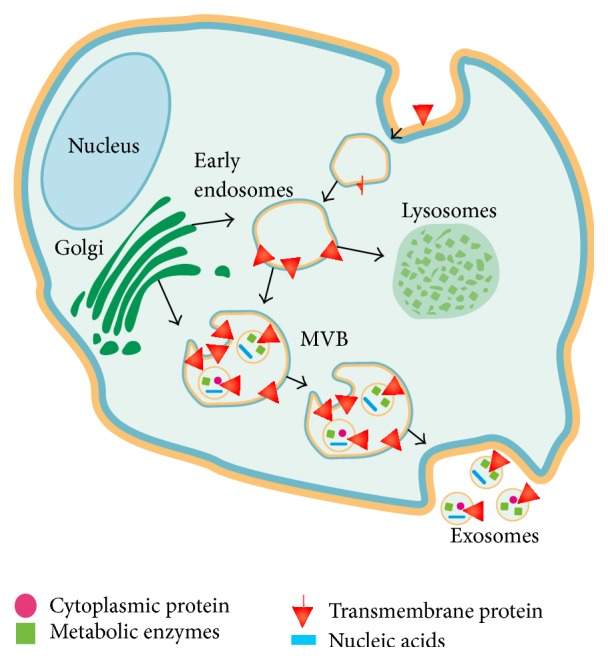
Figure 1
Figure 1
Biogenesis of exosomes. Exosomes are formed in the late endosomal compartment. They contain proteins from coated pits/lipid rafts in the cellular membrane, proteins directly sorted to the MVBs from RER and GC, mRNA, microRNA, and DNA. Exosomes are generated by inward budding of the limiting membrane of MVB, thus preserving the same orientation and folding of membrane-bound proteins on the exosomal membrane as those on the plasma membrane. The MVBs containing the exosomes either fuse with the plasma membrane to release exosomes or are sent to lysosomes for degradation (GC, Golgi complex; MVB, multivesicular body; and RER, rough endoplasmic reticulum).
Figure 2
Figure 2
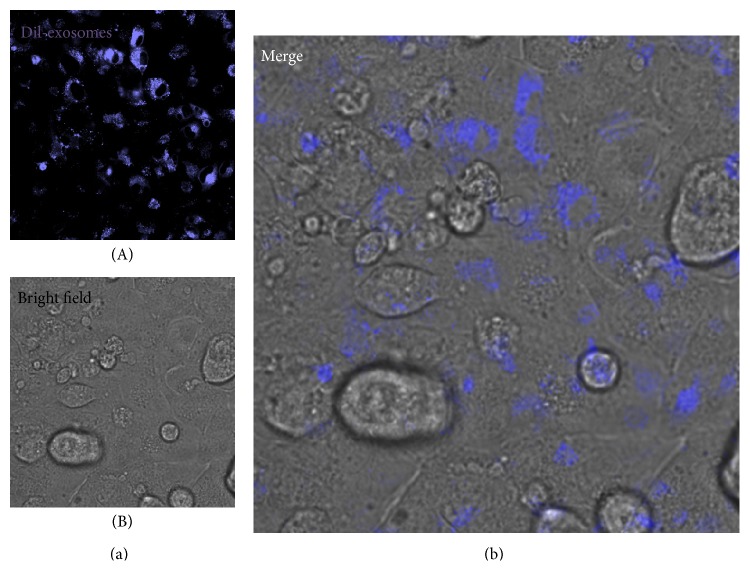
CPC exosome uptake by HL-1 CMs. (A) Laser confocal fluorescence photomicrograph showing HL-1 cells cultured with Dil-labeled (blue) human CPC exosomes. (B) Corresponding bright photomicrograph. (b) Merge (high magnification).
Figure 3
Figure 3
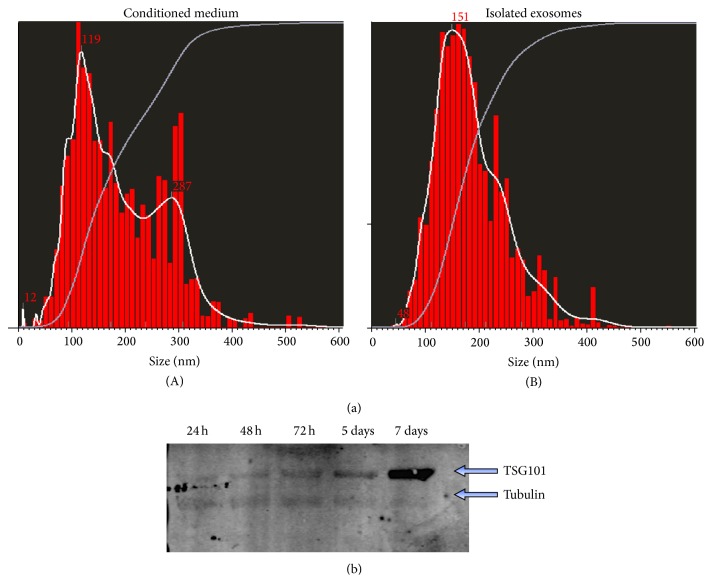
(a) Nanoparticle tracking analysis of CPC conditioned medium (A) and isolated CPC exosomes (B) using the Nanosight system. A minor peak at 287 nm seen in conditioned medium is not seen in purified exosomes. (b) Western blot analysis of the exosome marker TSG101 in exosomes isolated at the indicated time points of CPC cultures.

References

    1. Anversa P., Olivetti G., Melissari M., Loud A. V. Stereological measurement of cellular and subcellular hypertrophy and hyperplasia in the papillary muscle of adult rat. Journal of Molecular and Cellular Cardiology. 1980;12(8):781–795. doi: 10.1016/0022-2828(80)90080-2. - DOI - PubMed
    1. Laflamme M. A., Murry C. E. Heart regeneration. Nature. 2011;473(7347):326–335. doi: 10.1038/nature10147. - DOI - PMC - PubMed
    1. Barile L., Messina E., Giacomello A., Marbán E. Endogenous cardiac stem cells. Progress in Cardiovascular Diseases. 2007;50(1):31–48. doi: 10.1016/j.pcad.2007.03.005. - DOI - PubMed
    1. Théry C. Exosomes: secreted vesicles and intercellular communications. F1000 Biology Reports. 2011;3, article 15 doi: 10.3410/b3-15. - DOI - PMC - PubMed
    1. Quesenberry P. J., Goldberg L. R., Aliotta J. M., et al. Cellular phenotype and extracellular vesicles: basic and clinical considerations. Stem Cells and Development. 2014;23(13):1429–1436. doi: 10.1089/scd.2013.0594. - DOI - PMC - PubMed