


Diverse Cell Populations Involved in Regeneration of Renal Tubular Epithelium following Acute Kidney Injury
- PMID: 26089922
- PMCID: PMC4452180
- DOI: 10.1155/2015/964849
Diverse Cell Populations Involved in Regeneration of Renal Tubular Epithelium following Acute Kidney Injury
Abstract
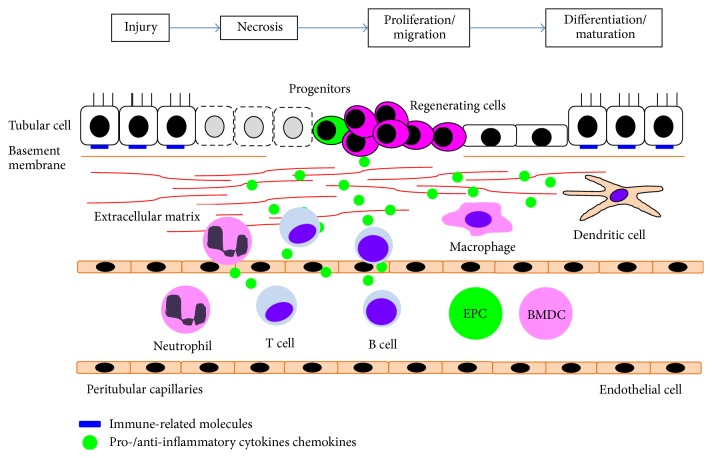
Renal tubular epithelium has the capacity to regenerate, repair, and reepithelialize in response to a variety of insults. Previous studies with several kidney injury models demonstrated that various growth factors, transcription factors, and extracellular matrices are involved in this process. Surviving tubular cells actively proliferate, migrate, and differentiate in the kidney regeneration process after injury, and some cells express putative stem cell markers or possess stem cell properties. Using fate mapping techniques, bone marrow-derived cells and endothelial progenitor cells have been shown to transdifferentiate into tubular components in vivo or ex vivo. Similarly, it has been demonstrated that, during tubular cell regeneration, several inflammatory cell populations migrate, assemble around tubular cells, and interact with tubular cells during the repair of tubular epithelium. In this review, we describe recent advances in understanding the regeneration mechanisms of renal tubules, particularly the characteristics of various cell populations contributing to tubular regeneration, and highlight the targets for the development of regenerative medicine for treating kidney diseases in humans.
Figures
References
Publication types
LinkOut - more resources
Full Text Sources
Other Literature Sources
