. 2015 Jun 19;46(1):63.
doi: 10.1186/s13567-015-0202-3.

The long subclinical phase of Mycobacterium avium ssp. paratuberculosis infections explained without adaptive immunity

Affiliations

The long subclinical phase of Mycobacterium avium ssp. paratuberculosis infections explained without adaptive immunity

Don Klinkenberg et al. Vet Res. .

Abstract

Mycobacterium avium ssp. paratuberculosis (MAP) is an infection of the ruminant intestine. In cows, a long subclinical phase with no or low intermittent shedding precedes the clinical phase with high shedding. It is generally considered that an adaptive cell-mediated immune response controls the infection during the subclinical phase, followed by unprotective antibodies later in life. Based on recent observations, we challenge the importance of adaptive immunity and instead suggest a role of the structural organization of infected macrophages in localized granulomatous lesions. We investigated this hypothesis by mathematical modelling. Our first model describes infection in a villus, assuming a constant lesion volume. This model shows the existence of two threshold parameters, the MAP reproduction ratio R MAP determining if a lesion can develop, and the macrophage replacement ratio R MF determining if recruitment of macrophages is sufficient for unlimited growth. We show that changes in R MF during a cow's life - i.e. changes in the innate immune response - can cause intermittent shedding. Our second model describes infection in a granuloma, assuming a growing lesion volume. This model confirms the results of the villus model, and can explain early slow granuloma development: small granulomas grow slower because bacteria leave the granuloma quickly through the relatively large surface area. In conclusion, our models show that the long subclinical period of MAP infection can result from the structural organization of the infection in granulomatous lesions with an important role for innate rather than adaptive immunity. It thus provides a reasonable hypothesis that needs further investigation.


Figures
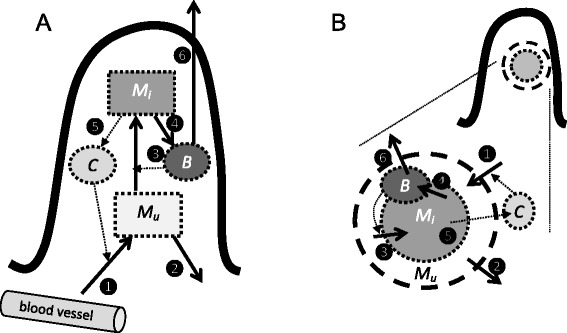
Figure 1
Figure 1
Sketch of the villus and granuloma models. In both models, M u is the number of uninfected macrophages, M i is the number of infected macrophages, B is the number of free bacteria, and C is the amount of cytokines. The processes in both models are (1) inflow of uninfected macrophages, both normal “background” inflow and additional recruitment proportional to the amount of cytokines; (2) outflow of uninfected macrophages; (3) infection of uninfected macrophages by free bacteria; (4) bursting of infected macrophages and release of free bacteria; (5) outflow of cytokines produced by infected macrophages; (6) outflow of free bacteria resulting in phagocytosis and excretion. All rates are density-dependent. In the villus model (A) the volume remains constant and the densities are proportional to the numbers of cells and amount of cytokines. In the granuloma model (B) the density of macrophages remains constant and the volume is determined by the number of macrophages; the densities are equal to the numbers of cells and amount of cytokines divided by the granuloma volume; some rates are proportional to the surface area (1, 2, 5, 6).
Figure 2
Figure 2
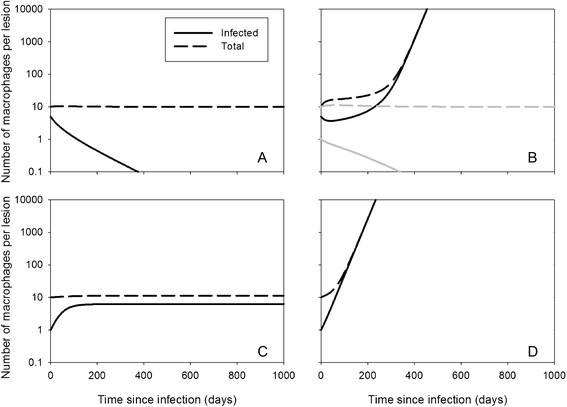
MAP dynamics with the villus model. Simulations with the villus model (Equation 2), with parameter values d = 0.04, M u 0 = 10, and b = 0.04. Other parameters: (A) R MAP = 0.8, R MF = 0.2; (B) R MAP = 0.8, R MF = 2; (C) R MAP = 0.8, R MF = 0.2; (D) R MAP = 0.8, R MF = 0.2. Initial conditions: (M u, M i) = (5, 5) in (A) and (B, black curve); (M u, M i) = (9, 1) in (B, grey curve), (C), (D).
Figure 3
Figure 3
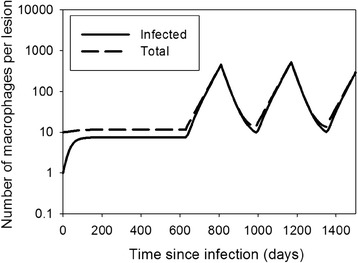
MAP intermittent shedding dynamics with the villus model. Simulations with the villus model (Equation 2), with parameter values d = 0.04, M u 0 = 10, b = 0.04, R MAP = 2.5. The parameter R MF = 0.2 before day 630, between days 810 and 990, and between days 1170–1350, otherwise R MF = 1.5. This reflects a cow with yearly calving and higher R MF three months before and three months after calving.
Figure 4
Figure 4
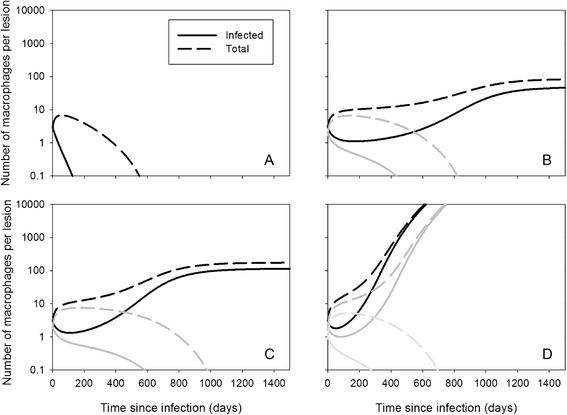
MAP dynamics with the granuloma model. Simulations with the granuloma model (Equation 4), with parameter values d = 0.04, i = 0.38, ρ = 1, and b = 0.04. Other parameters: (A) T MAP = 1.0, R MF = 0; (B) T MAP = 2.5, R MF = 0; (C) T MAP = 2.5, R MF = 0.2; (D) T MAP = 2.5, R MF = 1.1. Initial conditions: (M u, M i) = (0, 3) (black curves); (M u, M i) = (0, 2) (dark grey curves) (M u, M i) = (0, 1) (light grey curve).
Figure 5
Figure 5
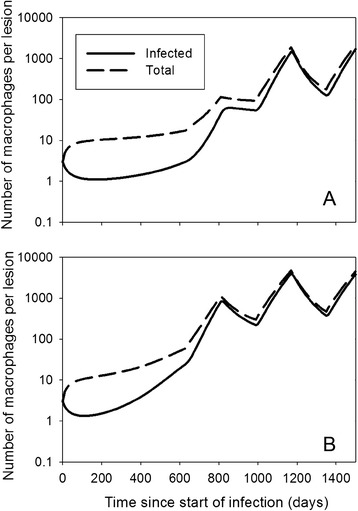
MAP intermittent shedding dynamics with the granuloma model. Simulations with the granuloma model (Equation 4), with parameter values d = 0.04, i = 0.38, ρ = 1, and b = 0.04. (A) The parameter R MF = 0 before day 630, between days 810 and 990, and between days 1170–1350, otherwise R MF = 1.1. (B) The parameter R MF = 0.2 before day 630, between days 810 and 990, and between days 1170–1350, otherwise R MF = 1.1. This reflects a cow with yearly calving and higher R MF three months before and three months after calving.

References

    1. Mitchell RM, Medley GF, Collins MT, Schukken YH. A meta-analysis of the effect of dose and age at exposure on shedding of Mycobacterium avium subspecies paratuberculosis (MAP) in experimentally infected calves and cows. Epidemiol Infect. 2012;140:231–246. doi: 10.1017/S0950268811000689. - DOI - PubMed
    1. Larsen AB, Merkal RS, Cutlip RC. Age of cattle as related to resistance to infection with Mycobactierium paratuberculosis. Am J Vet Res. 1975;36:255–257. - PubMed
    1. Sweeney RW. Pathogenesis of paratuberculosis. Vet Clin North Am Food Anim Pract. 2011;27:537–546. doi: 10.1016/j.cvfa.2011.07.001. - DOI - PubMed
    1. Sweeney RW, Jones DE, Habecker P, Scott P. Interferon-gamma and interleukin 4 gene expression in cows infected with Mycobacterium paratuberculosis. Am J Vet Res. 1998;59:842–847. - PubMed
    1. Stabel JR. Transitions in immune responses to Mycobacterium paratuberculosis. Vet Microbiol. 2000;77:465–473. doi: 10.1016/S0378-1135(00)00331-X. - DOI - PubMed

Publication types

LinkOut - more resources