. 2015 Aug;26(7-8):325-30.
doi: 10.1007/s00335-015-9573-z. Epub 2015 Jun 20.

MouseMine: a new data warehouse for MGI

Affiliations

MouseMine: a new data warehouse for MGI

H Motenko et al. Mamm Genome. 2015 Aug.

Abstract

MouseMine (www.mousemine.org) is a new data warehouse for accessing mouse data from Mouse Genome Informatics (MGI). Based on the InterMine software framework, MouseMine supports powerful query, reporting, and analysis capabilities, the ability to save and combine results from different queries, easy integration into larger workflows, and a comprehensive Web Services layer. Through MouseMine, users can access a significant portion of MGI data in new and useful ways. Importantly, MouseMine is also a member of a growing community of online data resources based on InterMine, including those established by other model organism databases. Adopting common interfaces and collaborating on data representation standards are critical to fostering cross-species data analysis. This paper presents a general introduction to MouseMine, presents examples of its use, and discusses the potential for further integration into the MGI interface.


Figures
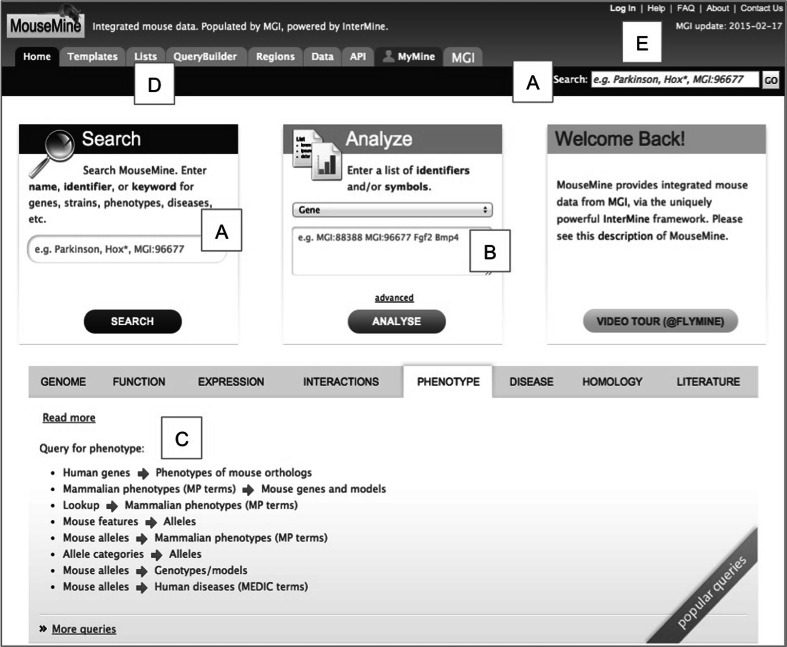
Fig. 1
Fig. 1
MouseMine home page (www.mousemine.org). The user can perform a keyword search (a), upload gene, or other IDs to create a list (b), or run one of the available queries (c). Other tabs (d) provide additional features such as the ability to create/edit custom queries or perform a region search. Users may optionally log in (e) in order to save lists and custom queries permanently. Other features on the home page include links to help, contact information, and the date of the most recent update from MGI
Fig. 2
Fig. 2
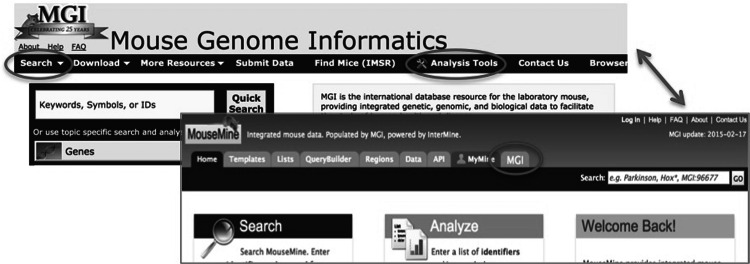
Top level links. Links to MouseMine from MGI are found on the main search menu and on the analysis tools page. A link to MGI from MouseMine is at the top of every MouseMine page
Fig. 3
Fig. 3
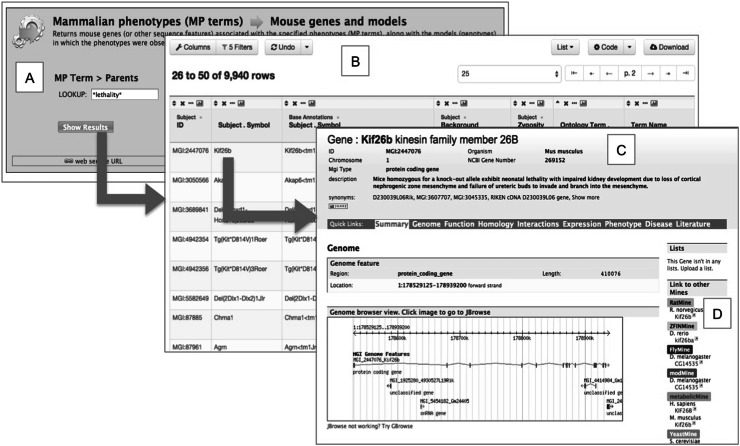
MouseMine offers query forms (a), tables of results (b), and detail pages for genes and other objects (c). Query forms tend to be very simple because results tables are so flexible, allowing easy filtering and customization after the initial query. Detail pages offer a variety of displays, e.g., graphical maps and result tables of data specific for that object. Gene pages in the different mines link to one another automatically, based on orthology relations (d)
Fig. 4
Fig. 4
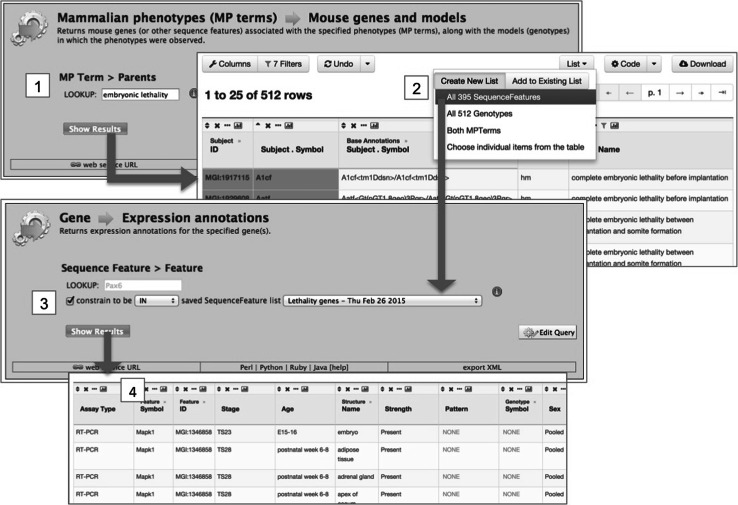
InterMine allows iterative workflows. From any query result, the user may further refine those results and then save a list of objects, e.g., genes, publications, GO terms, etc. In turn, saved lists can be combined (using standard set operations), and a list can be “plugged” into a query, running the query over that specific set of objects
Fig. 5
Fig. 5
The ability to save lists from queries, to combine saved lists in various ways, and to “plug” those lists into other queries, all combine to give the user great power and flexibility. Complex tasks can be broken down into a series of simple steps. In this example, the user wants the expression data for genes associated with certain embryonic lethality phenotypes in homozygous mutants. In the first panel (1), the user queries for all mouse genes and models (genotypes) associated with embryonic lethality. In the next panel (2), the user has filtered the results down to homozygous mutants and the particular forms of lethality (steps not shown) and is now saving the list of 395 remaining genes. In the next panel (3), the user “plugs” the new list, named “Lethality genes” (naming step not shown), into a query that returns all the expression data for those genes (4)
Fig. 6
Fig. 6
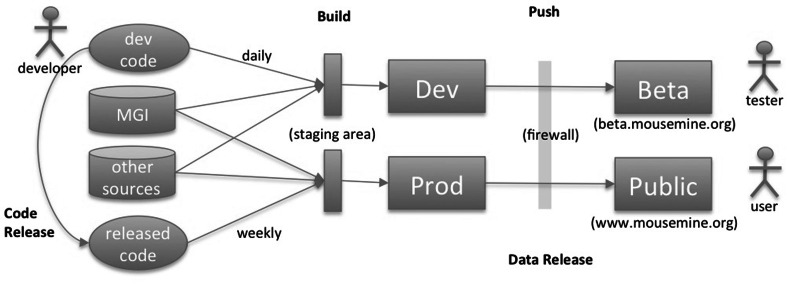
MouseMine build process. MouseMine builds are completely automated. The build process pulls data from MGI and a few other sources (e.g., ontologies are loaded from the OBO Foundry) to a staging area for loading/integrating in the mine. Each build is verified by a series of acceptance tests to ensure consistency with MGI. A successful build is then “pushed” across the Lab’s secure firewall to a public server. New development and testing, e.g., importing additional data types or developing new templates, happen on a Dev server and are pushed to a publicly accessible Beta server for preview. Sets of completed changes are then grouped and tagged for release and are included in the next build on Prod/Public

References

    1. Bult CJ, Krupke DM, Begley DA, Richardson JE, Neuhauser SB, Sundberg JP, Eppig JT. Mouse Tumor Biology (MTB): a database of mouse models for human cancer. Nucleic Acids Res. 2015;43:D818–D824. doi: 10.1093/nar/gku987. - DOI - PMC - PubMed
    1. Eppig JT, Blake JA, Bult CJ, Kadin JA, Richardson JE, Mouse Genome Database Group The Mouse Genome Database (MGD): facilitating mouse as a model for human biology and disease. Nucleic Acids Res. 2015;43:D726–D736. doi: 10.1093/nar/gku967. - DOI - PMC - PubMed
    1. Kalderimis A, Lyne R, Butano D, Contrino S, Lyne M, Heimbach J, Hu F, Smith R, Štěpán R, Sullivan J, Micklem G. InterMine: extensive web services for modern biology. Nucleic Acids Res. 2014;42:W468–W472. doi: 10.1093/nar/gku301. - DOI - PMC - PubMed
    1. Lyne R, Smith R, Rutherford K, Wakeling M, Varley A, Guillier F, Janssens H, Ji W, Mclaren P, North P, Rana D, Riley T, Sullivan J, Watkins X, Woodbridge M, Lilley K, Russell S, Ashburner M, Mizuguchi K, Micklem G. FlyMine: an integrated database for Drosophila and Anopheles genomics. Genome Biol. 2007;8(7):R129. doi: 10.1186/gb-2007-8-7-r129. - DOI - PMC - PubMed
    1. Smith RN, Aleksic J, Butano D, Carr A, Contrino S, Hu F, Lyne M, Lyne R, Kalderimis A, Rutherford K, Stepan R, Sullivan J, Wakeling M, Watkins X, Micklem G. InterMine: a flexible data warehouse system for the integration and analysis of heterogeneous biological data. Bioinformatics. 2012;28(23):3163–3165. doi: 10.1093/bioinformatics/bts577. - DOI - PMC - PubMed

Publication types

LinkOut - more resources