


Access to Electric Light Is Associated with Shorter Sleep Duration in a Traditionally Hunter-Gatherer Community
- PMID: 26092820
- PMCID: PMC5320422
- DOI: 10.1177/0748730415590702
Access to Electric Light Is Associated with Shorter Sleep Duration in a Traditionally Hunter-Gatherer Community
Abstract
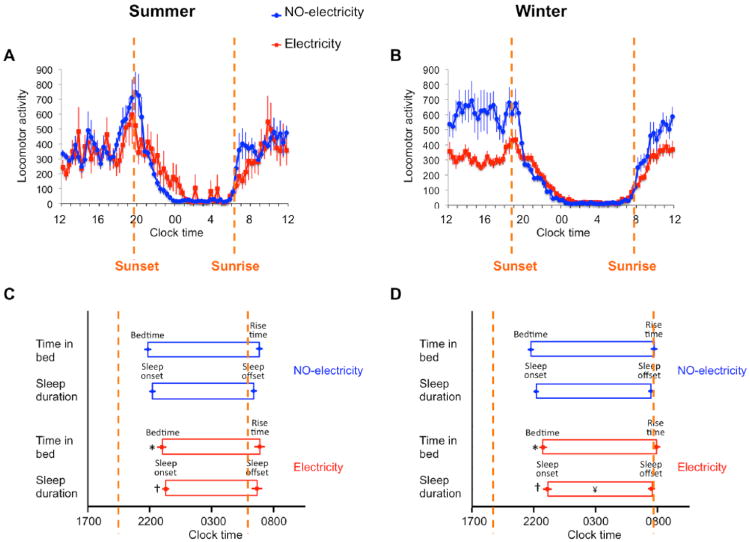
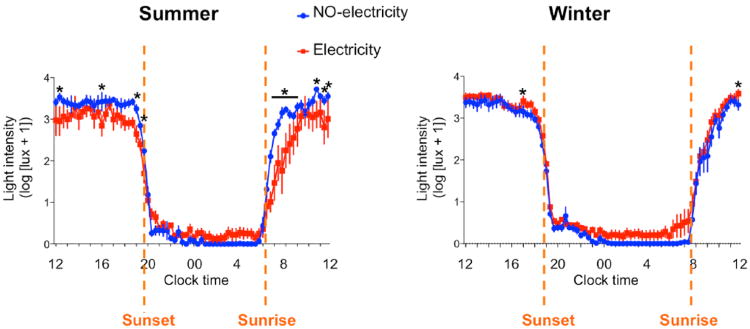
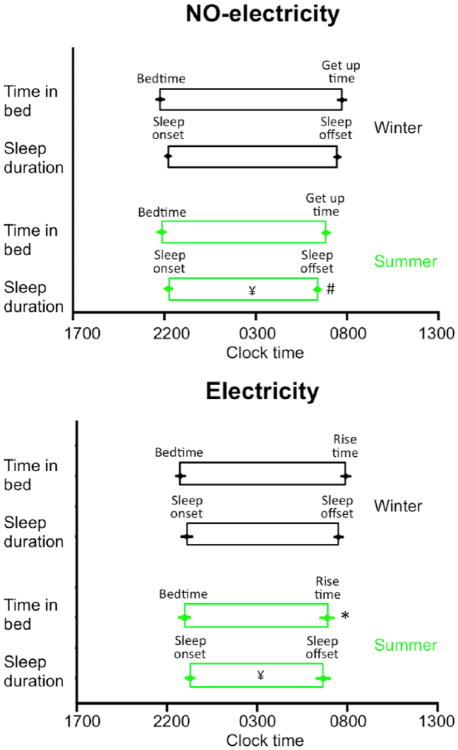
Access to electric light might have shifted the ancestral timing and duration of human sleep. To test this hypothesis, we studied two communities of the historically hunter-gatherer indigenous Toba/Qom in the Argentinean Chaco. These communities share the same ethnic and sociocultural background, but one has free access to electricity while the other relies exclusively on natural light. We fitted participants in each community with wrist activity data loggers to assess their sleep-wake cycles during one week in the summer and one week in the winter. During the summer, participants with access to electricity had a tendency to a shorter daily sleep bout (43 ± 21 min) than those living under natural light conditions. This difference was due to a later daily bedtime and sleep onset in the community with electricity, but a similar sleep offset and rise time in both communities. In the winter, participants without access to electricity slept longer (56 ± 17 min) than those with access to electricity, and this was also related to earlier bedtimes and sleep onsets than participants in the community with electricity. In both communities, daily sleep duration was longer during the winter than during the summer. Our field study supports the notion that access to inexpensive sources of artificial light and the ability to create artificially lit environments must have been key factors in reducing sleep in industrialized human societies.
Keywords: South American indigenous communities; artificial light-dark cycle; natural light-dark cycle; sleep timing.
© 2015 The Author(s).
Conflict of interest statement
Figures
References
-
- Ayres RU, Warr B. Accounting for growth: the role of physical work. Struct Change Econ Dynamics. 2004;16(2):181–209.
-
- Bekinschtein TA, Negro A, Goldín A, Fernández MP, Rosenbaum S, Golombek DA. Seasonality in a Mapuche native population. Biol Rhythm Res. 2004;35(1-2):145–152.
-
- Bin YS, Marshall NS, Glozier N. Secular trends in adult sleep duration: A systematic review. Sleep Med Rev. 2012;16(3):223–230. - PubMed
-
- Boivin DB, Duffy JF, Kronauer RE, Czeisler CA. Dose-response relationships for resetting of human circadian clock by light. Nature. 1996;379(6565):540–542. - PubMed
-
- Braunstein J, Miller E. Ethnohistorical introduction. In: Miller EK, editor. Peoples of the Gran Chaco. Bergin & Garvey; Westport, CT: 1999.
Publication types
MeSH terms
Grants and funding
LinkOut - more resources
Full Text Sources
Other Literature Sources
