. 2015 Jul 2;97(1):170-6.
doi: 10.1016/j.ajhg.2015.05.012. Epub 2015 Jun 18.

Paired-Duplication Signatures Mark Cryptic Inversions and Other Complex Structural Variation

Affiliations

Paired-Duplication Signatures Mark Cryptic Inversions and Other Complex Structural Variation

Harrison Brand et al. Am J Hum Genet. .

Abstract

Copy-number variants (CNVs) have been the predominant focus of genetic studies of structural variation, and chromosomal microarray (CMA) for genome-wide CNV detection is the recommended first-tier genetic diagnostic screen in neurodevelopmental disorders. We compared CNVs observed by CMA to the structural variation detected by whole-genome large-insert sequencing in 259 individuals diagnosed with autism spectrum disorder (ASD) from the Simons Simplex Collection. These analyses revealed a diverse landscape of complex duplications in the human genome. One remarkably common class of complex rearrangement, which we term dupINVdup, involves two closely located duplications ("paired duplications") that flank the breakpoints of an inversion. This complex variant class is cryptic to CMA, but we observed it in 8.1% of all subjects. We also detected other paired-duplication signatures and duplication-mediated complex rearrangements in 15.8% of all ASD subjects. Breakpoint analysis showed that the predominant mechanism of formation of these complex duplication-associated variants was microhomology-mediated repair. On the basis of the striking prevalence of dupINVdups in this cohort, we explored the landscape of all inversion variation among the 235 highest-quality libraries and found abundant complexity among these variants: only 39.3% of inversions were canonical, or simple, inversions without additional rearrangement. Collectively, these findings indicate that dupINVdups, as well as other complex duplication-associated rearrangements, represent relatively common sources of genomic variation that is cryptic to population-based microarray and low-depth whole-genome sequencing. They also suggest that paired-duplication signatures detected by CMA warrant further scrutiny in genetic diagnostic testing given that they might mark complex rearrangements of potential clinical relevance.


Figures

Figure 1
Figure 1
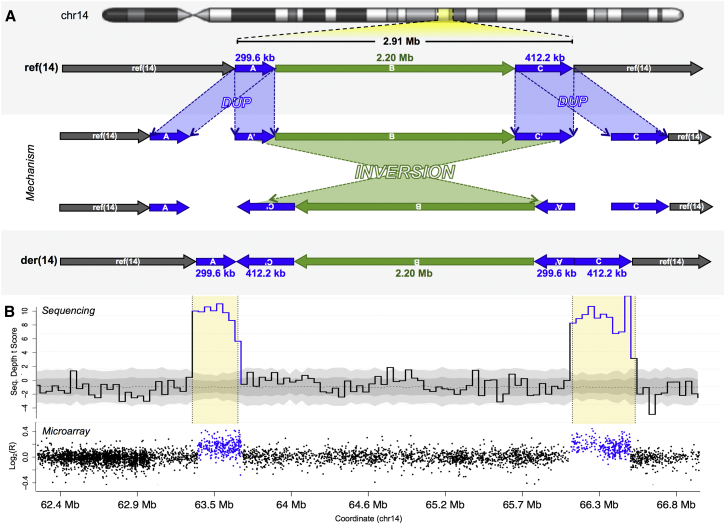
Paired Duplications Mark Cryptic Inversions (A) Duplication of two loci in proximity (segments A and C, in blue) flanks an inversion (segment B, in green) of the interval between the paired-duplication breakpoints. This example involves the rearrangement of 2.91 Mb of chromosome 14 (gray) in an ASD proband. (B) WGS clearly delineated the two flanking duplications (top), which were confirmed by microarray (bottom). Sequencing depth (top) is represented by the binwise t-score of the scaled physical sequence depth from mapped inserts in this ASD proband when normalized against all other probands in the cohort (n = 259). Blue bins indicate a statistically significant sequencing-depth alteration that exceeds a Bonferroni-corrected threshold. Gray shading represents either one (dark gray) or two (light gray) binwise median absolute deviations across all probands. Flanking duplications as delineated by clustered read pairs are highlighted in yellow. Microarray intensities (bottom) are plotted as log2 marker-intensity ratios; all markers corresponding to the microarray duplication calls are shaded blue. All coordinates listed are based upon the GRCh37 reference genome build version 71 (UCSC Genome Browser).
Figure 2
Figure 2
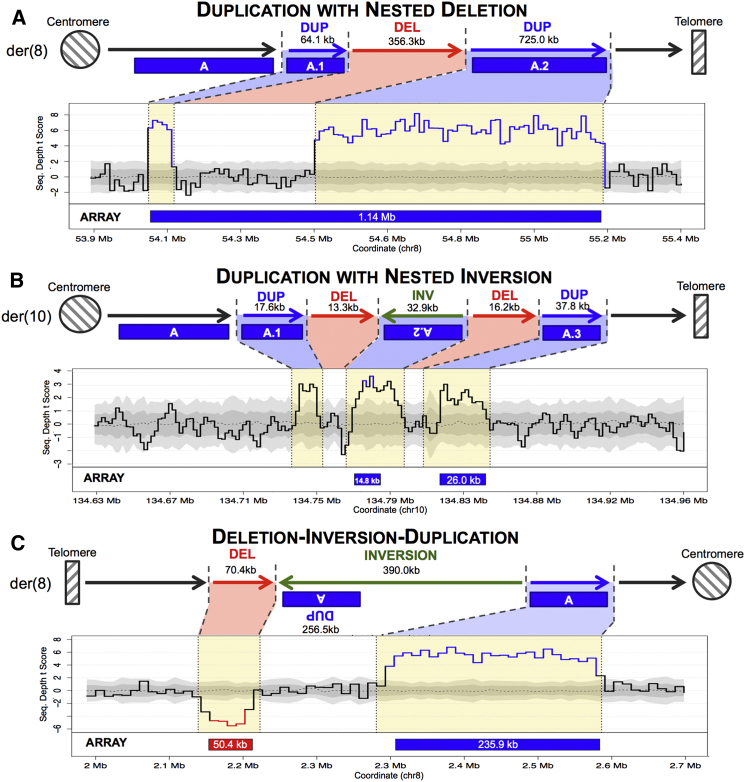
Sequencing Identifies a Spectrum of Complex Rearrangements Associated with Duplications Detected by Microarray Sequencing revealed that 7.6% of rare (≤1% population frequency) duplications detected by microarray at 40-kb resolution or greater were associated with cryptic complex rearrangements. The majority of these complex duplications were paired-duplication inversions (dupINVdup) as described in Figure 1; however, we also observed a spectrum of complex duplication-mediated rearrangements, such as duplications with nested deletions misclassified by microarray as single large duplications (A), complex duplication inversions with internal deletions (B), or rare duplications flanking inversions with distal deletions (C). See Figure 1 for a description of sequencing-depth plots.
Figure 3
Figure 3
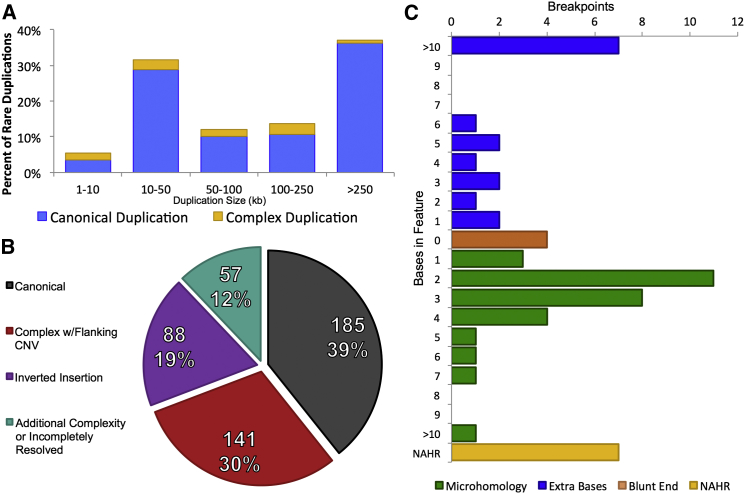
Characteristics of Complex Duplication and Inversion Rearrangements (A) Sizes of complex duplications (gold bars) are compared to those of all rare duplications identified in four or fewer individuals in this cohort (allele frequency ≤ 1.5%; blue bars). (B) Characterization of all 471 inversion variants detected among the 235 highest-quality proband WGS libraries (>60× haploid physical coverage) revealed that only 185/471 (39.3%) of inversion variants were simple, or canonical, inversions. (C) Microhomology-mediated breakpoint formation (green) was the predominant feature among all breakpoints of complex duplication-mediated rearrangements identified in this cohort. Notably, seven breakpoints also featured the insertion of non-templated sequence (blue) in excess of 10 bp.
Figure 4
Figure 4
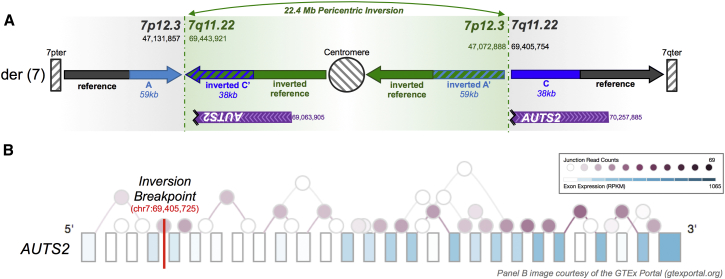
A Large Pericentric dupINVdup Directly Disrupts AUTS2 in a Proband with a Neuropsychiatric Phenotype (A) A de novo dupINVdup involves a 22.4-Mb pericentric inversion that is flanked by 59- and 38-kb duplications (blue) and directly disrupts AUTS2, a known pathogenic locus in ASD. Karyotype analysis confirmed the presence of the pericentric inversion, corroborating the proposed structure of the dupINVdup variants detected herein. The karyotype interpretation was inv(7)(p13q11.23). (B) Cortex expression data from the GTEx consortium portal (see Web Resources) are shown for the most common AUTS2 transcript. The breakpoint of this de novo disruptive dupINVdup is shown in red.

References

    1. Sebat J., Lakshmi B., Malhotra D., Troge J., Lese-Martin C., Walsh T., Yamrom B., Yoon S., Krasnitz A., Kendall J. Strong association of de novo copy number mutations with autism. Science. 2007;316:445–449. - PMC - PubMed
    1. Glessner J.T., Wang K., Cai G., Korvatska O., Kim C.E., Wood S., Zhang H., Estes A., Brune C.W., Bradfield J.P. Autism genome-wide copy number variation reveals ubiquitin and neuronal genes. Nature. 2009;459:569–573. - PMC - PubMed
    1. Girirajan S., Johnson R.L., Tassone F., Balciuniene J., Katiyar N., Fox K., Baker C., Srikanth A., Yeoh K.H., Khoo S.J. Global increases in both common and rare copy number load associated with autism. Hum. Mol. Genet. 2013;22:2870–2880. - PMC - PubMed
    1. Pinto D., Pagnamenta A.T., Klei L., Anney R., Merico D., Regan R., Conroy J., Magalhaes T.R., Correia C., Abrahams B.S. Functional impact of global rare copy number variation in autism spectrum disorders. Nature. 2010;466:368–372. - PMC - PubMed
    1. Mills R.E., Walter K., Stewart C., Handsaker R.E., Chen K., Alkan C., Abyzov A., Yoon S.C., Ye K., Cheetham R.K., 1000 Genomes Project Mapping copy number variation by population-scale genome sequencing. Nature. 2011;470:59–65. - PMC - PubMed

Publication types

MeSH terms

Substances