


Tumour regression in the randomized Stockholm III Trial of radiotherapy regimens for rectal cancer
- PMID: 26095256
- PMCID: PMC4744683
- DOI: 10.1002/bjs.9811
Tumour regression in the randomized Stockholm III Trial of radiotherapy regimens for rectal cancer
Abstract
Background: The Stockholm III Trial randomized patients with primary operable rectal cancers to either short-course radiotherapy (RT) with immediate surgery (SRT), short-course RT with surgery delayed 4-8 weeks (SRT-delay) or long-course RT with surgery delayed 4-8 weeks. This preplanned interim analysis examined the pathological outcome of delaying surgery.
Methods: Patients randomized to the SRT and SRT-delay arms in the Stockholm III Trial between October 1998 and November 2010 were included, and data were collected in a prospective register. Additional data regarding tumour regression grade, according to Dworak, and circumferential margin were obtained by reassessment of histopathological slides.
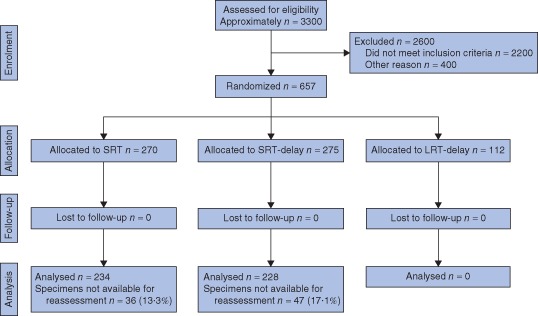
Results: A total of 462 of 545 randomized patients had specimens available for reassessment. Patients randomized to SRT-delay had earlier ypT categories, and a higher rate of pathological complete responses (11·8 versus 1·7 per cent; P = 0·001) and Dworak grade 4 tumour regression (10·1 versus 1·7 per cent; P < 0·001) than patients randomized to SRT without delay. Positive circumferential resection margins were uncommon (6·3 per cent) and rates did not differ between the two treatment arms.
Conclusion: Short-course RT induces tumour downstaging if surgery is performed after an interval of 4-8 weeks.
© 2015 The Authors. BJS published by John Wiley & Sons Ltd on behalf of BJS Society Ltd.
Figures
Comment in
-
[Tumor regression after neoadjuvant short-term irradiation for rectal cancer].Chirurg. 2015 Sep;86(9):900. doi: 10.1007/s00104-015-0070-4. Chirurg. 2015. PMID: 26228027 German. No abstract available.
References
-
- Peeters KC, Marijnen CA, Nagtegaal ID, Kranenbarg EK, Putter H, Wiggers T et al The TME trial after a median follow‐up of 6 years: increased local control but no survival benefit in irradiated patients with resectable rectal carcinoma. Ann Surg 2007; 246: 693–701. - PubMed
-
- Kapiteijn E, Marijnen CA, Nagtegaal ID, Putter H, Steup WH, Wiggers T et al Preoperative radiotherapy combined with total mesorectal excision for resectable rectal cancer. N Engl J Med 2001; 345: 638–646. - PubMed
-
- Improved survival with preoperative radiotherapy in resectable rectal cancer. Swedish Rectal Cancer Trial [see comments]. N Engl J Med 1997; 336: 980–987 - PubMed
- [published erratum appears in N Engl J Med 1997; 336: 1539].
-
- Martling A, Holm T, Johansson H, Rutqvist L, Cedermark B. The Stockholm II trial on preoperative radiotherapy in rectal carcinoma. Cancer 2001; 92: 896–902. - PubMed
Publication types
MeSH terms
LinkOut - more resources
Full Text Sources
Other Literature Sources
Medical
