. 2015 Oct;237(2):179-89.
doi: 10.1002/path.4573. Epub 2015 Jul 14.

Genomic landscape of adenoid cystic carcinoma of the breast

Affiliations

Genomic landscape of adenoid cystic carcinoma of the breast

Luciano G Martelotto et al. J Pathol. 2015 Oct.

Abstract

Adenoid cystic carcinoma (AdCC) is a rare type of triple-negative breast cancer (TNBC) characterized by the presence of the MYB-NFIB fusion gene. The molecular underpinning of breast AdCCs other than the MYB-NFIB fusion gene remains largely unexplored. Here we sought to define the repertoire of somatic genetic alterations of breast AdCCs. We performed whole-exome sequencing, followed by orthogonal validation, of 12 breast AdCCs to determine the landscape of somatic mutations and gene copy number alterations. Fluorescence in situ hybridization and reverse-transcription PCR were used to define the presence of MYB gene rearrangements and MYB-NFIB chimeric transcripts. Unlike common forms of TNBC, we found that AdCCs have a low mutation rate (0.27 non-silent mutations/Mb), lack mutations in TP53 and PIK3CA and display a heterogeneous constellation of known cancer genes affected by somatic mutations, including MYB, BRAF, FBXW7, SMARCA5, SF3B1 and FGFR2. MYB and TLN2 were affected by somatic mutations in two cases each. Akin to salivary gland AdCCs, breast AdCCs were found to harbour mutations targeting chromatin remodelling, cell adhesion, RNA biology, ubiquitination and canonical signalling pathway genes. We observed that, although breast AdCCs had rather simple genomes, they likely display intra-tumour genetic heterogeneity at diagnosis. Taken together, these findings demonstrate that the mutational burden and mutational repertoire of breast AdCCs are more similar to those of salivary gland AdCCs than to those of other types of TNBCs, emphasizing the importance of histological subtyping of TNBCs. Furthermore, our data provide direct evidence that AdCCs harbour a distinctive mutational landscape and genomic structure, irrespective of the disease site of origin.

Keywords: MYB-NFIB; adenoid cystic carcinoma; genomics; massively parallel sequencing; triple-negative breast cancer.


Conflict of interest statement

Conflict of interest: The authors have no conflicts of interest to declare.

Figures

Figure 1
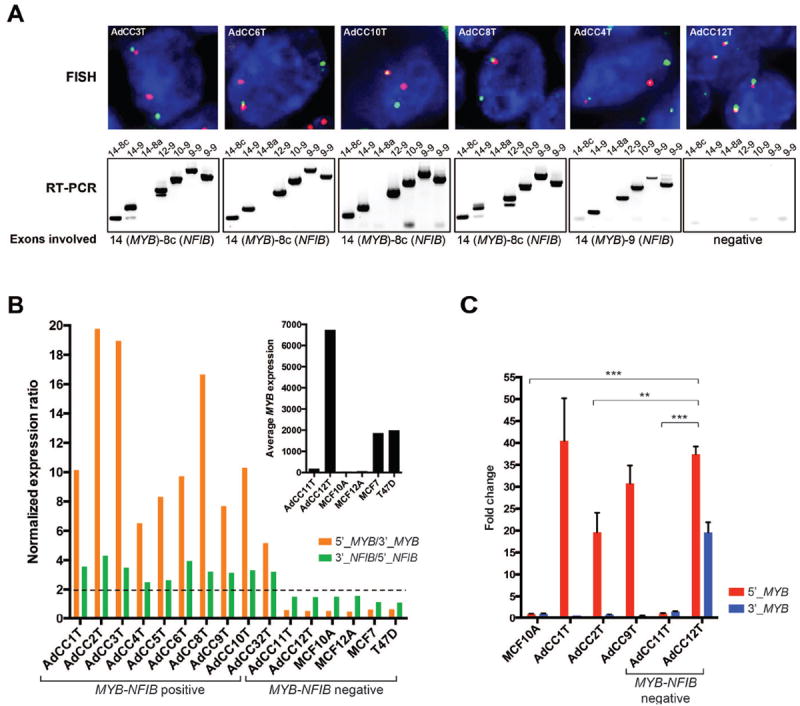
Figure 1. Detection of the MYB-NFIB fusion gene and MYB and NFIB expression in breast AdCCs
(A), Representative FISH micrographs and results of RT-PCR. A MYB dual color break-apart probe (top panel) was employed for FISH, where the green and the red probes are proximal and distal to the MYB breakpoint cluster region, respectively. The MYB-NFIB fusion transcripts (bottom panel) were detected using primers located in MYB exons 9, 10, 12 and 14, and in NFIB exons 8a, 8c and 9; lane names indicate the respective exons tested. In AdCC12T, neither a MYB split signal nor a MYB-NFIB fusion transcript could be identified. For the RT-PCR results of the remaining cases, see Supplementary Figure S2. (B) Normalized mRNA expression ratios of 5’_MYB(exons1-2)/3’_MYB(3’UTR) and 3’_NFIB(3’UTR)/5’_NFIB(exons5-6) for all breast AdCCs defined by digital gene expression. Controls included RNA derived from MCF10A and MCF12A breast epithelial cells (negative for MYB and MYB-NFIB fusion mRNA expression), and from T47D and MCF7 ER-positive breast cancer cell lines (positive for MYB and negative for MYB-NFIB fusion mRNA expression). Dotted line, 2-fold expression difference. Inset illustrating the average between 5’ and 3’ signals of MYB mRNA expression in the MYB-NFIB fusion gene-negative tumors AdCC11T and AdCC12T and in cell line controls. (C) Representative quantitative RT-PCR analysis of expression of 5’ and 3’ regions of MYB mRNA in 3 MYB-NFIB fusion gene-positive and the 2 MYB-NFIB fusion gene-negative AdCCs, and MCF10A cell line control. P-values, one-way ANOVA, Bonferroni’s multiple comparison correction, alpha: 0.05. **p<0.01, ***p<0.001. Error bars, s.d. of the mean (n=3 experimental replicates).
Figure 2
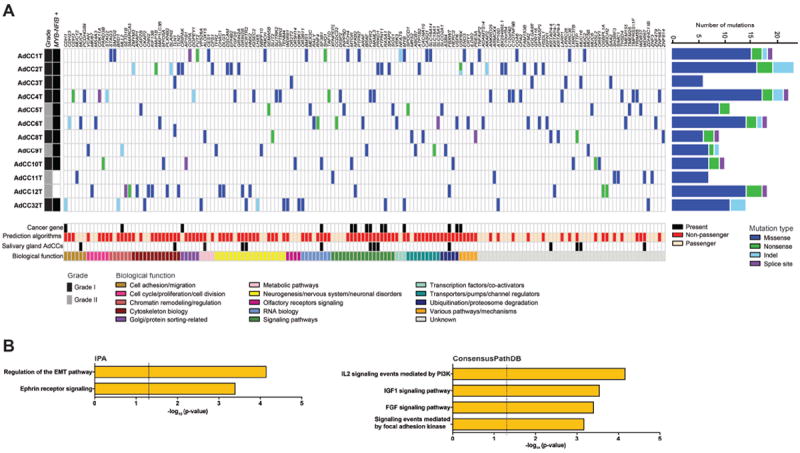
Figure 2. Spectrum of somatic mutations in breast AdCCs
(A) Matrix of all validated and high-confidence somatic mutations identified in 12 breast AdCCs, color-coded by mutation type. The number of mutations identified per case is indicated on the right, and the histologic grade and MYB-NFIB fusion gene status on the left. Somatic mutations were classified according to their biological function, and the membership of each gene in cancer gene datasets (Kandoth et al. [43], Cancer Gene Census [42] and Lawrence et al. [44]). The results of mutation effect prediction algorithms [35-37], and the mutation status in salivary gland AdCCs [12,13] are also shown. (B) Pathways enriched for genes targeted by somatic non-passenger mutations in breast AdCCs, as defined by Ingenuity Pathway Analysis (IPA, left) and ConsensusPathDB [38] (right). Log values of the Benjamini-Hochberg corrected p-value (IPA) and of the hypergeometric test p-value (ConsensusPathDB) are shown.
Figure 3
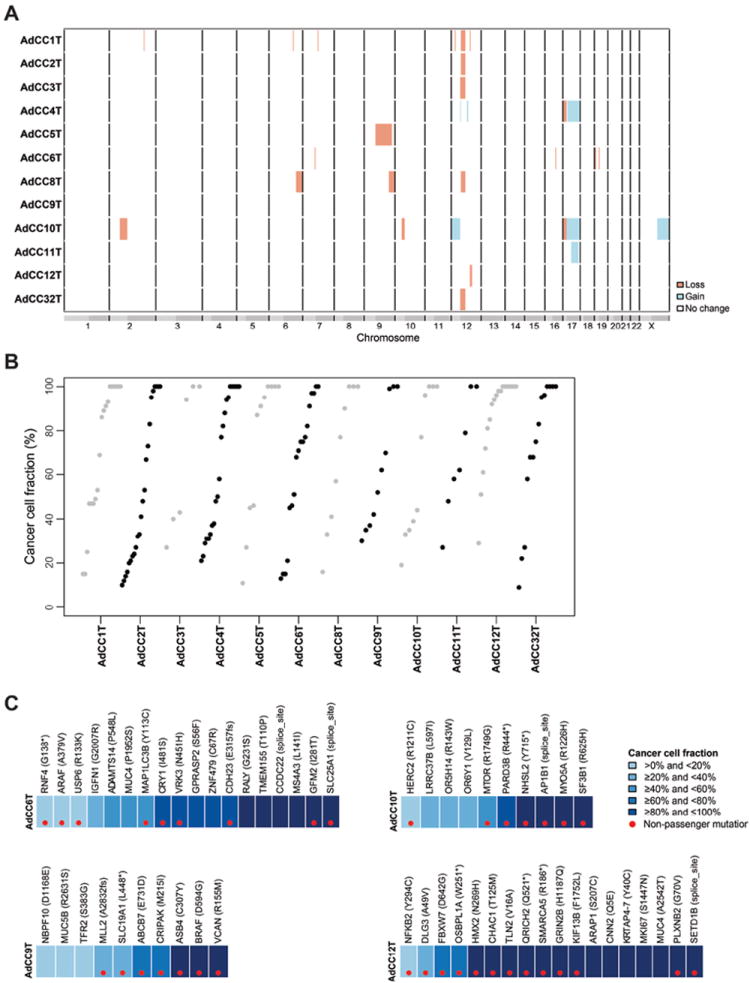
Figure 3. Copy number alterations and clonal mutation frequencies in breast AdCCs
(A) Copy number profiles of breast AdCCs. The genomic position is plotted along the x-axis and the samples on the y-axis. No amplifications and homozygous deletions were found. AdCCs harbored recurrent losses of 12q12-q14.1 and gains of 17q21-q25.1. Orange, copy number loss, blue, copy number gain, white, no copy number change. (B) Clonal frequencies of mutations in breast AdCCs as defined by ABSOLUTE [40] through integration of tumor cellularity, ploidy, gene copy number and mutation data. While all cases harbored clonal mutations (cancer cell fraction ≥80%), validated subclonal mutations were also identified. (C) Representative clonal frequency plots of breast AdCCs as defined by ABSOLUTE [40] through integration of tumor cellularity, ploidy, gene copy number and mutation data. Cancer cell fractions according to the color-coding in the legend. Red dots represent likely non-passenger mutations.

References

    1. Marchio C, Weigelt B, Reis-Filho JS. Adenoid cystic carcinomas of the breast and salivary glands (or ‘The strange case of Dr Jekyll and Mr Hyde’ of exocrine gland carcinomas) J Clin Pathol. 2010;63:220–228. - PubMed
    1. Weigelt B, Horlings HM, Kreike B, et al. Refinement of breast cancer classification by molecular characterization of histological special types. J Pathol. 2008;216:141–150. - PubMed
    1. Lakhani SR, Ellis IO, Schnitt SJ, Tan PH, van de Vijver MJ. WHO Classification of Tumours of the Breast. IARC; Lyon: 2012.
    1. Weigelt B, Reis-Filho JS. Histological and molecular types of breast cancer: is there a unifying taxonomy? Nat Rev Clin Oncol. 2009;6:718–730. - PubMed
    1. Foulkes WD, Smith IE, Reis-Filho JS. Triple-negative breast cancer. N Engl J Med. 2010;363:1938–1948. - PubMed

Publication types

MeSH terms

Substances