. 2016 Mar 31;35(13):1736-42.
doi: 10.1038/onc.2015.233. Epub 2015 Jun 22.

Comprehensive translational control of tyrosine kinase expression by upstream open reading frames

Affiliations

Comprehensive translational control of tyrosine kinase expression by upstream open reading frames

K Wethmar et al. Oncogene. .

Abstract

Post-transcriptional control has emerged as a major regulatory event in gene expression and often occurs at the level of translation initiation. Although overexpression or constitutive activation of tyrosine kinases (TKs) through gene amplification, translocation or mutation are well-characterized oncogenic events, current knowledge about translational mechanisms of TK activation is scarce. Here, we report the presence of translational cis-regulatory upstream open reading frames (uORFs) in the majority of transcript leader sequences of human TK mRNAs. Genetic ablation of uORF initiation codons in TK transcripts resulted in enhanced translation of the associated downstream main protein-coding sequences (CDSs) in all cases studied. Similarly, experimental removal of uORF start codons in additional non-TK proto-oncogenes, and naturally occurring loss-of-uORF alleles of the c-met proto-oncogene (MET) and the kinase insert domain receptor (KDR), was associated with increased CDS translation. Based on genome-wide sequence analyses we identified polymorphisms in 15.9% of all human genes affecting uORF initiation codons, associated Kozak consensus sequences or uORF-related termination codons. Together, these data suggest a comprehensive role of uORF-mediated translational control and delineate how aberrant induction of proto-oncogenes through loss-of-function mutations at uORF initiation codons may be involved in the etiology of cancer. We provide a detailed map of uORFs across the human genome to stimulate future research on the pathogenic role of uORFs.


Figures
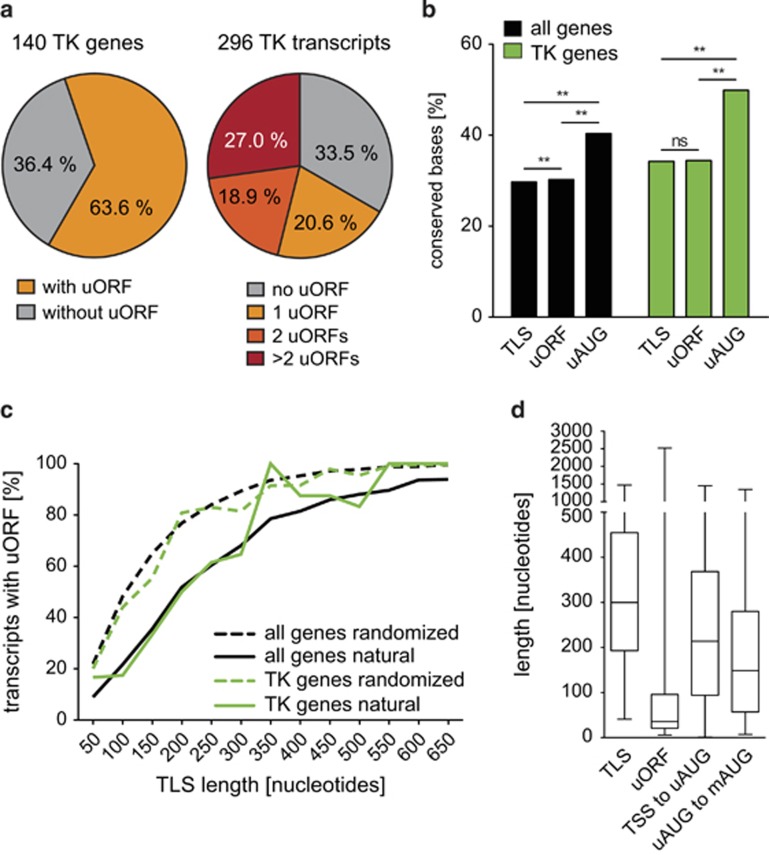
Figure 1
Figure 1
Presence, conservation and position of uORFs in human tyrosine kinases and all human genes. (a) Pie charts indicating the prevalence of uORFs in TK genes and the number of uORFs per transcript for alternative TK mRNAs. (b) Bar graph displaying the frequency of conserved bases within TLSs, uORFs and uAUGs of TKs and all human genes. Note that columns labeled ‘TLS' do not include uORF bases and columns labeled ‘uORF' do not include uAUGs, respectively. For genome-wide transcript analyses, Hg19 annotations were downloaded from the UCSC genome browser database. Of 44 113 entries, we excluded 7794 non-coding RNAs, 1861 sequences not aligning to autosomes or sexual chromosomes, and 1237 transcripts lacking a TLS. Finally, we positively selected the 32 332 mRNAs with unique genome alignments corresponding to 17 893 distinct genes (ftp://ftp.ncbi.nih.gov/refseq/H_sapiens/mRNA_Prot/). Conservation was defined by mapping the respective genomic positions to the ‘100 vertebrates conserved elements' provided by UCSC (http://genome.ucsc.edu/cgi-bin/hgTrackUi?g=cons100way). Statistical significance was analyzed using the χ2 test and indicated as **P<0.01 and NS (not significant). (c) Graph indicating the prevalence of uORFs in respect to the length of the TLS for TKs and all human genes (solid green and black lines, respectively). Dashed lines indicate expected uORF frequencies for TKs and all human genes following a 10 000-times randomization of TLS nucleotides (green and black, respectively). (d) Box plots summarizing the variable length of TLSs and uORFs in TK transcripts. The graph indicates the range of nucleotide distances from the transcriptional start site (TSS) to the uAUG and from the uAUG to the main AUG (mAUG).
Figure 2
Figure 2
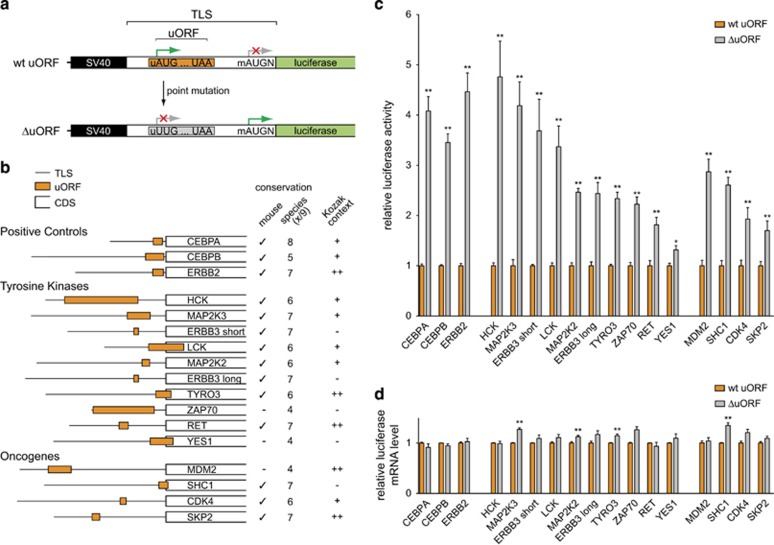
uORFs repress downstream translation of TKs and other proto-oncogenes. (a) Graphic representation of the luciferase reporter construct. The plasmid allows the insertion of a complete TLS including the endogenous mAUG initiation codon plus the surrounding Kozak sequence including base +4 (N) to retain the gene-specific initiation context. For functional experiments, the wild-type (wt) uORF initiation codon was deleted by the insertion of a point mutation that creates a UUG codon instead (ΔuORF). To generate the reporter plasmid, an SV40 promoter originating from the pSG5 vector (Agilent Technologies) was cloned into the pGL3-Basic vector (Promega). Then, the SV40 promoter plus the remainder of the multiple cloning (MCS) site of the pGL3-Basic vector were PCR-amplified and cloned back into the KpnI and a newly generated SacII restriction site, obtained by mutating the Firefly luciferase initiation codon of pSG5 to GCG. This cloning strategy resulted in a reporter plasmid with the required structure: 5′-SV40 promoter–MCS–luciferase gene-3′. TLSs containing either the wt uORF start site or a respective uUUG mutation (ΔuORF) were synthesized by GeneArt Gene Synthesis (Life Technologies) and introduced in-frame with the luciferase coding sequence. (For details on restriction sites and inserted sequences, see Supplementary Figure 1 and Supplementary Table 3 and 4). (b) Schematic representation of the position and length of uORFs within the TLSs of three positive control transcripts, 10 selected TKs and 4 other proto-oncogenes. Conservation of the uAUG among human and mouse (check mark) and among a total of nine vertebrate species (human, rhesus, mouse, rat, cow, dog, elephant, chicken, zebrafish) is depicted. The Kozak context is indicated as strong (++, a purine base at −3 and a guanine base at +4), intermediate (+, one of the core Kozak bases matches) or weak (−, no core Kozak base matches). Note that SKP2, MDM2 and CDK4 contain additional potential uORFs that were excluded from display and functional analysis as they were not consistently translated in ribosome profiling studies. (c) Bar graph showing the relative reporter activity in the presence of wt uORF and ΔuORF containing TLSs of indicated proteins. For Luciferase assays, HeLa cells were seeded in duplicates and cultured under standard conditions. After 6 h, cells were transfected with 1 μg/12-well of the TLS luciferase reporter construct and 30 ng of Renilla luciferase reporter construct (pRL-CMV, Promega) using Metafectene transfection reagent (Biontex). After 42 h, Firefly and Renilla luciferase activities were determined following a published protocol. For each construct, Firefly luciferase signals were normalized to Renilla luciferase internal control signals. (d) Bar graph indicating the relative luciferase mRNA levels of wt uORF and ΔuORF reporter constructs for indicated TLSs. Quantitative real-time PCRs was performed after RNA extraction and cDNA synthesis following standard protocols and using custom primers that targeted Firefly and Renilla luciferase as an internal control (Supplementary Table 4). Error bars represent the s.e.m. of three independent experiments. Data were analyzed by using GraphPad Prism (Version 5.0a) and statistically evaluated by the two-tailed, nonparametric Mann–Whitney test. Asterisks indicate statistical significance (**P<0.01 and *P<0.05).
Figure 3
Figure 3
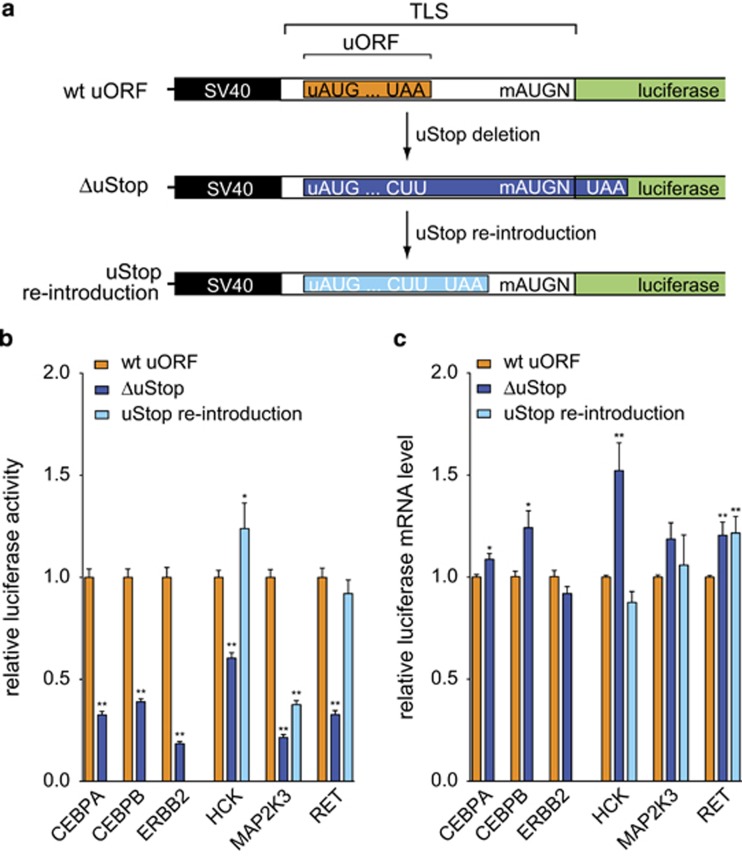
Reinitiating ribosomes contribute to TK translation. (a) Schematic representation of mutations introduced into the TLS reporter construct to determine the contribution of reinitiating ribosomes to TK translation. The deletion of uORF-related upstream stop codons (uStops to CUU, ΔuStop) created extended uORFs that overlapped the mAUG start site. Second, an alternative uStop codon was re-introduced between the natural uStop and the mAUG codon (uStop re-introduction). For CEBPA, CEBPB and ERBB2, the uStop re-introduction was not performed as the distances between the uStop and the CDS were as short as 7, 4 and 5 nt, respectively. All mutations were introduced by site-directed mutagenesis of the wt uORF version of the respective TLS using the PfuPlus! DNA Polymerase (Roboklon) and customized primers (Supplementary Tables 3 and 4). (b) Bar graph representing the relative luciferase activity detected in the presence of wt uORF-, ΔuStop- and re-introduced uStop-containing TLSs. (c) Bar graph indicating the relative luciferase mRNA levels of wt uORF, ΔuStop and re-introduced uStop reporter constructs for indicated TLSs. Error bars represent the s.e.m. of at least three independent experiments. Asterisks indicate statistical significance (**P<0.01 and *P<0.05).
Figure 4
Figure 4
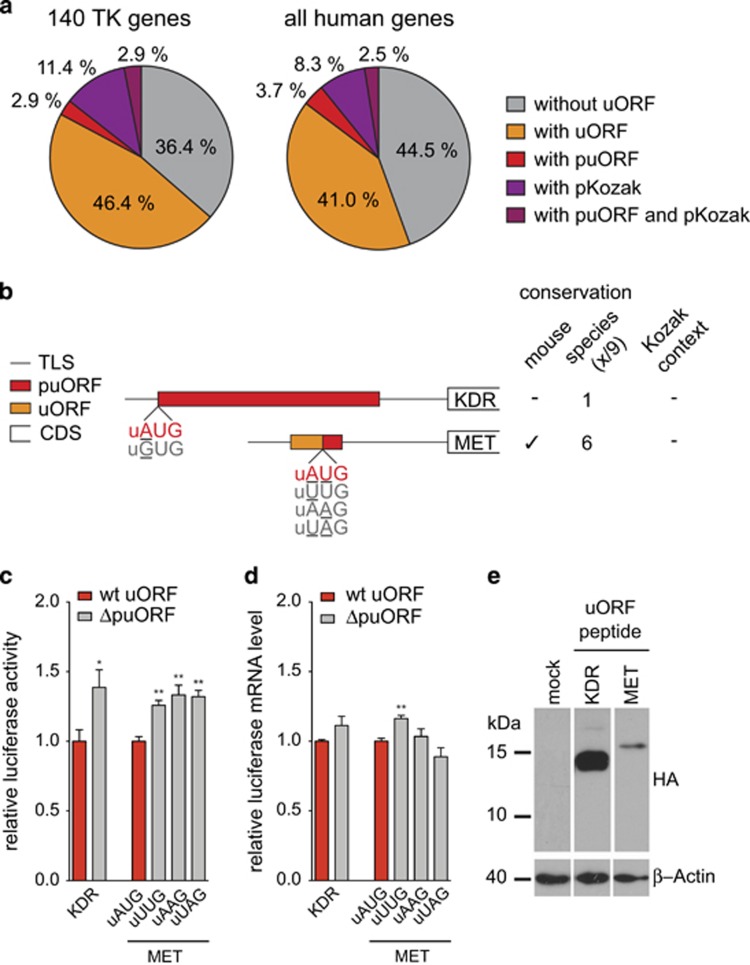
Polymorphic uORFs affect TK translation. (a) Pie charts indicating the fraction of TK genes and all human genes with SNPs in uORF start codons (puORF) and/or corresponding Kozak sequence contexts (pKozak). SNPs were analyzed for all RefSeq-annotated transcript variants of TKs and the whole human genome using dbSNP 137. (b) Schematic representation of the position and length of a uORF and puORFs within the TLSs of KDR and MET. SNPs that disrupt the uORF initiation codon are underlined and the resulting alternative codons are displayed in gray. Conservation of the uAUG among human and mouse (check mark) and among a total of nine vertebrate species is depicted. The weak quality of the Kozak context (−, no core Kozak base matches) is indicated. (c) Bar graph representing the relative luciferase activity in the presence of the wt puORF and the ΔpuORF containing TLSs of indicated TKs. For the two MET SNPs, all three possible SNP combinations were analyzed. (d) Bar graph indicating the relative luciferase mRNA levels of wt puORF and ΔpuORF reporter constructs for indicated TLSs. Error bars represent the s.e.m. of at least three independent experiments. Asterisks indicate statistical significance (**P<0.01 and *P<0.05). (e) Immunoblot shows HA-tagged peptides translated from KDR and MET uORFs. The TLSs of KDR and MET including the cap-to-uORF sequence, the uORF-coding sequences (with a disrupted uStop codon) and a C-terminally added triple HA-tag (Supplementary Table 4) were cloned into the pcDNA3 vector (Invitrogen). HEK293 cells were transfected following standard protocols and protein lysates were separated 42 h later on 18% SDS–polyacrylamide gels. After transfer, polyvinylidene fluoride membranes (Roth) were probed with specific antibodies: HA (HA.11, Covance) and β-Actin (Clone AC-15, Sigma-Aldrich) and horseradish peroxidase-linked secondary antibody (GE Healthcare Life Sciences).

References

    1. Ingolia NT, Ghaemmaghami S, Newman JR, Weissman JS. Genome-wide analysis in vivo of translation with nucleotide resolution using ribosome profiling. Science 2009; 324: 218–223. - PMC - PubMed
    1. Lee S, Liu B, Huang SX, Shen B, Qian SB. Global mapping of translation initiation sites in mammalian cells at single-nucleotide resolution. Proc Natl Acad Sci USA 2012; 109: E2424–E2432. - PMC - PubMed
    1. Calvo SE, Pagliarini DJ, Mootha VK. Upstream open reading frames cause widespread reduction of protein expression and are polymorphic among humans. Proc Natl Acad Sci USA 2009; 106: 7507–7512. - PMC - PubMed
    1. Wethmar K, Barbosa-Silva A, Andrade-Navarro MA, Leutz A. uORFdb—a comprehensive literature database on eukaryotic uORF biology. Nucleic Acids Res 2014; 42(Database issue): D60–D67. - PMC - PubMed
    1. Somers J, Poyry T, Willis AE. A perspective on mammalian upstream open reading frame function. Int J Biochem Cell Biol 2013; 45: 1690–1700. - PMC - PubMed

Publication types