


Local chromatin microenvironment determines DNMT activity: from DNA methyltransferase to DNA demethylase or DNA dehydroxymethylase
- PMID: 26098813
- PMCID: PMC4622917
- DOI: 10.1080/15592294.2015.1062204
Local chromatin microenvironment determines DNMT activity: from DNA methyltransferase to DNA demethylase or DNA dehydroxymethylase
Abstract
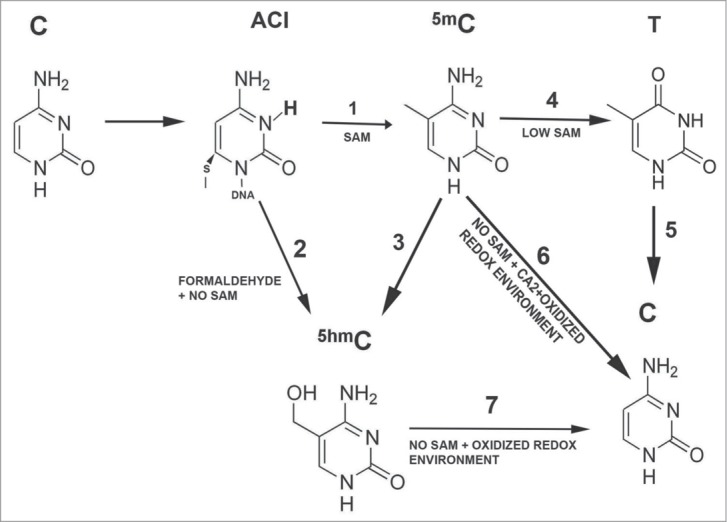
Insights on active DNA demethylation disproved the original assumption that DNA methylation is a stable epigenetic modification. Interestingly, mammalian DNA methyltransferases 3A and 3B (DNMT-3A and -3B) have also been reported to induce active DNA demethylation, in addition to their well-known function in catalyzing methylation. In situations of extremely low levels of S-adenosyl methionine (SAM), DNMT-3A and -3B might demethylate C-5 methyl cytosine (5mC) via deamination to thymine, which is subsequently replaced by an unmodified cytosine through the base excision repair (BER) pathway. Alternatively, 5mC when converted to 5- hydroxymethylcytosine (5hmC) by TET enzymes, might be further modified to an unmodified cytosine by DNMT-3A and -3B under oxidized redox conditions, although exact pathways are yet to be elucidated. Interestingly, even direct conversion of 5mC to cytosine might be catalyzed by DNMTs. Here, we summarize the evidence on the DNA dehydroxymethylase and demethylase activity of DNMT-3A and -3B. Although physiological relevance needs to be demonstrated, the current indications on the 5mC- and 5hmC-modifying activities of de novo DNA C-5 methyltransferases shed a new light on these enzymes. Despite the extreme circumstances required for such unexpected reactions to occur, we here put forward that the chromatin microenvironment can be locally exposed to extreme conditions, and hypothesize that such waves of extremes allow enzymes to act in differential ways.
Keywords: 5caC, 5-carboxylcytosine; 5fC, 5-formylcytosine; 5hmC, 5 hydroxymethylcytosine; 5mC, 5-methylcytosine; AID, activation-induced cytidine deaminase; APOBEC, apolipoprotein B mRNA editing enzyme catalytic polypeptide-like; BER, base excision and repair; C, cytosine; CGI, CpG islands; DNA dehydroxymethylation; DNA demethylation; DNMT, DNA methyltransferase; DNMTs; GADD45, growth arrest and DNA-damage-inducible protein 45; RARE, retinoic acid response element; S-adenosyl methionine (SAM); SAM, S-adenosyl methionine; TDG, thymine DNA glycosylase; TET, ten-eleven translocation.; chromatin microenvironment; oxidizing redox state.
Figures
References
-
- Oliveira AM, Hemstedt TJ, Bading H. Rescue of aging-associated decline in Dnmt3a2 expression restores cognitive abilities. Nat Neurosci 2012; 15:1111-3; PMID:22751036; http://dx.doi.org/10.1038/nn.3151 - DOI - PubMed
-
- Kandel ER, Schwartz JH. Principles of Neural Science. 5th ed. New York, NY etc: McGraw-Hill, 2013
-
- Miller CA, Sweatt JD. Covalent modification of DNA regulates memory formation. Neuron 2007; 53:857-69; PMID:17359920; http://dx.doi.org/10.1016/j.neuron.2007.02.022 - DOI - PubMed
-
- Chen CC, Wang KY, Shen CK. The mammalian de novo DNA methyltransferases DNMT3A and DNMT3B are also DNA 5-hydroxymethylcytosine dehydroxymethylases. J Biol Chem 2012; 287:33116-21; PMID:22898819; http://dx.doi.org/10.1074/jbc.C112.406975 - DOI - PMC - PubMed
-
- Chen CC, Wang KY, Shen CK. DNA 5-methylcytosine demethylation activities of the mammalian DNA methyltransferases. J Biol Chem 2013; 288:9084-91; PMID:23393137; http://dx.doi.org/10.1074/jbc.M112.445585 - DOI - PMC - PubMed
Publication types
MeSH terms
Substances
LinkOut - more resources
Full Text Sources
Other Literature Sources
Miscellaneous
