. 2015 Sep;83(9):3506-14.
doi: 10.1128/IAI.00497-15. Epub 2015 Jun 22.

Toxicity and SidJ-Mediated Suppression of Toxicity Require Distinct Regions in the SidE Family of Legionella pneumophila Effectors

Affiliations

Toxicity and SidJ-Mediated Suppression of Toxicity Require Distinct Regions in the SidE Family of Legionella pneumophila Effectors

James C Havey et al. Infect Immun. 2015 Sep.

Abstract

Intracellular bacteria use a variety of strategies to evade degradation and create a replicative niche. Legionella pneumophila is an intravacuolar pathogen that establishes a replicative niche through the secretion of more than 300 effector proteins. The function of most effectors remains to be determined. Toxicity in yeast has been used to identify functional domains and elucidate the biochemical function of effectors. A library of L. pneumophila effectors was screened using an expression plasmid that produces low levels of each protein. This screen identified the effector SdeA as a protein that confers a strong toxic phenotype that inhibits yeast replication. The toxicity of SdeA was suppressed in cells producing the effector SidJ. The effector SdeA is a member of the SidE family of L. pneumophila effector proteins. All SidE orthologs encoded by the Philadelphia isolate of Legionella pneumophila were toxic to yeast, and SidJ suppressed the toxicity of each. We identified a conserved central region in the SidE proteins that was sufficient to mediate yeast toxicity. Surprisingly, SidJ did not suppress toxicity when this central region was produced in yeast. We determined that the amino-terminal region of SidE was essential for SidJ-mediated suppression of toxicity. Thus, there is a genetic interaction that links the activity of SidJ and the amino-terminal region of SidE, which is required to modulate the toxic activity displayed by the central region of the SidE protein. This suggests a complex mechanism by which the L. pneumophila effector SidJ modulates the function of the SidE proteins after translocation into host cells.


Figures

FIG 1
FIG 1
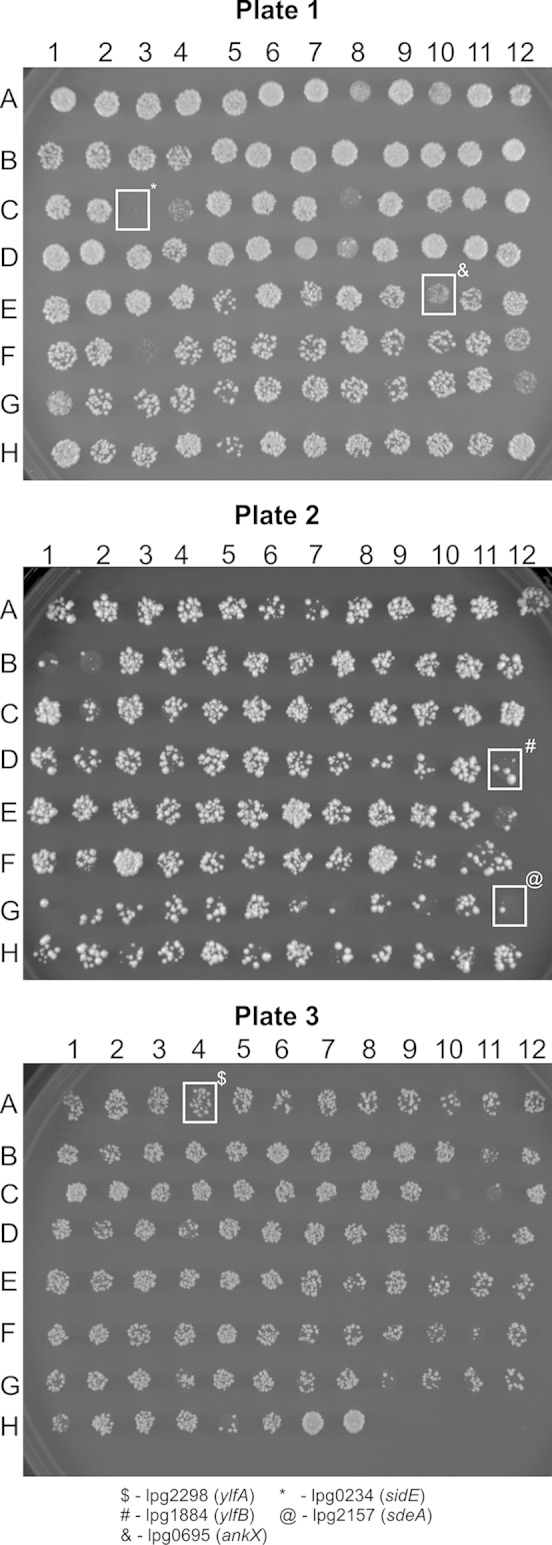
L. pneumophila effector toxicity in yeast. Effectors encoded from the constitutive low-expression plasmid pDEST22 were transformed into yeast and then plated on SC −Trp selective medium. Plates were incubated at 30°C. Transformed effectors are indicated in Table 1. Of specific note, spotted transformation marked with a “$” represents cells transformed with ylfA (lpg2298), transformation marked with a “#” represents cells transformed with ylfB (lpg1884), transformation marked with a “&” represents cells transformed with ankX (lpg0695), transformation marked with a “*” represents cells transformed with sidE (lpg0234), and transformation marked with a “@” represents cells transformed with sdeA (lpg2157).
FIG 2
FIG 2
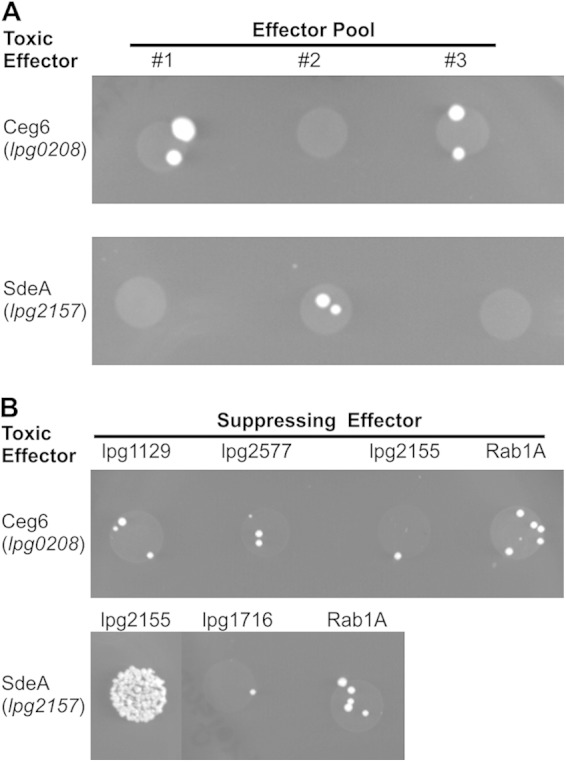
Effector-based suppression of SdeA and Ceg6 toxicity. (A) Yeast cells were individually transformed with each member of the L. pneumophila effector repertoire expressed from the pDEST22 plasmid and grown on selective media (data not shown). Each individually transformed cell was grown in liquid culture selecting for pDEST22 plasmid and then pooled. Pools were then transformed with either pDEST32-lpg0208(ceg6) or pDEST32-lpg2157(sdeA). Transformations were plated on SC −Leu, −Trp medium, which selects for both plasmids, and incubated at 30°C. (B) Effectors identified as suppressing Ceg6 or SdeA toxicity through the pooled assay by sequencing were individually transformed into yeast; Rab1A was used as a negative control. Transformed bacteria then underwent a second transformation with Ceg6 or SdeA and were plated on SC −Leu, −Trp medium, which selects for both plasmids. Transformations were incubated at 30°C.
FIG 3
FIG 3
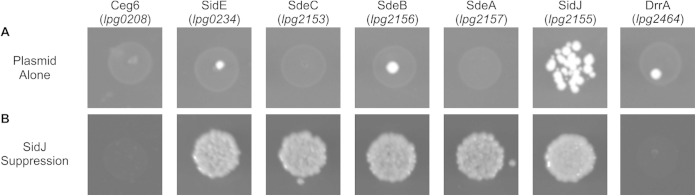
SidJ suppression of SidE family toxicity. (A) The indicated effectors were transformed into yeast and expressed from plasmid pDEST32. Transformations were grown on SC −Leu plates at 30°C. (B) SidJ, encoded from pDEST22, was transformed into wild-type yeast, and transformants were selected on SC −Trp (data not shown). These transformants were then transformed with the indicated effectors encoded from the pDEST32 plasmid. Transformants were plated on SC −Leu, −Trp medium selecting for both plasmids, and incubated at 30°C.
FIG 4
FIG 4
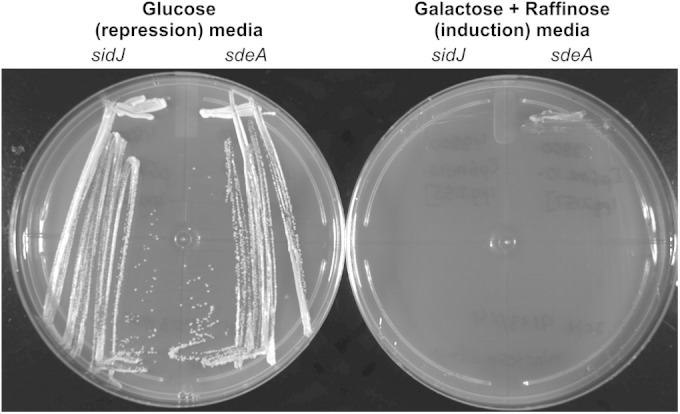
Overexpression of SdeA and SidJ. Saccharomyces strains were transformed with sdeA and sidJ expressed from a glucose-galactose-inducible expression system on pGML10. Transformed cells were plated on medium that repressed protein expression, i.e., SC −Leu with 2% glucose. Single colonies were then streaked onto repressing (glucose) and induction (galactose + raffinose) media. Plates were incubated at 30°C.
FIG 5
FIG 5
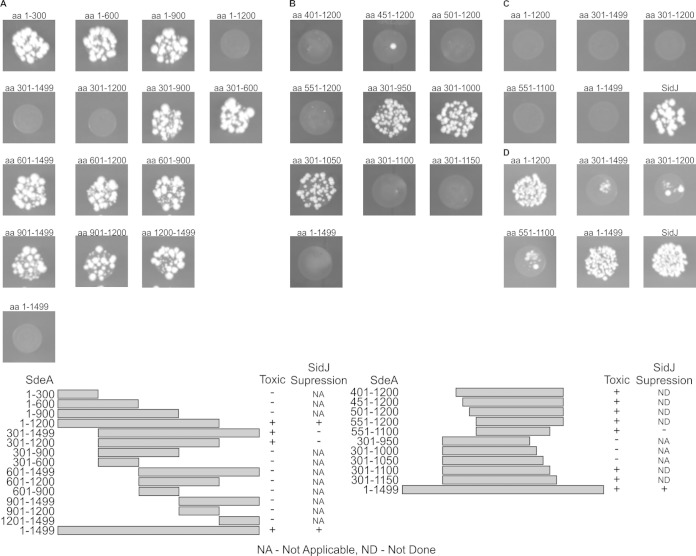
SdeA has distinct toxicity and SidJ suppression regions. (A to C) Truncations of SdeA were made by PCR amplification of genes from the pDONR223 vector and then recombined into pDEST32 vector by Gateway recombination, as described in Materials and Methods. Plasmids were transformed into wild-type yeast and plated on SC −Leu medium at 30°C. Specific truncations are indicated above the transformation. SidJ was transformed as a control to observe the full transformation efficiency (see panel C). (D) Yeast cells were transformed with SidJ (data not shown), and then the indicated SdeA truncation was transformed. Transformations were plated on SC −Leu, −Trp medium, which selects for both plasmids, followed by incubation at 30°C. aa, amino acids.
FIG 6
FIG 6
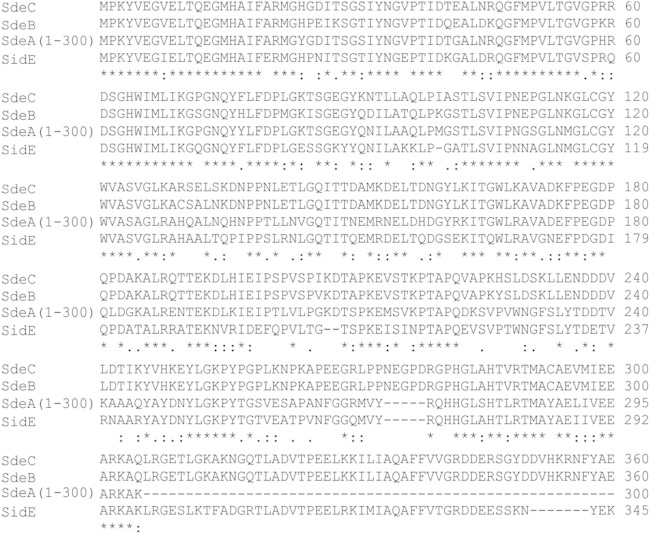
SidE proteins have a conserved amino-terminal domain. CLUSTAL W2 multiple-sequence alignment of the amino-terminal 300 amino acids from SdeA with the three other SidE family members.
FIG 7
FIG 7
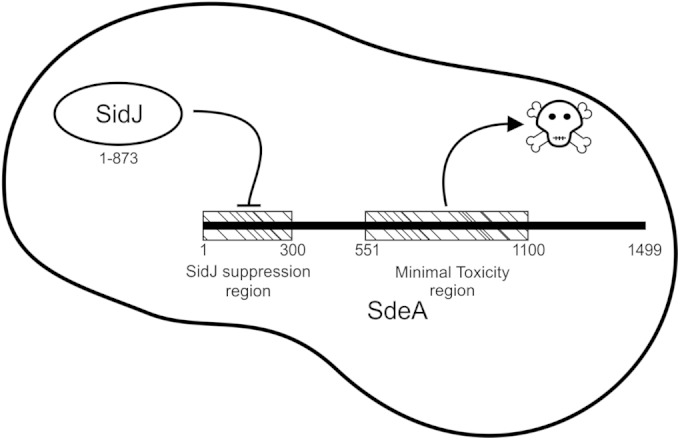
Functional regions of SdeA. The amino terminus of SdeA contains the residues necessary for SidJ suppression of toxicity, which we call the SidJ suppression region. The central region of SdeA contains all of the residues sufficient for toxicity, which we call the minimal toxicity region. The remaining regions of the proteins are of unknown function.

References

    1. Fraser DW, Tsai TR, Orenstein W, Parkin WE, Beecham HJ, Sharrar RG, Harris J, Mallison GF, Martin SM, McDade JE, Shepard CC, Brachman PS. 1977. Legionnaires' disease: description of an epidemic of pneumonia. N Engl J Med 297:1189–1197. doi: 10.1056/NEJM197712012972201. - DOI - PubMed
    1. McDade JE, Shepard CC, Fraser DW, Tsai TR, Redus MA, Dowdle WR. 1977. Legionnaires' disease: isolation of a bacterium and demonstration of its role in other respiratory disease. N Engl J Med 297:1197–1203. doi: 10.1056/NEJM197712012972202. - DOI - PubMed
    1. Isberg RR, O'Connor TJ, Heidtman M. 2009. The Legionella pneumophila replication vacuole: making a cosy niche inside host cells. Nat Rev Microbiol 7:13–24. doi: 10.1038/nrmicro1967. - DOI - PMC - PubMed
    1. Horwitz MA. 1983. Formation of a novel phagosome by the Legionnaires' disease bacterium (Legionella pneumophila) in human monocytes. J Exp Med 158:1319–1331. doi: 10.1084/jem.158.4.1319. - DOI - PMC - PubMed
    1. Kagan JC, Roy CR. 2002. Legionella phagosomes intercept vesicular traffic from endoplasmic reticulum exit sites. Nat Cell Biol 4:945–954. doi: 10.1038/ncb883. - DOI - PubMed

Publication types

MeSH terms

LinkOut - more resources