


Challenges for bovine viral diarrhoea virus antibody detection in bulk milk by antibody enzyme-linked immunosorbent assays due to changes in milk production levels
- PMID: 26099792
- PMCID: PMC4477516
- DOI: 10.1186/s13028-015-0125-z
Challenges for bovine viral diarrhoea virus antibody detection in bulk milk by antibody enzyme-linked immunosorbent assays due to changes in milk production levels
Abstract
Background: Bovine viral diarrhoea (BVD) is considered eradicated from Denmark. Currently, very few (if any) Danish cattle herds could be infected with BVD virus (BVDV). The Danish antibody blocking enzyme-linked immunosorbent assay (ELISA) has been successfully used during the Danish BVD eradication program, initiated in 1994. During the last decade, the cattle herd size has increased while the prevalence of BVDV has decreased. In this study, we investigated how these changes could affect the performance of the Danish blocking ELISA and of the SVANOVIR® BVDV-Ab indirect ELISA. The latter has successfully been used to eradicate BVD in Sweden. Data (2003-2010) on changes in median herd size and milk production levels, occurrence of viremic animals and bulk milk surveillance were analysed. Additionally, the Danish blocking ELISA and the SVANOVIR ELISA were compared analyzing milk and serum samples. The prevalence of antibody positive milking cows that could be detected by each test was estimated, by diluting positive individual milk samples and making artificial milk pools.
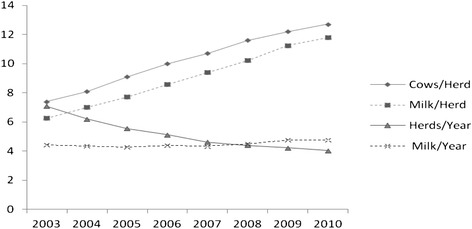
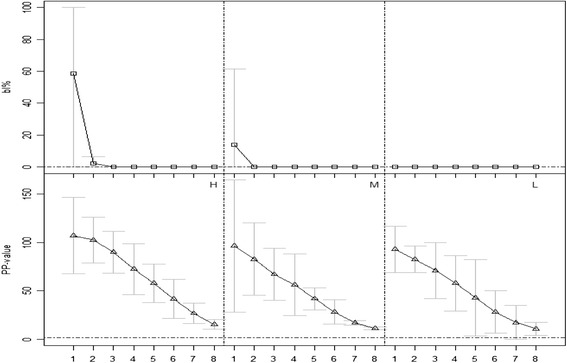
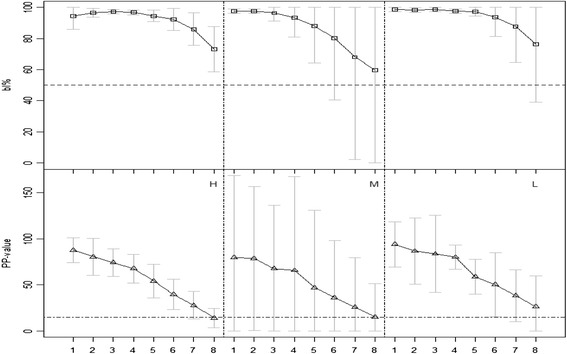
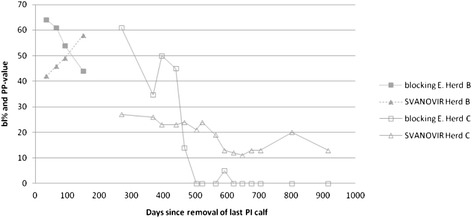
Results: During the study period, the median herd size increased from 74 (2003) to 127 cows (2010), while the prevalence of BVDV infected herds decreased from 0.51 to 0.02 %. The daily milk yield contribution of a single seropositive cow to the entire daily bulk milk was reduced from 1.61 % in 2003 to 0.95 % in 2010 due to the increased herd size. It was observed that antibody levels in bulk milk decreased at national level. Moreover, we found that when testing bulk milk, the SVANOVIR® BVDV-Ab can detect a lower prevalence of seropositive lactating cows, compared to the Danish blocking ELISA (0.78 % vs. 50 %). Values in the SVANOVIR® BVDV-Ab better relate to low concentrations of antibody positive milk (R(2) = 94-98 %), than values in the blocking ELISA (R(2) = 23-75 %). For sera, the two ELISAs performed equally well.
Conclusions: The SVANOVIR ELISA is recommended for analysis of bulk milk samples in the current Danish situation, since infected dairy herds e.g. due to import of infected cattle can be detected shortly after BVDV introduction, when only few lactating cows have seroconverted. In sera, the two ELISAs can be used interchangeably.
Figures
References
-
- Rønsholt L, Nylin B, Bitsch V. A BVDV antigen- and antibody blocking ELISA (DVIV) system used in a Danish voluntary eradication program. In: Edwards S, Paton DJ, Wensvoort G, editors. Proceedings of the third ESVV Symposium on Pestivirus Infections: 19-20 September 1996; Lelystad, The Netherlands. Weybridge, UK: Central Veterinary Laboratory, European Society for Veterinary Virology; 1997. p. 150–3.
-
- Bitsch V, Houe H, Nylin B, Rønsholt L. Examination of blood and bulk tank milk samples to monitor the bovine virus diarrhoea infection status of cattle herds. In: Edwards S, Paton DJ, Wensvoort G, editors. Proceedings of the third ESVV Symposium on Pestivirus Infections: 19-20 September 1996; Lelystad, The Netherlands. Weybridge, UK: Central Veterinary Laboratory, European Society for Veterinary Virology; 1997. p. 158–61.
-
- Bitsch V, Rønsholt L. Control of bovine viral diarrhea virus infection without vaccines. Vet Clin N Am-Food A. 1995;11:627–40. - PubMed
Publication types
MeSH terms
Substances
LinkOut - more resources
Full Text Sources
Other Literature Sources
