. 2015 Jun 24:15:155.
doi: 10.1186/s12870-015-0548-8.

Arabidopsis leucine-rich repeat extensin (LRX) proteins modify cell wall composition and influence plant growth

Affiliations

Arabidopsis leucine-rich repeat extensin (LRX) proteins modify cell wall composition and influence plant growth

Christian Draeger et al. BMC Plant Biol. .

Abstract

Background: Leucine-rich repeat extensins (LRXs) are extracellular proteins consisting of an N-terminal leucine-rich repeat (LRR) domain and a C-terminal extensin domain containing the typical features of this class of structural hydroxyproline-rich glycoproteins (HRGPs). The LRR domain is likely to bind an interaction partner, whereas the extensin domain has an anchoring function to insolubilize the protein in the cell wall. Based on the analysis of the root hair-expressed LRX1 and LRX2 of Arabidopsis thaliana, LRX proteins are important for cell wall development. The importance of LRX proteins in non-root hair cells and on the structural changes induced by mutations in LRX genes remains elusive.

Results: The LRX gene family of Arabidopsis consists of eleven members, of which LRX3, LRX4, and LRX5 are expressed in aerial organs, such as leaves and stem. The importance of these LRX genes for plant development and particularly cell wall formation was investigated. Synergistic effects of mutations with gradually more severe growth retardation phenotypes in double and triple mutants suggest a similar function of the three genes. Analysis of cell wall composition revealed a number of changes to cell wall polysaccharides in the mutants.

Conclusions: LRX3, LRX4, and LRX5, and most likely LRX proteins in general, are important for cell wall development. Due to the complexity of changes in cell wall structures in the lrx mutants, the exact function of LRX proteins remains to be determined. The increasingly strong growth-defect phenotypes in double and triple mutants suggests that the LRX proteins have similar functions and that they are important for proper plant development.


Figures
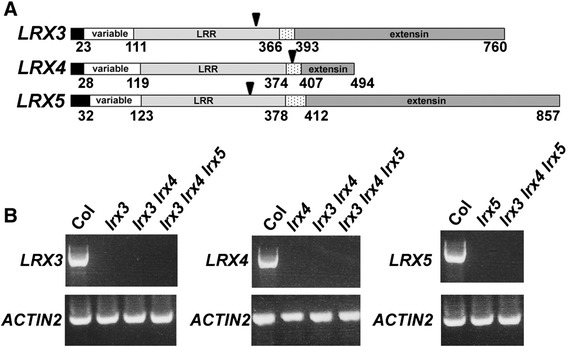
Fig. 1
Fig. 1
Protein structure of LRX3, LRX4, and LRX5 and gene expression. a Leucine-rich repeat extensin (LRX) proteins consist of a signal peptide for protein export (black), followed by a variable domain, nine complete leucine-rich repeats (LRR, grey), a Cys-rich hinge region (dotted), and a C-terminal extensin domain (dark grey) that show the typical Ser-Hyp4 motifs of hydroxyproline-rich glycoproteins. Numbers indicate amino acid positions, arrowheads the positions corresponding to the T-DNA insertions in the identified mutants. b RT-PCR on total RNA extracted from wild-type and mutant seedlings with gene-specific primers for each of the three LRX genes and ACTIN2 as an internal control
Fig. 2
Fig. 2
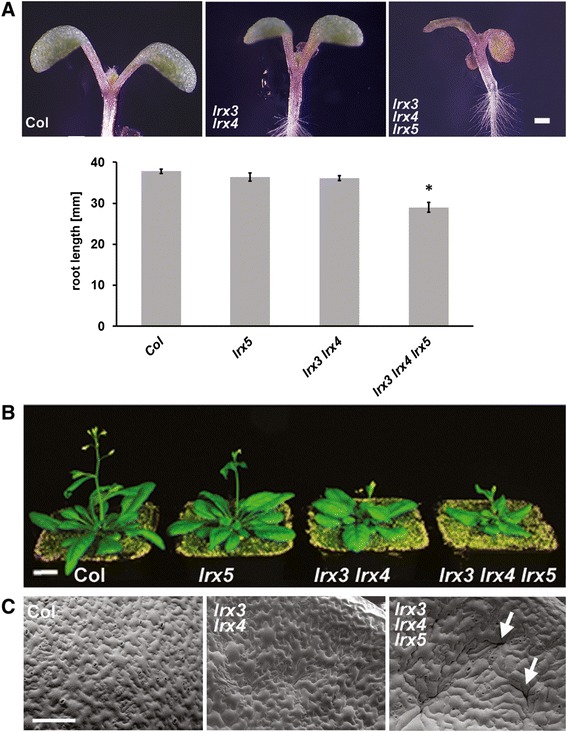
Mutations in LRX genes cause aberrant plant growth. a Cotyledons of 7 days-old seedlings are gradually smaller in the lrx3 lrx4 double mutant and the lrx3 lrx4 lrx5 triple mutant compared to the wild type (Col). Roots of the same seedlings are significantly shorter in the lrx3 lrx4 lrx5 triple mutant. Error bars shown in the graph represent standard errors. Significance was tested by T-test; n ≥ 14, *: P < 0.05. b Mature plants of double and triple mutants reveal a reduction in growth compared to wild-type plants, whereas the lrx5 single mutant grows comparable to the wild type. c Sinuous structures were observed in double and triple mutant cotyledons with occasional cracks (arrows) in the epidermis of the triple mutant. Bars: A = 0.5 mm; B = 10 mm; C = 100 μm
Fig. 3
Fig. 3
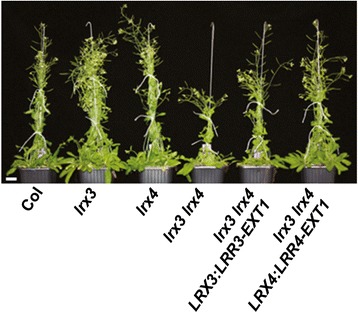
Mutations in LRX genes cause dwarfism. As exemplified by the lrx3 and lrx4 mutations, single mutants grow similar to the wild type whereas the lrx3 lrx4 double mutant shows severely reduced growth that is alleviated by the LRX3 and LRX4 complementation constructs. Bar = 10 mm.
Fig. 4
Fig. 4
Cell wall composition analysis. Cell wall material was extracted from rosette leaves a and stem tissue b and monosaccharides were quantified. Error bars shown in the graph represent standard errors. Significance was tested by T-test; n = 3, *P < 0.05. c The degree of lignification was visualized in stem cross section using Wiesner staining. Bar = 500 μm.

References

    1. Cosgrove DJ. Growth of the plant cell wall. Nature Rev Mol Cell Biol. 2005;6(11):850–861. doi: 10.1038/nrm1746. - DOI - PubMed
    1. Wolf S, Hematy K, Hoefte H. Growth control and cell wall signaling in plants. In: Merchant SS, editor. Annual Review of Plant Biology, Vol 63. 2012. pp. 381–407. - PubMed
    1. Seifert GJ, Blaukopf C. Irritable walls: The plant extracellular matrix and signaling. Plant Physiol. 2010;153(2):467–478. doi: 10.1104/pp.110.153940. - DOI - PMC - PubMed
    1. Ringli C. Monitoring the Outside: Cell Wall-Sensing Mechanisms. Plant Physiol. 2010;153(4):1445–1452. doi: 10.1104/pp.110.154518. - DOI - PMC - PubMed
    1. Tsang DL, Edmond C, Harrington JL, Nuehse TS. Cell wall integrity controls root elongation via a general 1-aminocyclopropane-1-carboxylic acid-dependent, ethylene-independent pathway. Plant Physiol. 2011;156(2):596–604. doi: 10.1104/pp.111.175372. - DOI - PMC - PubMed

Publication types

MeSH terms