. 2015 Jul 7;112(27):8181-6.
doi: 10.1073/pnas.1503302112. Epub 2015 Jun 22.

Pathways to dewetting in hydrophobic confinement

Affiliations

Pathways to dewetting in hydrophobic confinement

Richard C Remsing et al. Proc Natl Acad Sci U S A. .

Abstract

Liquid water can become metastable with respect to its vapor in hydrophobic confinement. The resulting dewetting transitions are often impeded by large kinetic barriers. According to macroscopic theory, such barriers arise from the free energy required to nucleate a critical vapor tube that spans the region between two hydrophobic surfaces--tubes with smaller radii collapse, whereas larger ones grow to dry the entire confined region. Using extensive molecular simulations of water between two nanoscopic hydrophobic surfaces, in conjunction with advanced sampling techniques, here we show that for intersurface separations that thermodynamically favor dewetting, the barrier to dewetting does not correspond to the formation of a (classical) critical vapor tube. Instead, it corresponds to an abrupt transition from an isolated cavity adjacent to one of the confining surfaces to a gap-spanning vapor tube that is already larger than the critical vapor tube anticipated by macroscopic theory. Correspondingly, the barrier to dewetting is also smaller than the classical expectation. We show that the peculiar nature of water density fluctuations adjacent to extended hydrophobic surfaces--namely, the enhanced likelihood of observing low-density fluctuations relative to Gaussian statistics--facilitates this nonclassical behavior. By stabilizing isolated cavities relative to vapor tubes, enhanced water density fluctuations thus stabilize novel pathways, which circumvent the classical barriers and offer diminished resistance to dewetting. Our results thus suggest a key role for fluctuations in speeding up the kinetics of numerous phenomena ranging from Cassie-Wenzel transitions on superhydrophobic surfaces, to hydrophobically driven biomolecular folding and assembly.

Keywords: assembly; capillary evaporation; fluctuations; kinetic barriers.


Conflict of interest statement

The authors declare no conflict of interest.

Figures
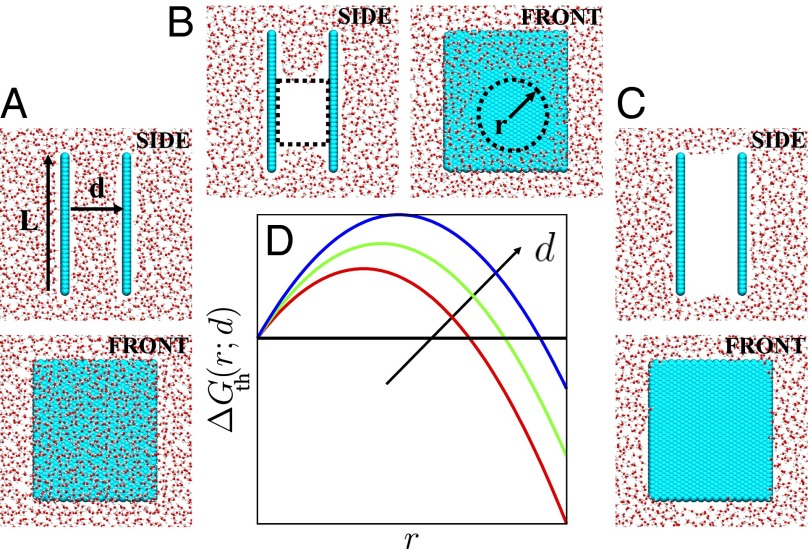
Fig. 1.
Fig. 1.
(A–C) Simulation snapshots of water (shown in red/white) in confinement between two square hydrophobic surfaces (shown in cyan) of size L=4 nm that are separated by a distance of d=20 Å; configurations highlighting (A) the liquid basin, (B) a cylindrical vapor tube of radius, r, that spans the confined region, and (C) the vapor basin are shown. In the front views, only one of the confining surfaces is shown. (D) Macroscopic theory predicts a free energetic barrier to vapor tube formation (Eq. 1), suggesting that a vapor tube larger than a critical size must be nucleated before dewetting can proceed.
Fig. 2.
Fig. 2.
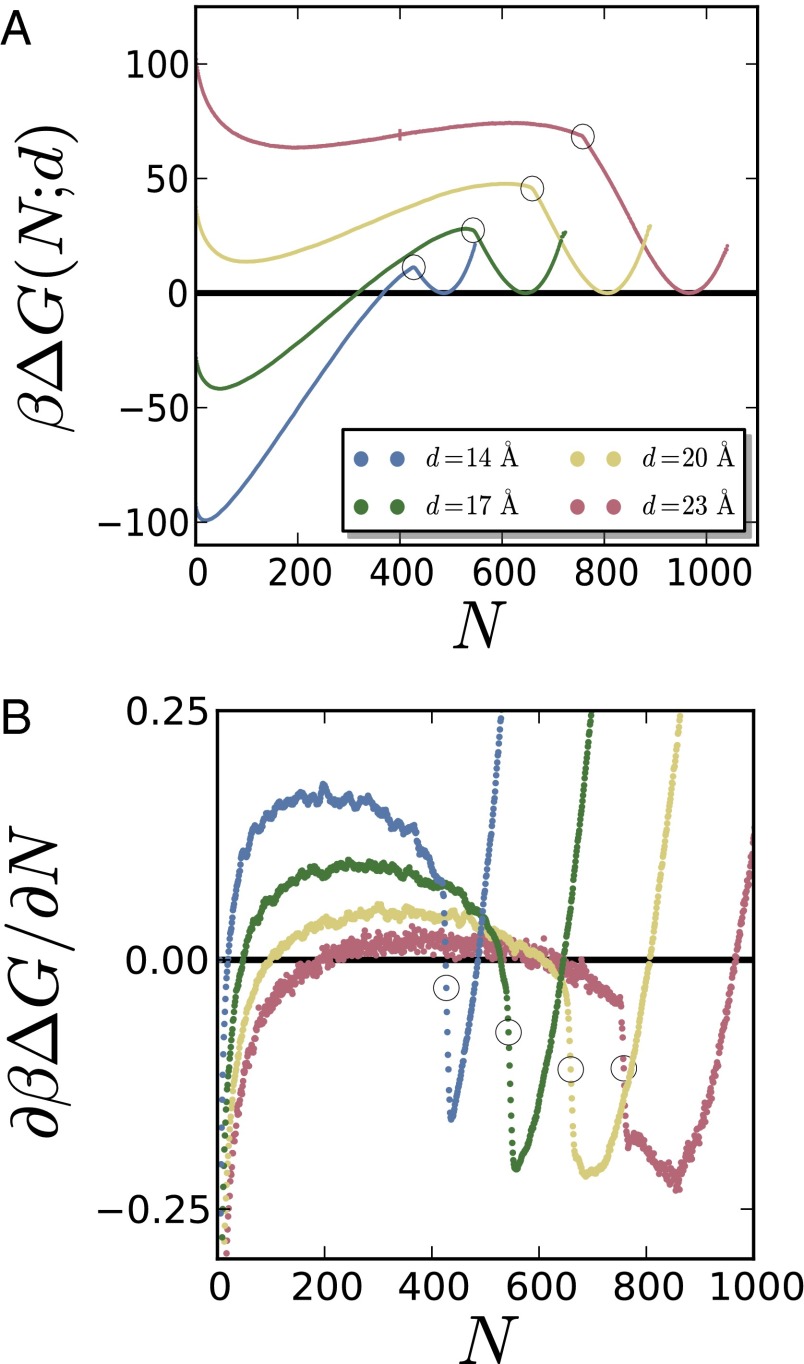
(A) The simulated free energy profiles, βΔG(N;d), as a function of the number of water molecules between the surfaces, N, display marked kinks (highlighted by circles). Here, β=1/kBT, with kB being the Boltzmann constant and T being the temperature. The size of the largest error bar is also shown for d=23 Å and N=400. (B) The kinks are also apparent in the smoothed derivatives of the free energy profiles, which display a sharp decrease in the vicinity of Nkink.
Fig. 3.
Fig. 3.
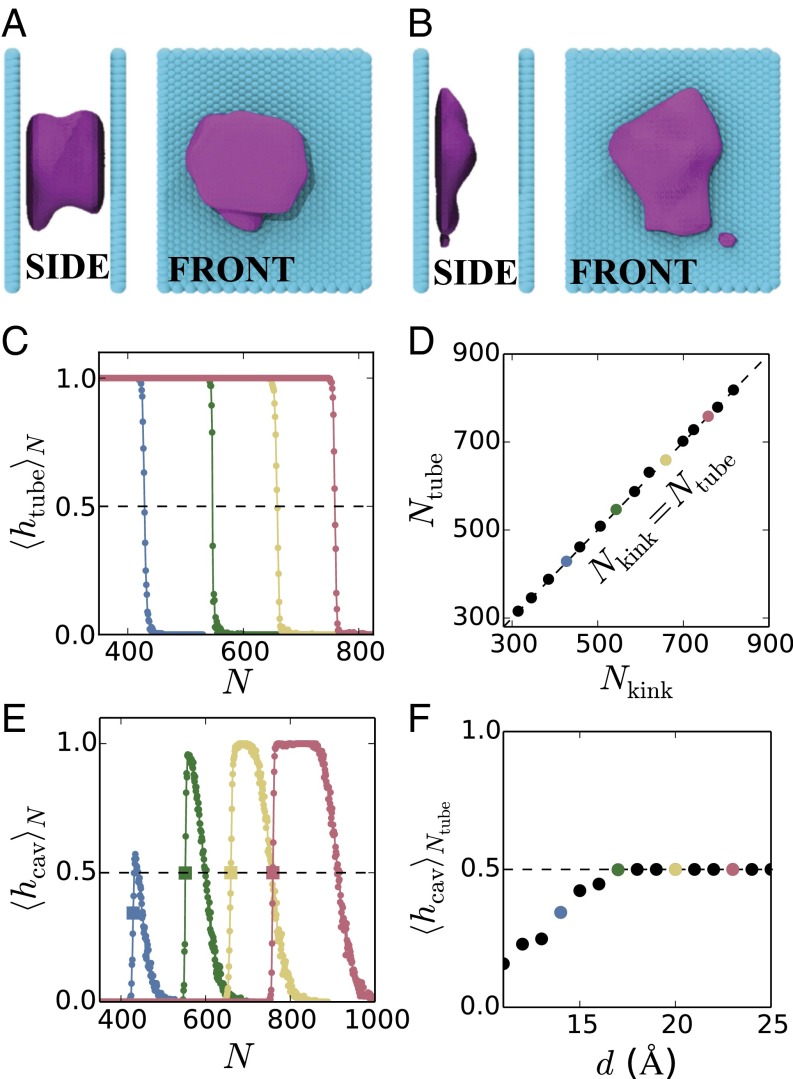
Instantaneous interfaces encompassing dewetted regions (shown in purple) between the hydrophobic surfaces (shown in cyan) separated by d=20 Å highlight the presence of (A) a vapor tube for N=Nkink12, and (B) an isolated cavity for N=Nkink+3. Water molecules not shown for clarity. (C) Average of the binary vapor tube indicator function, htube, conditioned on the number of waters in confinement being N, displays a sharp transition from 1 to 0 as N is increased. The color scheme is the same as that in Fig. 2. The value of N corresponding to htubeN=0.5 (dashed line) is defined as Ntube. (D) Ntube is identical to the location of the kink in the free energy profiles, Nkink, as shown by the agreement between the simulation data and a straight line (dashed). This agreement confirms that the kink demarcates conformations with and without vapor tubes. (E) Conditional average of the isolated cavity indicator function, hcavN, shows a sharp increase in the vicinity of Nkink (the square symbols correspond to Ntube), followed by a gradual decrease at larger N values, and eventually vanishes around N=Nliq. (F) For the larger d values, htubeNtube=hcavNtube=0.5. However, for the smaller d values, hcavNtube<0.5, suggesting the possibility of direct vapor tube nucleation without isolated cavities as intermediates.
Fig. 4.
Fig. 4.
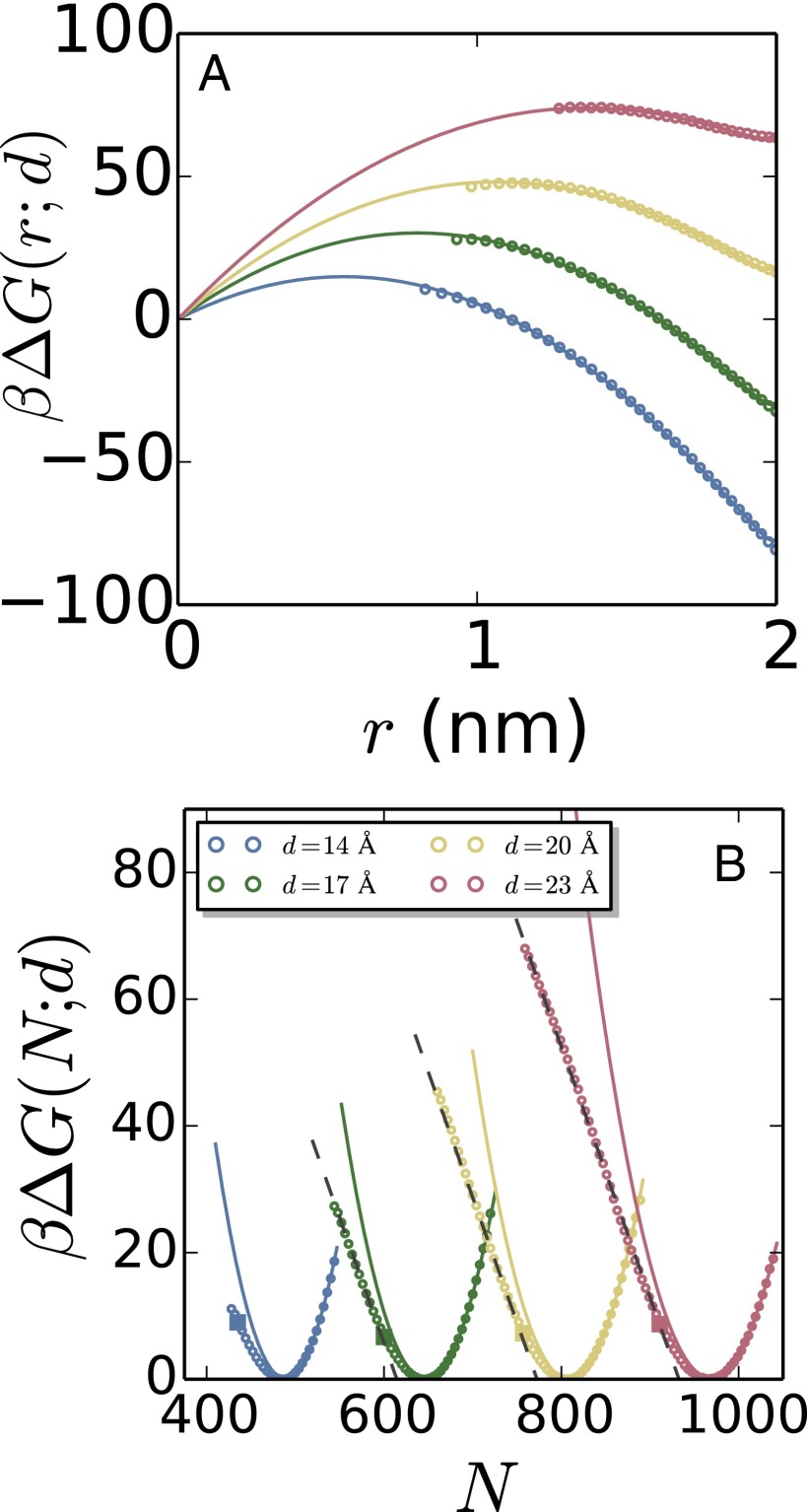
(A) βΔG(NNkink;d) is recast as βΔG(r;d), the free energy to form a vapor tube of radius, r. The points were obtained from the simulated free energy profiles by using the relation πr2/L2=(NliqN)/Nliq in the region rkink<r<L/2, and the lines are fits to macroscopic theory. (B) The portion of the free energy corresponding to the liquid basin (NNkink) is parabolic at high N (Gaussian fluctuations), but linear at low N (fat tails in water number distributions). The crossover is gradual and occurs in the vicinity of Ncav (square symbols), that is, the value of N for which hcavN is 0.5 with a negative slope. The linear regions have roughly the same slope for all separations.
Fig. 5.
Fig. 5.
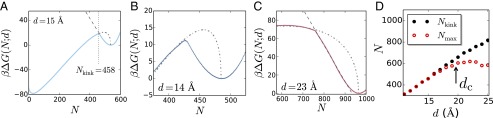
(A) The simulated βΔG(N;d) for d=15Å (solid) is shown along with the expected metastable branches of the free energies corresponding to the vapor tube (dot-dashed) and isolated cavity (dashed) ensembles. The metastable branches are anticipated from the fits shown in Fig. 4. The system minimizes its free energy by localizing to the ensemble with the lower free energy. (B) For d=14 Å, the nascent vapor tube formed at the kink is larger than the critical vapor tube anticipated by macroscopic theory, and therefore grows spontaneously. As a result, the corresponding barrier to dewetting is smaller than that predicted by macroscopic theory. (C) For larger separations, here d=23 Å, the newly formed vapor tube is subcritical, and has to grow larger for dewetting to proceed. (D) Comparison of the location of the kink, Nkink, with the location of the barrier between the liquid and vapor basins, Nmax. For small d, the barrier (point of highest ΔG) occurs at the kink, so that NmaxNkink. In contrast, for larger d values, the barrier occurs in the vapor tube segment of the simulated free energy profile and corresponds to the classical critical vapor tube, so that Nmax<Nkink. The transition from nonclassical to classical behavior occurs in the vicinity of the coexistence separation, dc.

References

    1. Tanford C. The Hydrophobic Effect - Formation of Micelles and Biological Membranes. Wiley Interscience; New York: 1973.
    1. Kauzmann W. Some factors in the interpretation of protein denaturation. Adv Protein Chem. 1959;14:1–63. - PubMed
    1. Stillinger FH. Structure in aqueous solutions of nonpolar solutes from the standpoint of scaled-particle theory. J Solution Chem. 1973;2:141–158.
    1. Israelachvili JN. Intermolecular and surface forces. revised third edition Academic, Waltham, MA; 2011.
    1. Chandler D. Interfaces and the driving force of hydrophobic assembly. Nature. 2005;437(7059):640–647. - PubMed

Publication types

LinkOut - more resources