. 2015 Jul 7;112(27):8362-6.
doi: 10.1073/pnas.1503926112. Epub 2015 Jun 22.

The butterfly plant arms-race escalated by gene and genome duplications

Affiliations

The butterfly plant arms-race escalated by gene and genome duplications

Patrick P Edger et al. Proc Natl Acad Sci U S A. .

Abstract

Coevolutionary interactions are thought to have spurred the evolution of key innovations and driven the diversification of much of life on Earth. However, the genetic and evolutionary basis of the innovations that facilitate such interactions remains poorly understood. We examined the coevolutionary interactions between plants (Brassicales) and butterflies (Pieridae), and uncovered evidence for an escalating evolutionary arms-race. Although gradual changes in trait complexity appear to have been facilitated by allelic turnover, key innovations are associated with gene and genome duplications. Furthermore, we show that the origins of both chemical defenses and of molecular counter adaptations were associated with shifts in diversification rates during the arms-race. These findings provide an important connection between the origins of biodiversity, coevolution, and the role of gene and genome duplications as a substrate for novel traits.

Keywords: chemical defenses; coevolution; diversification; evolutionary novelty; phylogenomics.


Conflict of interest statement

The authors declare no conflict of interest.

Figures
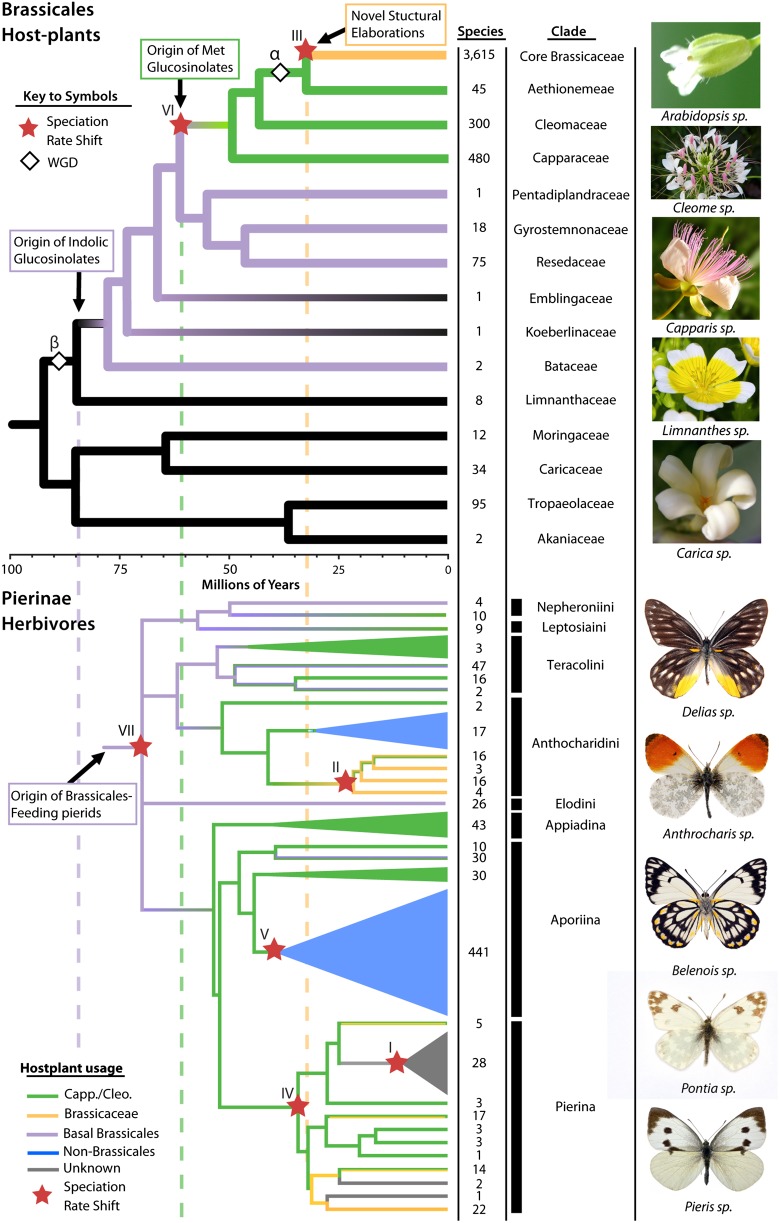
Fig. 1.
Fig. 1.
Phylogeny and diversity. A chronogram of both Brassicales families (Upper) and Pierinae butterfly genera (Lower), showing species numbers and identification of clades in the adjacent table. A common temporal scale is provided between the two chronograms. The branches in the Brassicales phylogeny are colored to indicate the origin of indolic glucosinolates (purple), methionine derived glucosinolates (green), and novel structural elaborations to glucosinolates unique to the core Brassicaceae lineage (orange). Vertical dashed lines also indicate the origin of these novel chemical groups. Primary host–plant associations of various Pierinae lineages are similarly colored: orange (Brassicaceae), green (Capparaceae or Cleomaceae), orange-green (mixture of previous), purple (more basal Brassicales that synthesize indolic glucosinolates), blue (non-Brassicales feeding) and gray (unknown). The phylogenetic positions for the At-α and At-β WGDs are depicted with white diamond symbols, and significant net diversification rate shifts with red star symbols.
Fig. 2.
Fig. 2.
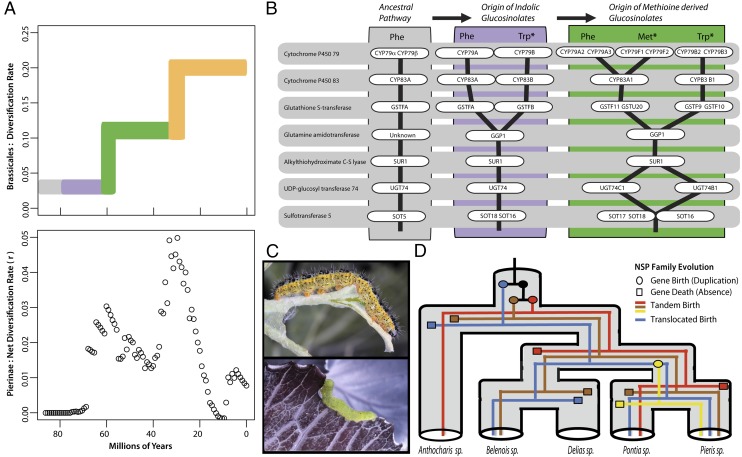
Evolution of glucosinolate biosynthethic pathways and detoxification nitrile-specifier protein (NSP) family. (A) Shifts in diversification rates during Brassicales evolution are highly punctuated (Upper). Lines are colored identical to lineages in Fig. 1. (Lower) How Pierinae butterflies have diversified during the same period. Time estimates are shown at the bottom. (B) An illustration of the evolution of core glucosinolate pathways across Brassicales; with substrates tryptophan (Trp), phenylalanine (Phe), and methionine (Met) shown at the top, enzymes depicted as white ovals, and each pathway as black vertical lines. (C) Photographs show Pieris brassicae (Upper) and Pieris rapae (Lower) caterpillar feeding on Brassica oleracea (European cabbage). (D) Evolution of the NSP gene family is shown across select Pierinae genera, indicating the birth and death dynamics of four paralogous clades.

References

    1. Ehrlich PR, Raven PH. Butterflies and plants: A study in coevolution. Evolution. 1964;18:586–608.
    1. Gadamer J. Ueber das sinigrin. Ber Dtsch Chem Ges. 1897;30:2322–2327.
    1. Halkier BA, Gershenzon J. Biology and biochemistry of glucosinolates. Annu Rev Plant Biol. 2006;57:303–333. - PubMed
    1. Arabidopsis Genome Initiative Analysis of the genome sequence of the flowering plant Arabidopsis thaliana. Nature. 2000;408(6814):796–815. - PubMed
    1. Benderoth M, et al. Positive selection driving diversification in plant secondary metabolism. Proc Natl Acad Sci USA. 2006;103(24):9118–9123. - PMC - PubMed

Publication types

MeSH terms

Associated data